







 Australia’s Spring Auctions Rise but Remain Well Below 2025
 Number of Foreigners Holding Turkish Residence Permits Exceeds 1.27 Million
 Demand from Russian Tourists for Holidays in Georgia Rises by 20–25%
 Montenegro Property Buying Costs in 2026
 Four in Ten Companies Would Not Choose Slovakia
 Gulf Countries Prepare Unified Tourist Visa
Powerful earthquakes in Venezuela: more than 30 dead, 700 injured
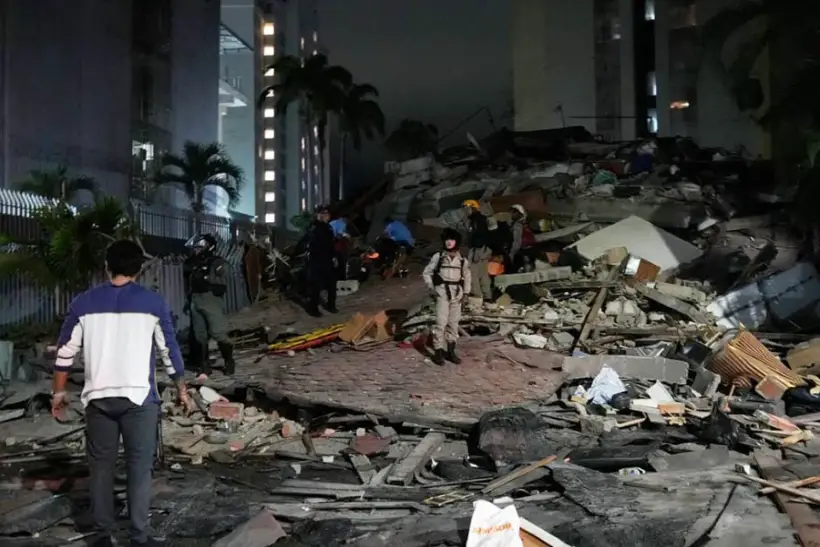
AP Photo/Ariana Cubillos
On the evening of June 24, two powerful earthquakes struck Venezuela. The epicenters were located off the country’s northern coast, near the city of Morón. At least 32 people were killed and around 700 were injured. Significant damage was reported across several states, with rescue operations ongoing, according to the Associated Press.
Earthquake magnitude in Venezuela
According to the U.S. Geological Survey (USGS), the first quake was initially measured at magnitude 7.1, later revised to 7.2. Its epicenter was west of the city of Morón on the Caribbean coast, about 168 kilometers from Caracas. The hypocenter was at a depth of 22 km. About a minute later, USGS recorded a second, even stronger earthquake of magnitude 7.5, at a depth of 10 km, with an epicenter 16 km southwest of Morón.
The earthquakes were among the strongest to hit Venezuela in more than a century. A state of emergency was declared in the country. Evacuations were carried out, including in the Amazonian Brazilian cities of Manaus, Belém, and Macapá, located roughly 1,700 km from Venezuela’s capital Caracas. The tremors were also felt across the Caribbean and in northeastern Colombia, although no reports of damage or casualties were received there. The U.S. Pacific Tsunami Center issued a tsunami warning, later lowering the assessed risk.
Aftermath: disaster zones
Acting President Delcy Rodríguez said early on June 25 that at least 32 people had been killed and 700 injured. She warned that the death toll could rise as rescuers continue clearing debris and emergency teams reach affected areas. The U.S. Geological Survey (USGS) estimates there is a risk of more than 10,000 deaths.
The hardest-hit area was the northern coastal state of La Guaira, CBS News reported, where dozens of buildings collapsed. Rodríguez described the region as “experiencing a real tragedy and turned into a disaster zone.”
State broadcaster VTV showed footage of three children being rescued alive from the rubble in La Guaira. Damage was also reported at a hospital in the city of Tucacas, about 200 km northwest of Caracas.
Due to the destruction, Simón Bolívar International Airport — the country’s main international airport — was closed. In Caracas, metro services and natural gas supply were suspended. Authorities canceled school classes for several days, with some school buildings being used as shelters and aid distribution centers. Interior Minister Diosdado Cabello urged motorists to give way to ambulances and emergency services.
International support
U.S. Secretary of State Marco Rubio said on social media that, on the orders of President Donald Trump, the United States is sending search-and-rescue teams, medical resources, and humanitarian aid to Venezuela.
Deputy Secretary of State for Foreign Assistance Jeremy P. Lewin said the State Department had deployed a disaster response team and a special task force to coordinate assistance with Venezuela’s interim government.
Qatar has already sent rescue teams, with additional units expected from Mexico. El Salvador’s President Nayib Bukele, once sharply critical of Venezuela’s government, said he had offered assistance. Ecuador’s President Daniel Noboa announced he had ordered the immediate delivery of humanitarian aid.
Bolivia’s President Rodrigo Paz also said his country was ready to provide any necessary assistance. Condolences and offers of help were also sent by the governments of Argentina, Brazil, Chile, Panama, and Uruguay.
Unusual situation
Strong earthquakes are rare in Venezuela. The country lies at the boundary of the South American and Caribbean tectonic plates and is crossed by several fault lines, but seismic activity here is significantly lower than in many other Latin American countries.
The main zone of high seismic activity in the region runs along the Pacific coast, including Mexico and Chile. These areas lie within the Pacific Ring of Fire — the world’s largest seismic belt. According to the USGS, about 90% of all earthquakes occur in this zone.
Impact on tourism
Analysts at International Investment note that such events inevitably affect the tourism sector, especially in coastal regions and major cities. In the aftermath of destruction and infrastructure disruptions, cancellations and a temporary slowdown in bookings are being recorded, primarily among international travelers.
The main pressure falls on transport infrastructure and tourism hubs. The closure of Simón Bolívar International Airport, disruptions to communications and transport in Caracas, and damage in several regions are reducing accessibility and making travel within the country more difficult.
Hotel facilities in affected areas are operating at limited capacity or being used to shelter evacuees. Tourism companies are revising itineraries, while some programs have been suspended until the situation stabilizes and infrastructure assessments are completed.
In the medium term, the impact will depend on the speed of recovery of transport and urban infrastructure. Restoring confidence in the destination typically takes time and is closely linked to how quickly core services return to normal operation.