







 Covivio Hotels Revenue Grows 4.7% as European Markets Split
 Lithuanian Apartment Prices Accelerate Across Major Cities
 Georgia's Tourism Revenue Hits Record High
 Norway's Sovereign Fund Commits €1.5bn to European Warehouses
 Market Rout of October 2026: Can Branded Hotels Protect Capital?
 Residential Property Prices in Tbilisi Rise by 5.9% Year-on-Year
Russia Targets 107 Million Tourist Trips as Bookings Decline
Unsplash
Russia aims to increase domestic tourist traffic to 107 million trips in 2026 and 140 million by 2030. However, current hotel market trends are weaker than these targets suggest: hotel bookings fell by 9.4% in January–September, while demand for the autumn and winter period also remains below last year’s level.
Russia’s Tourism Targets Through 2030
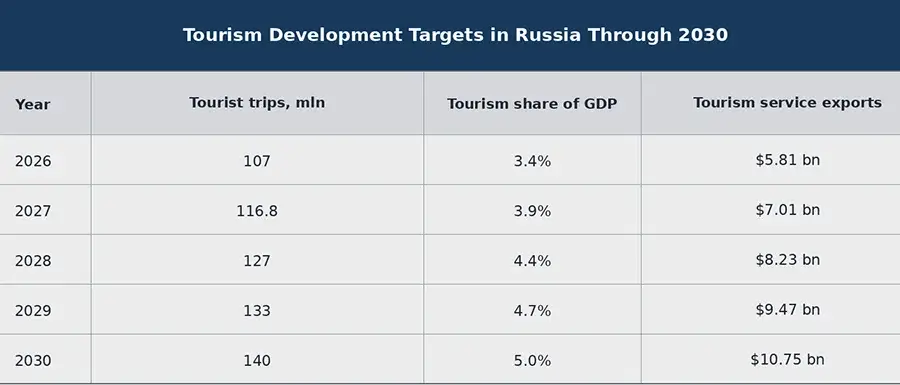
The Russian government plans to increase the number of domestic tourist trips to 107 million in 2026. The target rises to 116.8 million in 2027, 127 million in 2028 and 133 million in 2029. The goal for 2030 is 140 million. This means an increase of about 33 million trips, or nearly 31%, over four years.
For comparison, Russia recorded 83.6 million tourist trips in 2023 and 91.5 million in 2024. If the 2030 target is reached, traffic will be roughly two-thirds higher than in 2023. The strongest gains are expected over the next couple of years: almost 10 million additional trips in 2027 and more than 10 million in 2028.
The authorities also aim to increase tourism’s contribution to the Russian economy. The industry’s share of GDP is expected to rise from 3.4% in 2026 to 3.9% in 2027, 4.4% in 2028 and 4.7% in 2029, reaching 5% by 2030. Another target concerns exports of tourism services. Their value is estimated at $5.81 billion in 2026, rising to $7.01 billion in 2027 and $8.23 billion in 2028. The figures planned for 2029 and 2030 are $9.47 billion and $10.75 billion respectively. This would bring the total close to doubling within four years.
Growth in Russia’s Tourist Traffic Has Slowed
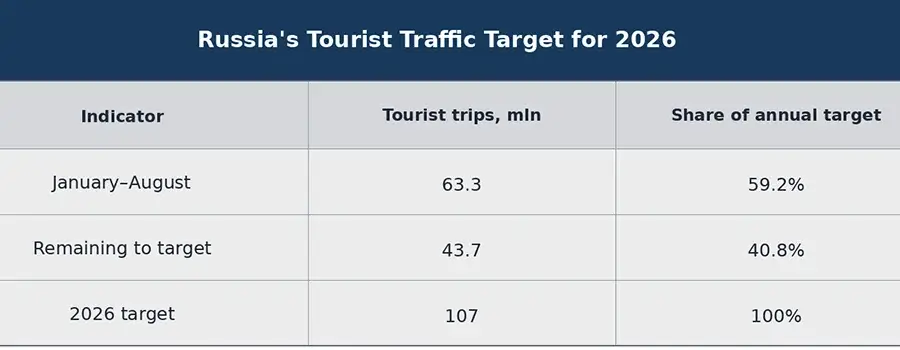
A total of 63.3 million tourist trips across Russia were recorded in January–August 2026. This was 2.6% more than in the same period of 2025, when the figure stood at 61.7 million. However, domestic tourist traffic grew by 5.4% in the first eight months of last year, indicating a slowdown in the pace of expansion. Around 10 million Russians travelled within the country in August.
The Moscow Region, Moscow, Tatarstan, the Amur Region and the Altai Republic were among the fastest-growing destinations during the first eight months. The Altai Republic recorded a 61% increase. Blagoveshchensk is also gaining importance as a transit hub for Russians travelling to China. Residents of Moscow and surrounding areas account for about 30% of domestic tourist traffic. With the 2026 target set at 107 million trips, another 43.7 million are needed. Almost 41% of the annual target is therefore expected to fall in September–December.
Deputy Prime Minister Dmitry Chernyshenko noted that the trend was weaker than expected, attributing the slowdown to external factors and shifts in tourist flows between regions. The Moscow Region, Moscow, Tatarstan, the Amur Region and the Altai Republic were among the leaders in growth during the first eight months. Tourist traffic in the Altai Republic increased by 61%. Blagoveshchensk is also gaining importance as a transit hub for Russians travelling to China. Residents of Moscow and the Moscow Region generate about 30% of domestic tourist traffic.
Hotel Bookings in Russia Decline
In 2026, Russia’s hotel market has performed more weakly than overall tourist traffic. During the summer season, bookings fell by 6.34%, while overnight stays declined by 8.18%. In the Krasnodar Region, the decreases reached 15.2% and 12.9% respectively. The sharper drop in overnight stays may indicate that tourists are spending less time in hotels.
The situation had not improved by the end of September. TravelLine recorded a 9.4% decline in bookings across Russia in January–September. In Sochi, the decrease reached 17.4%, while the Krasnodar Region recorded a 10.9% drop. The platform works with more than 12,000 accommodation properties across the country.
Forward sales for the end of the year also remain below last year’s level. Bookings for October–December were down 12.5%, while overnight stays were almost 15% lower. The Russian Union of Travel Industry believes the gap may narrow as travellers increasingly book accommodation shortly before their trips.
Growth in the overall number of tourist trips and declining hotel demand are not contradictory. Government statistics cover travel regardless of accommodation type, including trips without hotel stays. TravelLine tracks commercial accommodation, meaning tourist traffic can increase while hotel occupancy falls and stays become shorter.
Prospects for Tourism in Russia and Risks for Investors
International Investment analysts note a slowdown in the growth of domestic tourism in Russia. Hotel bookings are declining, while security is playing a greater role in travel decisions. Drone attacks have affected tourist regions as well, creating risks to people’s lives and health. Airport disruptions and schedule changes are also making travel less predictable.
The industry’s prospects will largely depend on geopolitical developments. If tensions persist, some destinations may continue to lose popularity, making the government’s tourist traffic targets more difficult to achieve. An easing of these pressures could support the market and help restore part of the demand.
Investors in hotel real estate should take a more cautious approach to new projects. Growth in nationwide tourist traffic does not guarantee high occupancy at an individual property. Location security, transport accessibility, seasonality and a business’s ability to withstand a sharp decline in demand all need to be considered. Under current conditions, financial models should also account for such a scenario.