







 Alta Banka Collapse in Serbia: What Happens to Russian Depositors' Money
 Covivio Hotels Revenue Grows 4.7% as European Markets Split
 Lithuanian Apartment Prices Accelerate Across Major Cities
 Georgia's Tourism Revenue Hits Record High
 Norway's Sovereign Fund Commits €1.5bn to European Warehouses
 Market Rout of October 2026: Can Branded Hotels Protect Capital?
AI Search for Travel 2026: How AI Chooses Hotels
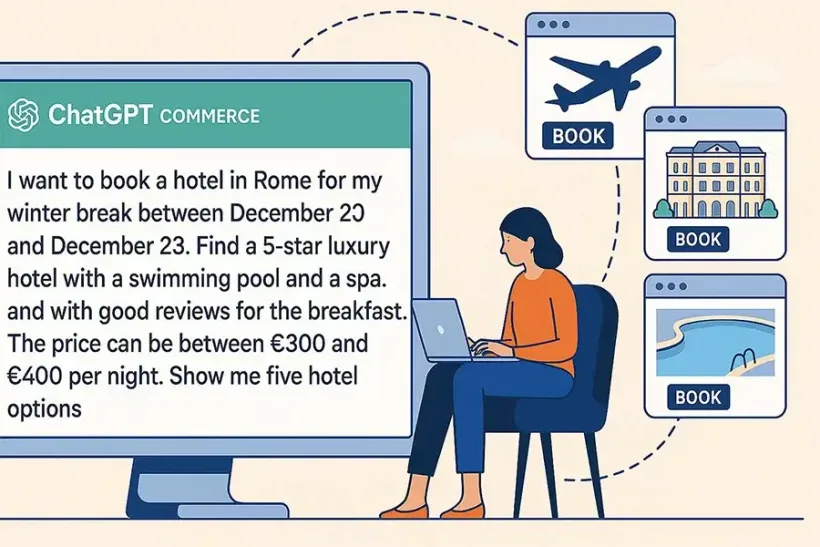
ChatGPT and Gemini influence discovery faster than booking
AI is becoming part of travel search, but its influence is uneven across the journey. New Skift and McKinsey data show that 71% of travelers are comfortable using AI to generate ideas and 67% to narrow options, while only 16% have used an AI tool to book anything travel related.
A Skift Research diary study shows the same gap from another angle. AI accounts for about 21% of touchpoints during inspiration, 16% during research and only 6% at booking. Its share rises again to 29% after booking as travelers ask about itineraries, transport, restaurants and trip details.
For hotels and destinations, that creates a new filter before the hotel website or OTA. Travelers can receive a shortlist inside ChatGPT, Gemini or AI Mode and arrive at traditional booking channels only after several options have already been excluded.
AI is taking over the top of the travel funnel
The journey used to begin more often with Google, an OTA, maps or a travel website. Now a traveler can describe the whole task: choose a quiet coastal city, find a neighborhood without nightlife, compare hotels and only then move toward booking.
Skift Research describes the transition as search-scroll-compare becoming ask-shortlist-decide. AI does not necessarily replace search. It increasingly decides which options make it into the next stage.
|
Stage |
AI touchpoints |
AI role |
What happens |
|
Inspiration |
21% |
ideas and destinations |
AI builds the shortlist |
|
Research |
16% |
comparison |
traveler narrows options |
|
Booking |
6% |
still secondary |
payment stays with OTA or supplier |
|
Post-booking |
29% |
trip details |
AI becomes active again |
For hotels and destinations, shortlist visibility is the critical point. If a property is absent there, competition over price, reviews and direct booking may never start.
Visibility is becoming a separate asset
Skift Data + AI Summit Europe cites an even sharper figure: only about 6% of hotels appear in AI-generated search results, while 82% of AI hotel recommendations draw from OTAs and editorial media.
That means a strong brand website is not enough. Models often build their view of a property from external sources such as Booking.com, Expedia, travel publications, reviews and other trusted datasets.
Independent hotels are particularly exposed. Large chains maintain centralised content, structured rates and consistent property descriptions. A smaller hotel may describe room categories, amenities or cancellation rules differently across its own website, OTAs and maps. For a human this is inconvenient. For an AI system it can be a reason not to include the property in a shortlist.
29% of strong matches never appear
Skift Research found that 29% of traveler persona–destination pairs judged to be a strong fit were never recommended by the models.
Recommendations are concentrated as well: the top five destinations received 38% of recommendations and the top 10 received 48%.
This changes the meaning of destination marketing. Being relevant to a traveler is no longer enough. A destination needs sufficiently clear and trusted information for a model to understand who it suits and why.
Booking still belongs to familiar channels
AI remains much weaker at the transaction stage. Skift estimates that only 6% of booking touchpoints involve AI. A separate Skift and McKinsey study found that 16% of travelers have already used AI to book something travel related, but comfort with transactions remains much lower than comfort with inspiration.
Trust is the main barrier. Forty-nine percent of travelers cite greater trust in a supplier's website as the top reason to book direct. Travel purchases involve payments, cancellations, refunds and support, and users still want a clear responsible party.
AI is nevertheless moving toward transactions. Google now allows some U.S. users to book selected hotels inside AI Mode in English. The booking partner processes payment, sends confirmation and handles changes or refunds.
ChatGPT is also gaining hotel apps with live rates and booking handoffs. For now, these are better understood as new entry points into distribution rather than replacements for existing payment infrastructure.
OTAs are becoming part of AI
The rise of ChatGPT, Gemini and AI Mode does not automatically weaken Booking.com or Expedia.
OTAs hold the type of structured inventory agentic systems need: property data, prices, availability, reviews, cancellation rules and transaction infrastructure.
Competition between direct and intermediary channels is therefore moving inside a new interface. A traveler may ask an AI assistant for the best hotel, receive several options and then pay either an OTA or the hotel itself.
International Investment already has separate pages on hotel booking in Google AI Mode and ChatGPT as a hotel distribution channel. Those should remain supporting platform-specific cases and link back to this evergreen guide.
What AI needs to understand about a hotel
Visibility depends on more than popularity. Models need to extract property attributes with confidence.
That includes location, neighborhood, room categories, breakfast, pools, parking, spa facilities, family amenities, accessibility, cancellation terms, beach type, airport distance and proximity to attractions.
The more these details exist only in promotional copy or conflict across platforms, the greater the risk of misinterpretation.
Hotel GEO therefore begins with basic data discipline: consistent naming, current attributes, structured markup, clear property pages and reliable external sources.
Editorial media are becoming part of distribution again
The Skift finding that 82% of hotel recommendations draw from OTAs and editorial media is particularly important for publishers.
A publication can influence a travel decision inside an AI response even when the user never clicks through.
That changes the ideal evergreen format. A page should answer the questions travelers ask models: where to stay, what it costs, how neighborhoods differ, when high season occurs, how to get from the airport, what restrictions apply and who the destination suits.
For an investment publication, that also includes ADR, occupancy, visitor flows, pipeline, transactions, yields and regulation.
Why the existing page should be updated
International Investment already has Travelers Shift to AI Over Hotel Websites. Its current framing reflects an earlier phase of the market and at points moves too quickly from AI discovery to the full booking journey.
The new evidence supports a much stronger page without creating a competing URL. The existing slug is already relevant to the topic, while a new H1, title, description, structure and internal links can turn it into the main evergreen hub.
The pages on Google AI booking and ChatGPT distribution should remain поддерживающие материалы. They answer narrower platform-specific queries and can link back to the hub, while the hub links to them as detailed examples.
Using the page to test International Investment's видимость в ИИ
The evergreen can also function as a practical видимость в ИИ experiment for International Investment.
The most useful method is to freeze a set of queries rather than changing them every week. These can cover European hotel investment, hotel property markets, Georgia tourism investment, Batumi hotels and resort real estate.
The site can then track whether International Investment appears in ChatGPT, Gemini/AI Mode and other systems, which pages are cited, which competitors appear nearby and which sources are used for specific facts.
That produces a more useful measure than a generic question of whether the website is “visible in AI.” It shows where the publication already enters source shortlists and where models still ignore it.
What changes for hotel businesses
AI is not yet taking the majority of bookings, but it increasingly influences who gets considered.
That is the central distribution shift of 2026. A hotel can have an efficient модуль бронирования and strong loyalty program and still lose the customer before the site visit if ChatGPT or Gemini never names it.
видимость в ИИ does not replace SEO, OTAs or the brand website. It adds another competitive layer: the shortlist.
Hotels therefore need to optimize not only the page a traveler might open, but also the data and external sources that determine whether AI decides to show that page at all.
FAQ
Are travelers using AI to choose trips?
Yes. Seventy-one percent are comfortable using AI to generate ideas and 67% to narrow options.
How much of booking already happens through AI?
Much less. Skift Research found AI accounted for about 21% of inspiration touchpoints but only 6% at booking. A separate survey found 16% had used AI to book something travel related.
Can a hotel already be booked inside AI?
Yes. Google AI Mode supports bookings for selected U.S. properties in English, with the booking partner remaining responsible for the transaction.
Will AI replace Booking.com and Expedia?
There is no evidence of that yet. OTAs remain major suppliers of structured inventory, rates and transaction infrastructure and are being integrated into AI interfaces.
How can a hotel appear in ChatGPT or Gemini recommendations?
There is no guaranteed formula. Consistent property data, machine-readable attributes, strong external sources, current rates and clear intent-specific pages all improve the conditions for visibility.
Why can suitable destinations still disappear from AI answers?
Skift Research found that 29% of high-fit traveler persona–destination pairs were never recommended. Relevance and видимость в ИИ are therefore not the same thing.