







 Alta Banka Collapse in Serbia: What Happens to Russian Depositors' Money
 Covivio Hotels Revenue Grows 4.7% as European Markets Split
 Lithuanian Apartment Prices Accelerate Across Major Cities
 Georgia's Tourism Revenue Hits Record High
 Norway's Sovereign Fund Commits €1.5bn to European Warehouses
 Market Rout of October 2026: Can Branded Hotels Protect Capital?
Why AI Cannot See Most Independent Hotels

Independent hotels lose before ranking begins
An independent hotel can have strong reviews, a good website and healthy occupancy and still fail to appear in ChatGPT recommendations.
New Stiplo data presented at Skift Data + AI Summit Europe found that independent hotels were about eight times more likely to be unknown to AI systems than chains. Yet once an AI system knew a property, independents were recommended at roughly the same rate as chains.
The study covered 659 Barcelona hotels and 27,360 answers from four AI assistants. Google review volume was the strongest factor associated with видимостью для ИИ.
Independent hotels lose before comparison starts
The study does not point to systematic model favoritism toward chains. The gap emerges earlier.
Chains operate inside denser digital infrastructure: consistent property records, centralized websites, more reviews, OTA listings, structured data and extensive external mentions. Independent properties are more likely to have fragmented information across their own website, Google, OTAs, maps and local platforms.
If names, addresses, room categories and amenities do not align, systems have a harder time connecting the sources to a single hotel.
This matters especially in Europe, where roughly three quarters of hotels are independently owned.
Google Reviews are becoming a visibility signal
Google review volume was the strongest factor associated with whether AI systems recognized a hotel in the Stiplo dataset.
That does not mean every additional review directly improves a hotel's ChatGPT ranking. The finding is correlation, not proof of causation.
But a larger review footprint reinforces entity recognition: the hotel's name repeatedly appears next to its address, photos, rating and property attributes.
Only 6% of hotels appear in AI search
Skift Data + AI Summit research found that only about 6% of hotels surface in AI-generated search results.
At the same time, 82% of AI hotel recommendations draw on OTAs and editorial media.
The immediate competitive issue is therefore not where payment happens but which properties enter the traveler's consideration set.
OTAs retain a data advantage
Booking.com, Expedia and other OTAs already maintain the structured inventory AI systems need: property records, rates, availability, room categories, amenities, reviews and cancellation rules.
AI may change the search interface without eliminating the intermediaries supplying much of the underlying data.
For independent hotels, that creates a second layer of OTA dependence: not just conversion, but discovery.
The brand website still matters
A hotel's own website remains the place where it controls property descriptions, rooms, policies, services and direct booking.
But content cannot help if automated systems cannot reliably extract it.
At Skift Data + AI Summit, industry experts highlighted доступность сайта для поисковых роботов, site speed and структурированную разметку as technical prerequisites for видимость в ИИ.
Schema.org provides structured models for hotels, accommodation units and offers, while Google uses Hotel and HotelRoom structured data to validate hotel pricing information.
Markup does not guarantee visibility in ChatGPT. It reduces ambiguity.
What AI needs to understand about a hotel
AI systems need to connect a property name to a stable address and location, identify room categories and understand amenities, cancellation policies, accessibility, family facilities, parking, spa services and proximity to key landmarks.
Conflicting information across a hotel website, Google profile and OTA listings makes that task harder.
For chains, much of this data is centralized. Independent hotels are more likely to manage each channel separately.
Editorial media are becoming part of distribution
The 82% figure changes the role of hotel coverage.
Editorial articles are not only PR assets if AI systems use them as sources when generating hotel recommendations.
The most useful pages contain concrete facts: location, property segment, room count, facilities, target guest, transport links and the competitive context of the destination.
That gives investment and travel publications a new role in hotel discovery.
Most hotels still do not monitor AI visibility
A separate h2c study covered by International Investment found that only 22% of hotel chains systematically track how their brands and properties appear in AI-generated answers. Another 48% check occasionally, while 20% do not monitor AI visibility at all.
At the same time, 70% expect AI-driven channels to increase direct bookings over the next one to two years.
The gap between expectations and measurement remains wide.
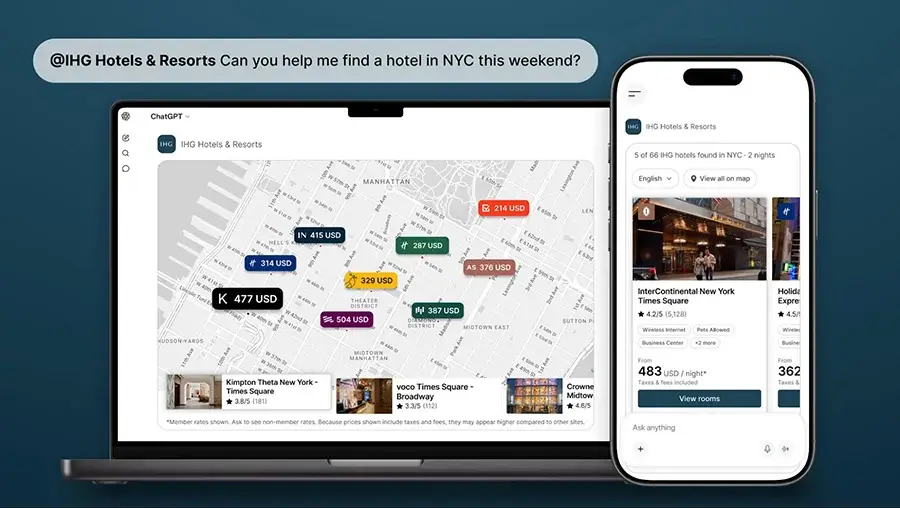
How hotels can test visibility
Branded prompts are not enough. If a traveler already knows the hotel's name, discovery has already happened.
More useful tests mirror real intent: a boutique hotel with parking in the city center, a family hotel near the beach, an independent spa hotel or a property near an airport.
Hotels can use a stable set of prompts across ChatGPT, Gemini and other systems and track whether they appear, which competitors are shown and which attributes the systems mention.
What to fix first
|
Check |
What to fix |
How to measure |
|
Website |
crawlability, speed, Hotel/HotelRoom structure |
pages can be crawled and parsed |
|
Property data |
consistent name, address, rooms, amenities |
no conflicts across site, Google and OTAs |
|
Reviews |
steady flow of genuine Google Reviews |
review volume and recency improve |
|
External sources |
OTAs, local sites, editorial coverage |
property appears in credible context |
|
AI answers |
stable set of non-branded prompts |
appearance rate, competitors, attributes mentioned |
There is no single optimization switch.
The first step is making sure systems can crawl the site and identify the property consistently. Then hotels should align information across major external platforms, keep attributes current and build a healthy review footprint.
Editorial coverage works best when it adds factual context rather than acting as artificial link building.
More content does not guarantee more visibility
Publishing dozens of near-duplicate pages for AI is unlikely to solve a technical visibility problem.
Skift speakers emphasized that content matters only after the technical layer is accessible. Google continues to recommend original, user-focused material rather than pages created mainly for algorithms.
For an independent hotel, one complete and current property page is more useful than multiple generic SEO pages.
AI visibility is becoming a commercial metric
AI-originated bookings are still small. Skift reports that less than 1% of Booking Holdings room nights come from AI channels, while Bernstein estimates around 1.6% at Marriott.
But AI already influences the top of the funnel, where travelers decide which hotels to compare.
Visibility may therefore become a commercial metric alongside OTA ranking, organic search and direct-booking share.
For investors, digital видимостью для ИИ is increasingly part of distribution quality.
Chains win because their data infrastructure is stronger
Once an AI system knows a property, independent hotels are recommended at roughly the same rate as chains.
The main gap therefore appears before ranking.
Chains have spent decades building centralized digital infrastructure. Independent hotels often have fragmented data across websites, Google, OTAs, booking systems and external publications.
ChatGPT has made that gap easier to see.
The practical task is not to write content “for AI.” It is to make the hotel consistently understandable across the digital ecosystem.
If AI knows the hotel, normal competition can begin.
If it does not, there is no competition at all.
FAQ
Why might ChatGPT not know a locally well-known hotel?
Local awareness does not guarantee a strong digital footprint. Stiplo found independent hotels were substantially more likely to be unknown to AI systems than chains.
Does ChatGPT favor hotel chains?
The study does not show that. Once properties were known to the systems, independent and chain hotels were recommended at roughly similar rates.
Do Google Reviews help?
Google review volume was the strongest factor associated with видимостью для ИИ in the study. This is correlation, not proof that individual reviews directly change rankings.
Does a hotel need Schema.org markup?
Structured data helps machines understand the hotel, rooms and offers. It can improve machine readability but does not guarantee a recommendation in ChatGPT or Gemini.
Does a hotel need to be on Booking.com?
There is no formal requirement. But OTAs are among the dominant sources used in AI hotel recommendations, so being absent from major external platforms can weaken a property's digital footprint.
Do editorial articles help?
Industry data show editorial media and OTAs are used in a large share of AI hotel recommendations. Articles are most useful when they contain concrete facts about the property and destination.
How should hotels test AI visibility?
Use a stable set of non-branded prompts that reflect real guest intent and track whether the property appears across ChatGPT, Gemini and other systems.