







 Covivio Hotels Revenue Grows 4.7% as European Markets Split
 Lithuanian Apartment Prices Accelerate Across Major Cities
 Georgia's Tourism Revenue Hits Record High
 Norway's Sovereign Fund Commits €1.5bn to European Warehouses
 Market Rout of October 2026: Can Branded Hotels Protect Capital?
 Residential Property Prices in Tbilisi Rise by 5.9% Year-on-Year
Hotels Adopt AI but Struggle to Prove Returns
New Perspective Y.K., Wikimedia Commons, CC BY 4.0
Artificial intelligence is already used by 91% of the hotel chains participating in h2c’s 2026 global study. Another 8% plan adoption within the next 12–24 months. Yet only 28% have a company-wide strategy led by senior management, while just 13% report measurable ROI.
The gap is even clearer in distribution. Some 70% of hotel chains expect AI-driven discovery and booking channels to increase direct bookings over the next one to two years. Yet only 22% systematically monitor how their brands and individual properties appear in AI-generated answers and recommendations. Another 48% check occasionally, while 20% do not monitor AI visibility at all.
The figures suggest that the next stage of hotel AI is no longer about adoption. The more difficult questions are whether operators can connect AI to revenue and costs, and whether hotels remain visible as discovery shifts into AI interfaces.
h2c’s study covers 113 hotel chains across Europe, the Middle East and Africa, Asia Pacific and the Americas. Together they represent more than 8,200 properties and roughly 1.3 million rooms. The research includes 122 responses, including 21 executive interviews, while 78 participating chains contributed 230 implemented AI use cases. Results were not weighted by chain size, so the 91% figure represents participating companies rather than the share of hotel rooms globally.
AI is saving time before it proves profit
The clearest benefits so far are operational. Nearly seven in ten respondents report improved efficiency and automation, while 59% say AI allows staff to focus on higher-value work. Improved guest experience is reported by 32%.
The 230 implemented use cases are also concentrated in existing workflows: guest communication, reputation management, revenue management and forecasting, internal productivity, marketing, reservations, personalization, finance and technology automation.
That helps explain the gap between 91% adoption and 13% measurable ROI. Automating review analysis or management reporting can save real staff time, but that value is harder to isolate and translate into incremental profit.
Hotel chains rate AI’s overall contribution to business performance at 5.6 out of 10. AI is already useful, but for most chains it is not yet a standalone source of clearly measurable financial performance.
Only 13% can demonstrate measurable ROI
For hotel owners and investors, this may be the most important figure in the study.
Only 13% report measurable returns from AI initiatives. That does not mean the other 87% are receiving no value. Many companies have not yet built a reliable way to separate AI’s contribution from seasonality, rate changes, occupancy, marketing spend and other variables.
Hotel economics make attribution difficult. One tool can shorten response times, another can improve demand forecasting, while a third can increase direct-booking conversion. Profit still depends on ADR, occupancy, distribution costs, labour and customer-acquisition costs.
The number of AI features therefore says little about operator quality on its own. More useful measures include booking-processing cost, direct-channel share, labour cost, conversion, ancillary revenue and staff time saved.
International Investment has previously examined how hotel revenue growth does not automatically produce the same increase in operating profit when labour, utilities, distribution and management costs are rising. AI becomes investment-relevant when an operator can show which of those metrics actually changed.
Strategy is lagging adoption
Almost every participating chain now uses AI, but only 28% have an enterprise strategy led by senior management.
Adoption has moved quickly. In h2c’s 2025 study, 78% of participating chains used AI; in the 2026 sample, the figure is 91%. The two studies use different samples, so this is not a panel comparison of identical companies. It nevertheless shows how rapidly AI has moved from isolated experimentation into routine hotel operations.
Public external tools such as ChatGPT account for around 60% of reported day-to-day use. AI embedded in vendor systems accounts for another 27%, while internally developed or hosted solutions represent only 12%.
At the broader implementation level, 31% of chains primarily rely on vendor-provided solutions and another 25% use a hybrid of internal and vendor technology.
For hotel operators, architecture therefore matters more than feature count. If PMS, CRM, loyalty, booking and revenue-management systems rely on fragmented data, AI does not automatically solve the problem. It simply processes those fragments faster.
Skills and integration are the main constraints
Hotel chains rate their internal AI knowledge at just 3.4 out of 10.
A lack of expertise, training and skills is the leading barrier, cited by 56%. Integration with existing systems affects 38%, while 32% lack a clear strategy or roadmap. Security and privacy concerns are cited by 29%, data governance and access management by 28%, and budget constraints by 22%.
This changes the hotel technology debate. Access to an AI model is no longer the main difficulty. Connecting it to a fragmented hotel technology stack is harder.
The same guest can exist across a property-management system, CRM, loyalty platform, booking engine, payment provider and external distribution channels. AI becomes more useful when those sources are consistent and access rules are clear.
Agents are moving to the centre
AI agents and bookings through AI platforms are each identified by 70% of respondents as leading innovation areas over the next two years.
Among organizations already using or planning AI agents, 70% see staff-facing applications and 55% see guest-facing uses. Internal applications include reporting, operational insights, finance, administration and coordination. Guest-facing uses include upselling, booking requests and customer inquiries.
Autonomy still creates concern. Liability for AI errors is cited by 56%, data privacy and security by 54%, guests’ willingness to share the necessary personal data by 53%, and accuracy, reliability and potential bias by 52%.
The next phase is therefore less about replacing staff than deciding which actions a hotel is prepared to delegate and where human control remains mandatory.
The next distribution battle is AI booking
Some 70% of hotel chains expect AI-driven channels to increase direct bookings. Of those respondents, 47% expect a moderate increase and 23% a significant one.
The market is already testing this model. Wyndham Hotels & Resorts launched a native ChatGPT app that lets users explore roughly 8,400 hotels using natural-language prompts, maps, amenity filters and property cards. The booking is still completed on WyndhamHotels.com, so this is not a full in-chat transaction. It is a new entrance into Wyndham’s direct distribution channel.
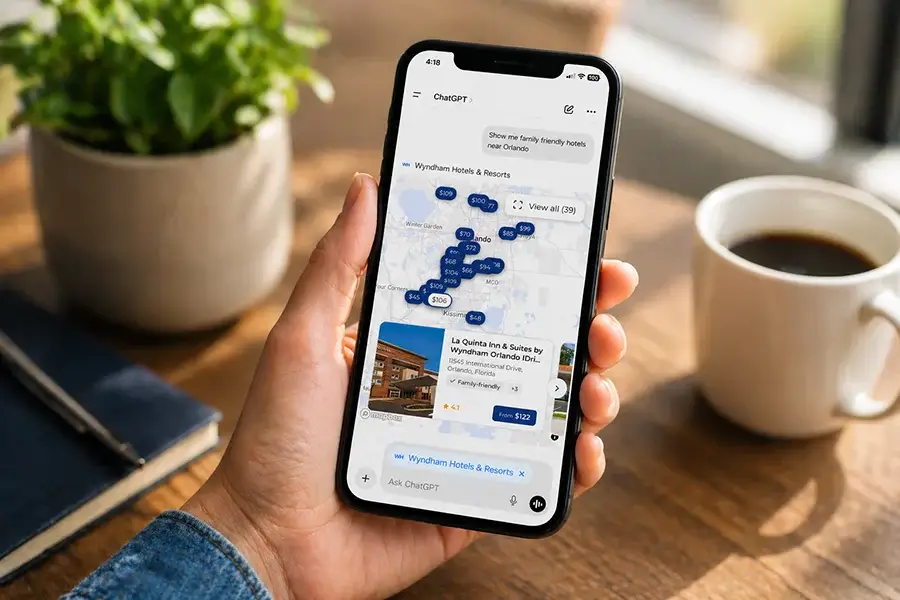
Wyndham hotel discovery inside ChatGPT. Booking is completed on WyndhamHotels.com. Image: Wyndham Hotels & Resorts / Hotel Management.
The example shows why AI visibility is becoming a distribution issue. Hotels previously competed for placement in Google, metasearch and online travel agencies. AI adds another layer in which a system can filter the market before the traveler opens a hotel website.
Only 22% systematically monitor AI visibility
Expectations for the new channel are much higher than current readiness.
Only 22% systematically track how their brands and properties appear in AI-generated results. Another 48% do so occasionally, while 20% do not monitor visibility at all and 10% are unsure.
A further 33% have not implemented any specific measures to improve AI visibility and bookability.
h2c says hotel chains are beginning to work on answer-engine and generative-engine optimization, structured data, real-time availability and booking capabilities.
In practice, hotels have two separate tasks. An AI system first needs to understand the property correctly: location, room types, amenities, policies and positioning. It then needs sufficiently current commercial data to move from recommendation to transaction.
Strong conventional search rankings do not guarantee equivalent representation in generative answers. Monitoring AI visibility is therefore becoming a separate distribution task rather than simply a new label for SEO.
AI does not eliminate intermediaries
Growth in AI-driven direct bookings could reduce some dependence on traditional travel platforms, but the new interface can itself become an intermediary.
If an AI service compares hundreds of hotels, selects options, accesses rates and manages a transaction, it performs some of the functions associated with OTAs and metasearch.
The more important question for hotel groups is therefore who controls property data, the guest relationship and the route to purchase.
Strong direct channels, loyalty programs and connected technology infrastructure give international brands an advantage because they can plug into new discovery interfaces without becoming fully dependent on one external platform.
Technology is becoming part of operator quality
AI does not change a hotel’s location, room count or land value. It can affect servicing costs, direct bookings, marketing efficiency and revenue management.
Technology readiness is therefore becoming another dimension of operator quality.
International Investment has previously noted that branded hospitality sells more than a name: investors are also buying into an operating model, professional management and distribution infrastructure. AI strengthens that distinction because the value of a brand increasingly includes its ability to keep properties visible and bookable as discovery channels change.
When evaluating an operator, the useful questions are not how many AI tools it has, but how well its data is governed, how connected its systems are, whether it measures outcomes and whether its hotels are visible in AI-driven search.
Hotels are entering the second stage of AI
The first stage moved quickly: hotel groups added public AI tools and vendor features to many existing workflows.
The second stage is harder. Those tools need to connect with data, booking systems and property economics. Performance needs to be measured through revenue, costs and direct sales rather than through feature counts.
Hotels must also prepare for a new customer entry point. If a traveler begins discovery through an AI conversation rather than a search box or OTA, data quality and technical bookability become part of distribution.
That is the gap between the 91% of participating hotel chains already using AI and the 13% that can currently demonstrate measurable financial returns.
FAQ: AI in hotels in 2026
How many hotel chains use AI?
AI is already used by 91% of hotel chains in h2c’s 2026 sample. Another 8% plan adoption within the next 12–24 months.
How many hotel chains can show AI ROI?
Only 13% report measurable ROI from AI initiatives. This does not mean the rest receive no benefit; many have not yet built reliable measurement.
Do hotel chains have enterprise AI strategies?
Only 28% report a company-wide strategy led by senior management. Most implementation remains distributed across departments, tools and technology providers.
Will travelers book hotels through AI?
Some 70% expect AI-driven booking channels to increase direct booking volume over the next one to two years. Forty-seven percent expect a moderate increase and 23% a significant increase.
Do hotels monitor visibility in ChatGPT and other AI services?
Only 22% systematically monitor AI-generated search and recommendation results. Another 48% do so occasionally, while 20% do not monitor them at all.
What affects hotel visibility in AI search?
Accurate and consistent property data, room and amenity information, policies, rates and availability all matter. Moving from recommendation to sale also requires reliable connectivity to a booking channel.