







 Covivio Hotels Revenue Grows 4.7% as European Markets Split
 Lithuanian Apartment Prices Accelerate Across Major Cities
 Georgia's Tourism Revenue Hits Record High
 Norway's Sovereign Fund Commits €1.5bn to European Warehouses
 Market Rout of October 2026: Can Branded Hotels Protect Capital?
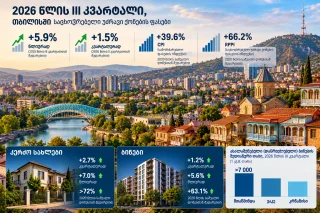 Residential Property Prices in Tbilisi Rise by 5.9% Year-on-Year
Grand Prix and Fashion Drive Milan Hotel Rates Higher

Milan hotels recorded their second-highest monthly average daily rate and revenue per available room on record in September 2026. Only February, when the city hosted the Winter Olympics, delivered stronger monthly results. The Italian Grand Prix, Milan Fashion Week and international trade fairs helped sustain demand across the month, highlighting the commercial value of a recurring events calendar for hotel operators and investors.
September hotel performance nears Olympic records
Preliminary CoStar figures put Milan's September occupancy at 84.2%, up 1.6% year over year. Average daily rate (ADR) rose 7.2% to €310.04 and revenue per available room (RevPAR) increased 8.9% to €261.17. Both rate and room-revenue metrics were the second highest monthly results on record, behind the February 2026 Winter Olympics. Occupancy was the strongest since October 2019.
This was not Milan's first event-driven September. In 2025, when the Grand Prix and Fashion Week also boosted demand, ADR reached €292.27 and RevPAR €240.23. The comparison suggests that repeated international events can help hotels maintain pricing power, although the figures do not isolate the incremental impact of any single event.
Formula 1 delivered September's peak
On Saturday, 5 September, during the Italian Grand Prix, Milan occupancy reached 95.3%, ADR climbed to €444.75 and RevPAR hit €424.07. All three were September peaks. That night's ADR was about 43% above the monthly average. The figure is a marketwide hotel rate for one night, not an estimate of the Grand Prix's total economic contribution.
Race weekends create demand concentrated around fixed dates. Teams, sponsors, corporate visitors and spectators have limited flexibility to shift their trips. Yet a reliable estimate of incremental hotel revenue attributable to the race would require a counterfactual baseline, rather than a comparison of event-night and monthly averages alone.
Fashion Week and trade shows filled the calendar
Milan Fashion Week ran from 22 to 26 September. Occupancy reached 93.5% on its second night, while ADR peaked at €396.59 and RevPAR at €358.30 on the fourth night. Fashion buyers, brands, media and business travellers bring a different demand mix from leisure tourists.
On 15 September, the final day of MICAM Milano coincided with the opening of SIMAC. Hotel occupancy reached 94.7%, the month's second-highest reading. ADR was €301.17 and RevPAR €285.21. The numbers illustrate why occupancy and pricing must be read together: a heavily booked night need not deliver the highest room rate.
Across September, occupancy exceeded 70% on all but two nights, according to CoStar. This is more consequential for hotel operations than any isolated record. A sequence of events may support both peak-night pricing and occupancy on the days between them.
Olympic pricing versus recurring demand
The Winter Olympics remain the benchmark for Milan's pricing performance. CoStar's analysis of the Games documented exceptionally high luxury hotel rates, but a one-off mega-event and a recurrent sequence of sporting, fashion and trade events carry different implications. Hotels can plan staffing, contracted demand and dynamic pricing around an established annual events calendar.
For investors, the relevant question is whether these recurring demand periods improve results over a full year, not merely whether a city approaches its Olympic records. Location, hotel category, corporate relationships and revenue management will determine how much benefit an individual property retains.
What the results mean for hotel investors
RevPAR combines occupancy and ADR and measures room revenue per available room. It is not a measure of net profit. Event periods can require additional labour, services and distribution costs, while financing and capital expenditure remain outside the metric. Investors need operating-margin data, acquisition pricing and multi-year performance before drawing conclusions about returns.
Milan's latest figures show the pricing potential of a dense, varied event calendar. They do not demonstrate that every hotel benefited equally or that room-rate increases translated into asset-value gains. That distinction matters in a European hotel market where higher revenue can coincide with pressure on operating margins.
How this fits the European hotel market
International Investment previously covered Olympic-related accommodation pressure across Italy and Milan's pre-Games hotel bookings. September provides a useful follow-up: a city's hotel economy can benefit from multiple recurring international events. The wider European hotel outlook also points to the need to assess revenue gains against rising operating costs.
FAQ
Why were Milan hotel rates high in September 2026?
The Italian Grand Prix, Fashion Week and major trade fairs supported demand. Monthly ADR reached €310.04 and RevPAR €261.17.
What was Milan's peak hotel night?
On 5 September, occupancy reached 95.3%, ADR €444.75 and RevPAR €424.07.
Did September beat Olympic hotel rates?
No. February 2026 remains the only month with higher monthly ADR and RevPAR.
Does higher RevPAR guarantee higher profits?
No. RevPAR excludes operating costs, commissions and capital costs