







 Vietnam Mortgage Surge Pushes Homes Out of Reach
 Lithuanian Apartment Prices Accelerate Across Major Cities
 London Flats Lose Value Ahead of Leasehold Reform
 Construction of the Batumi–Sarpi Highway Begins in Georgia
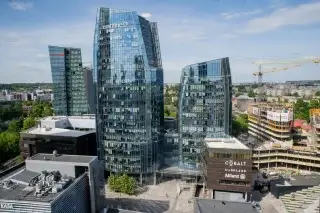 Baltic Property Investment Accelerates in 2026
 Hong Kong and Singapore Renew Their Expat Rivalry
AI Has Lifted New York Office Leasing

New York office leasing gained momentum as AI firms moved in
New York’s office market picked up fresh momentum in March as artificial intelligence companies emerged as an increasingly visible source of demand, offering one of the clearest signs yet that Manhattan commercial real estate is regaining traction. Bloomberg reported that after years of weak occupancy and persistent space overhang, the city is attracting a new wave of well-funded tenants, including AI firms willing to pay for high-quality space in top locations.
Manhattan entered 2026 with stronger office market fundamentals
By early 2026, Manhattan’s fundamentals were already improving. Colliers said January office leasing reached 3.69 million square feet, 33.6% above the 10-year monthly average. Availability tightened to 13.5%, the lowest since late 2020, while the average asking rent climbed to $77 per square foot, up 5.1% from a year earlier. Newmark said full-year 2025 office leasing totaled 42.8 million square feet, the third-highest annual result of the past 20 years, while available space had fallen for seven straight quarters.
AI firms have become one of the clearest new demand drivers
What matters most for landlords is that AI firms are not just taking small flexible suites. They are signing major leases in premium buildings. SL Green said Harvey AI expanded by another 92,663 square feet at One Madison Avenue, bringing the building to 100% leased. The landlord explicitly said New York stands to benefit from growth in tech and AI. At the same time, AI startup Clay leased 163,095 square feet at 11 Madison Avenue, adding another large AI-led deal to Manhattan’s leasing recovery.
Why AI is helping New York’s office market rebound
For property owners, the importance of these tenants goes beyond the lease count. They represent high-growth companies backed by significant capital and often seeking top-tier buildings close to talent and business infrastructure. In its 2026 US office outlook, CBRE said gateway markets such as Manhattan are positioned for continued growth because of the agglomeration benefits and access to skilled labor they offer, while large occupiers accounted for 40% of all activity in 2025. That helps explain why New York, despite remote-work pressures, is once again attracting expanding tech teams.
The recovery remains uneven and strongest in trophy properties
The rebound does not mean every building is recovering at the same pace. Newmark said Midtown trophy assets have tightened especially fast, with direct availability dropping to 3.7%. Colliers added that Manhattan’s sublet inventory has been shrinking for 16 straight months and is now at its lowest since September 2019. That points to a two-speed market in which premium, well-located offices are filling up while weaker and older stock remains under pressure.
New York is benefiting from a wider tech office shift
The AI leasing story in Manhattan is part of a broader geographic shift in technology real estate. OpenAI previously chose the Puck Building in SoHo for its first New York office, a move that industry outlets said raised hopes among owners that the city could build a durable AI tenant base. At the same time, early 2026 leasing tables showed technology tenants accounting for a significant share of Manhattan’s largest deals, suggesting that this is becoming a trend rather than a one-off headline.
What it means for rents and investors
For investors and developers, the real significance is that AI demand supports both occupancy and pricing discipline. Newmark said 2025 ended with positive absorption of 4.8 million square feet, the first annual positive reading in more than a decade. Colliers said asking rents in January hit their highest level since September 2020. When fast-growing technology tenants return to the market, especially in premium buildings, they strengthen landlords’ pricing power and improve sentiment around New York office assets.
As International Investment experts report, the current shift matters not because AI has fully rescued New York’s office market, but because it has created a new demand engine for expensive, high-quality space. If that flow continues, Manhattan should be able to reduce vacancy faster and support rents in the premium segment even if older and lower-quality offices recover much more slowly.