







 Vietnam Mortgage Surge Pushes Homes Out of Reach
 Lithuanian Apartment Prices Accelerate Across Major Cities
 London Flats Lose Value Ahead of Leasehold Reform
 Construction of the Batumi–Sarpi Highway Begins in Georgia
 Baltic Property Investment Accelerates in 2026
 Hong Kong and Singapore Renew Their Expat Rivalry
New York Unlocks Brooklyn Land for Housing
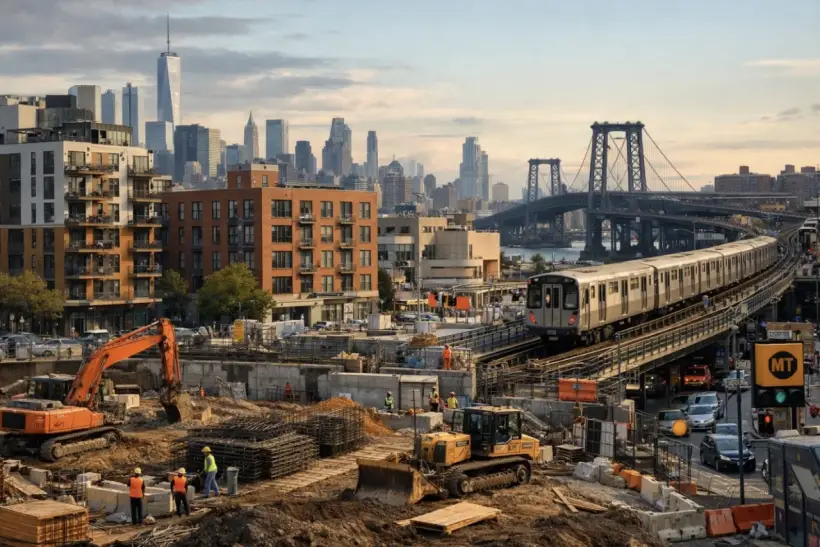
New York launches a new housing push near transit
New York State has opened a new phase in its housing expansion drive by putting an MTA-owned site in Brooklyn out for proposals to build about 300 homes. On the homepage of Homes and Community Renewal, or HCR, the state’s housing agency says that on March 24, 2026 Governor Kathy Hochul announced a Request for Proposals, or RFP, to transform an underutilized Metropolitan Transportation Authority site in Brooklyn into a residential development. The HCR notice explicitly says the project is aimed at roughly 300 homes.
While the full technical profile of the parcel is not yet publicly laid out in the indexed materials available, the announcement fits a well-established pattern in Hochul’s housing policy: use public land, accelerate construction and tie new residential supply to transit infrastructure. That same logic runs through her 2026 State of the State agenda, where she said New York needs to build more housing, reduce infrastructure bottlenecks and move projects faster after years of delay caused by regulation and underinvestment.
The Brooklyn MTA site fits Hochul’s broader housing strategy
The Brooklyn proposal is not an isolated move. In February 2026, Hochul announced the selection of a nonprofit partnership to redevelop state-owned land at 1024 Fulton Street in Clinton Hill into a mixed-use project with 125 permanently affordable homes, a 28,000-square-foot intergenerational community center and a health clinic. In that official HCR release, the project was described as an example of the state leveraging underutilized public land to increase housing supply.
The governor’s office said in January that the state’s housing agenda is no longer built only around subsidy programs, but also around structural reforms: accelerating affordable housing, reducing infrastructure constraints, supporting lower-cost construction methods and clearing barriers that prevent supply growth. In that context, the Brooklyn MTA parcel is not simply a land disposition. It is part of a transit-oriented development model, meaning housing that is deliberately aligned with public transportation access and built around a transit node.
Why Brooklyn remains central to New York housing growth
Brooklyn is not a random choice for a new state-backed housing push near transit. The borough has become one of the main testing grounds for both city and state efforts to add supply in response to extremely tight housing conditions. Back in February 2024, Empire State Development announced progress on 18 projects in Gowanus expected to unlock more than 5,300 housing units, including over 1,400 affordable homes. At the time, Hochul directly linked those projects to the need to build faster as New York City faced its lowest housing vacancy rate in six decades.
That direction continued through 2025 and 2026. In addition to Gowanus, the state has advanced major affordable housing projects in East New York and Clinton Hill, while repeatedly showing that public land and underused parcels can be turned into the core of new residential clusters. In the case of 1024 Fulton Street, officials stressed that the site had sat unused since 1997. That language closely mirrors the new MTA announcement, where the key descriptor is again underutilized land.
Housing and transit are becoming one policy
The Brooklyn announcement arrives against the backdrop of a much broader strengthening of New York’s transit policy. In May 2025, Hochul signed legislation fully funding the MTA’s $68.4 billion capital plan for 2025 through 2029. In the official release, the package was described as the largest investment in New York State transportation history. It includes the Interborough Express, or IBX, signal modernization, rolling-stock renewal and a series of projects aimed at improving connectivity across the metropolitan region.
That matters because the link between housing and transit has become one of the defining principles of Hochul’s policy approach. It is visible not only in Brooklyn, but also in projects such as Beacon Metro-North, where the state previously advanced housing next to commuter rail, and in her January infrastructure agenda, which tied transit upgrades to broader community growth. For Albany, housing near transit is increasingly being treated as part of one infrastructure strategy rather than as a stand-alone development story.
What is confirmed about the 300-home development
The most firmly confirmed figure in the current announcement is the scale: about 300 homes. Just as importantly, the state is not announcing a completed project or a started construction site. It is announcing an RFP, which means MTA is formally seeking redevelopment proposals for the site. At this stage, final details such as the affordable housing share, design, any commercial or community space and the delivery timeline would typically be determined later, after a developer is selected and follow-on approvals are secured.
That is why the story should be read as a launch of the development process rather than a fully locked construction plan. Even so, it carries market weight. When New York State brings an MTA-owned parcel near transit in Brooklyn to the proposal stage, it shows that housing policy is moving from rhetoric into a real land-and-infrastructure pipeline. In a city where supply is constrained and developable sites are scarce, those pipeline decisions matter as much as headline construction starts.
Why the news matters for New York real estate
New York has spent years struggling with a housing shortage, heavy rent pressure and the high cost of development. In that environment, every public-land project near transit carries outsized policy and market significance. Hochul has repeatedly argued that the only long-term answer to the housing crisis is to build more. That argument has run through her housing platform, Brooklyn-specific programs and now the new MTA-linked site announcement.
The significance of the Brooklyn move is amplified by the scale of the state’s wider housing pipeline. HCR says the state’s five-year $25 billion housing plan is designed to create or preserve 100,000 affordable homes statewide, including 10,000 with supportive services, and that more than 60,000 homes have already been created or preserved. That makes the Brooklyn MTA parcel more than a local story. It is another component in a larger construction cycle in which land near major transport infrastructure is becoming one of the state’s most strategic housing assets.
As International Investment experts report, the new competition to build 300 homes on an MTA-owned site in Brooklyn shows that New York State is no longer relying only on housing finance tools, but is increasingly reallocating urban land itself toward residential use. For the market, that is a meaningful signal: sites near public transport are becoming priority assets, and public parcels are emerging as one of the few realistic reserves for expanding housing supply in New York City.
FAQ
Question: What exactly did New York State announce on March 24, 2026?
Answer: HCR published an announcement saying Governor Kathy Hochul launched an RFP to build about 300 homes on an underutilized MTA-owned site in Brooklyn.
Question: Is this already an approved construction project?
Answer: Not yet. It is currently at the RFP stage, which means the site is being offered for redevelopment proposals and the final project details will be determined later in the process.
Question: Why is the project tied to a transit hub?
Answer: The parcel belongs to MTA, and the state’s housing strategy increasingly emphasizes transit-oriented development, meaning homes built close to public transport and major mobility links.
Question: Are there similar projects in Brooklyn already?
Answer: Yes. In February 2026 the state selected partners for the 1024 Fulton Street redevelopment in Clinton Hill, which will deliver 125 permanently affordable homes, and the Gowanus program is advancing more than 5,300 homes across 18 sites.
Question: Why does this matter for New York housing?
Answer: Because New York faces a severe housing shortage, and public land near transit offers one of the most realistic ways to expand supply in high-demand neighborhoods.