







 Latvia’s Residence Permits for Real Estate to Be Abolished from September 15
 Egypt Prepares New Law for Property Developers
 Young Japanese Buyers Turn to 50-Year Mortgages
 Argentina Narrows Tourism Gap as Arrivals Rise
 Seattle Luxury Housing Loses Its Former Momentum
 The World’s Strongest Passports for Travel, Living and Investment
U.S. Inbound Travel Slips
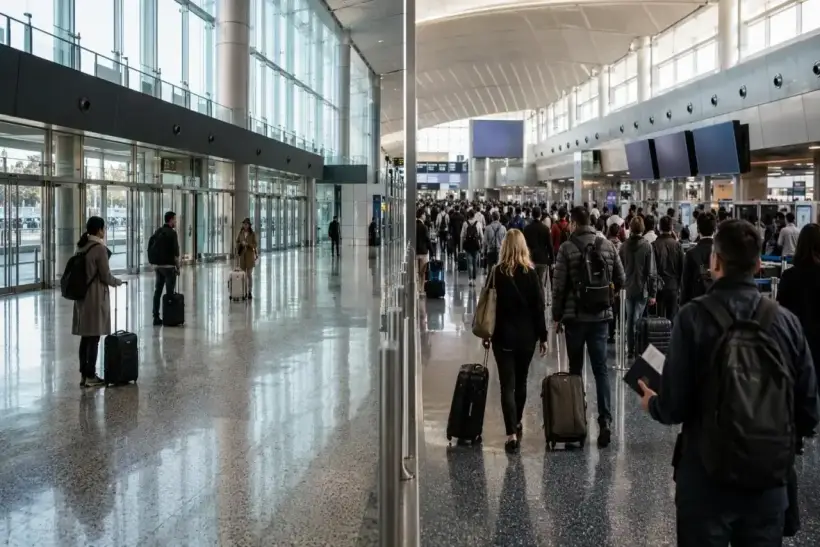
International arrivals to the United States fell 5.5% year over year in April 2026 to 5.65 million visitors, while outbound trips by U.S. citizens rose 2% to 8.52 million departures. The divergence adds pressure on hotels, airlines, retailers and destinations that depend on foreign visitors.
U.S. international arrivals declined in April 2026
Hotel News Resource, citing figures from the National Travel and Tourism Office, reported that the United States received 5,645,630 international visitors in April 2026, down 5.5% from a year earlier. The inbound figure covers non-U.S. residents arriving from abroad, including the neighboring markets of Mexico and Canada. Over the same period, U.S. citizen travel abroad increased to 8,518,078 departures, up 2% from April 2025.
The holiday calendar distorted the annual comparison. Easter fell on April 5 in 2026 and on April 20 in 2025. For travel demand, that shift matters because school breaks, family trips and short-haul travel often cluster around the holiday week, moving some activity between March and April.
Mexico and Canada remained the core inbound markets
Mexico was the largest source market for U.S. arrivals, with 1,665,114 visitors in April. Canada ranked second with 1,363,690 arrivals. The United Kingdom followed with 356,712, France with 161,811 and India with 156,279. Together, the five largest markets accounted for 66% of all international arrivals to the United States during the month.
The ranking changes when Canada and Mexico are excluded. In overseas travel, meaning countries outside those two neighboring markets, the United Kingdom led with 304,371 tourism arrivals, followed by France with 144,974, Brazil with 137,041, India with 113,191 and Japan with 106,134. The pattern shows that U.S. inbound recovery still relies on transatlantic routes, Asian demand and Latin America, even though the largest volumes remain concentrated in nearby markets.
Business travel and student flows show uneven demand
The United Kingdom also led overseas business travel to the United States, with 50,892 arrivals. India generated 38,107 business trips, Germany 25,805, Japan 24,022 and China 17,394. Business travel matters for large urban hotels, conference venues and airlines because it often carries a higher average spend than parts of the leisure segment.
China led overseas student arrivals with 8,230 entries. India followed with 4,981, South Korea with 1,862, the United Kingdom with 1,449 and Brazil with 1,390. These flows are important for university cities because student-related travel supports not only air traffic but also short-term accommodation, services, local retail and family visits.
Americans traveled abroad more often
U.S. citizens increased foreign travel in April from a year earlier. Mexico received 3,204,057 U.S. departures, equal to 37.6% of all outbound travel for the month. Canada posted a 6.5% year-over-year increase in U.S. visitors. North America, meaning Mexico and Canada combined, represented 50.2% of all U.S. international departures, while overseas destinations accounted for 49.8%.
Year to date, Mexico and the Caribbean together represented 53.4% of all U.S. citizen international departures, with 13,702,545 trips to Mexico and 3,947,662 to the Caribbean. Europe received 1,834,932 U.S. travelers in April, accounting for 21.5% of outbound travel; U.S. travel to Europe rose 5.2% from a year earlier.
The official forecast is positive, but recovery is uneven
The official outlook from the National Travel and Tourism Office, part of the U.S. Department of Commerce, projects international arrivals rising from 68.3 million in 2025 to 70.5 million in 2026, 74.1 million in 2027, 78.7 million in 2028, 82.3 million in 2029 and 85.2 million in 2030. The 2026 forecast implies 3.2% growth, partly supported by the FIFA World Cup, which the United States will co-host with Canada and Mexico.
The agency separates two major blocks: neighboring markets, Canada and Mexico, and overseas markets. That distinction is important for hotel analysis because short cross-border and car-based trips affect lodging differently from long-haul travel from Europe, Asia or Latin America.
The top 12 inbound markets in the forecast are Canada, Mexico, France, Germany, Italy, the United Kingdom, China, India, Japan, South Korea, Australia and Brazil. These countries accounted for 77.2% of all international arrivals to the United States in 2025. Growth in 2026 is expected in 10 of the 12 markets; the exceptions are India, where arrivals are projected to contract 4.1%, and France, where arrivals are expected to decline 1% before recovering later.
Hotels face a demand mix problem
The U.S. Travel Association noted that total travel spending in the United States grew 4.5% year over year in April 2026, but part of that increase reflected higher prices rather than stronger physical demand. Air passenger volume was nearly flat, hotel demand growth slowed to 2%, and overseas arrivals fell 14.1%, partly because of the Easter calendar shift.
For hotels, the picture is uneven. Resort and suburban properties benefit from leisure and domestic travel, while hotels in business districts depend more heavily on international corporate travel, conferences and urban tourism. Inbound travel is especially important for upscale accommodation, restaurants, shopping districts and cultural venues, where foreign visitors often generate higher average spending.
The spring forecast from U.S. Travel puts total U.S. travel spending at $1.37 trillion in 2026 in inflation-adjusted 2025 dollars. Domestic travel accounts for 87% of that total, while international inbound spending is expected to rise 1.6% to $178 billion, still 18% below the 2019 level after inflation. The forecast does not expect inbound visit volume to return to the 2019 level of about 79 million visits until 2029.
April’s figures look less like a reversal and more like a warning signal for U.S. tourism. The long-term forecast still points upward, but current data show a weak point: the United States is not yet converting the global travel recovery into steady inbound growth. As International Investment experts report, the key risk is dependence on event-driven demand, including the FIFA World Cup, without a broader recovery in regular travel from Europe, Asia and Canada. If international visitors choose alternative destinations because of price, visa procedures, weak consumer confidence or perception issues, hotels and cities may face not a temporary dip but a structural loss of high-margin demand.