







 How Ukraine’s New-Build Housing Market Has Changed Over Four Years
 European Prime Rents Rise as Property Yields Turn Higher
 The Most Expensive Airlines in Europe in 2026
 Housing Prices in Italy Reach a Two-Year High
 Travellers Increasingly Choose Cooler Scandinavia
 Serbia Property Sales Decline as Transaction Value Rises
Albanian Capital Moves Into Property Abroad
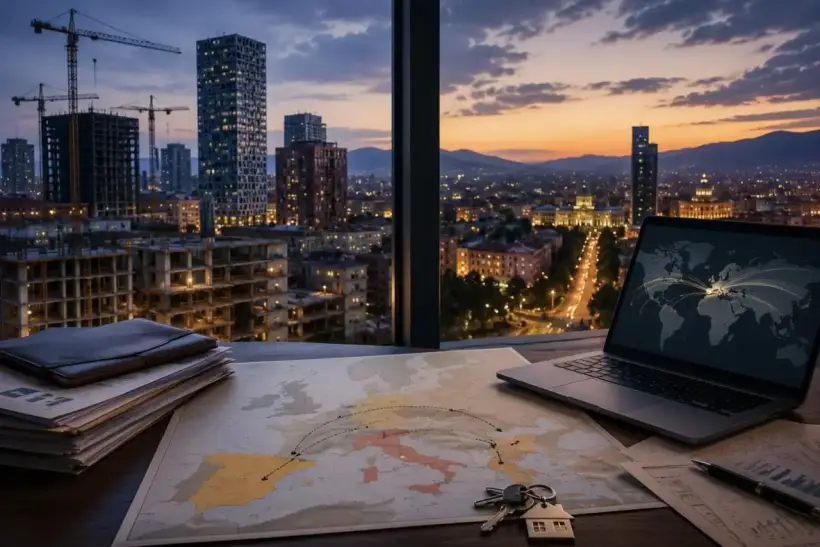
Albania is facing a new economic paradox: the country continues to attract record foreign investment, while a growing share of its own private capital is moving abroad, mostly into real estate. The trend reflects not only the rise of private wealth, but also weak confidence in the domestic investment environment.
Capital outflow becomes a structural trend
Albania’s economy is entering a new phase of international integration. The country was long viewed mainly as a recipient of foreign capital. Now another flow is becoming visible: Albanian residents are buying assets abroad. In formal terms, that can look like business maturity, as companies and wealthy families accumulate capital and expand beyond the domestic market.
The structure of the flows makes the picture less optimistic. ALTAX says Albanian investment abroad is increasingly moving not into production networks, technology, export platforms or industrial companies, but into real estate in jurisdictions with stronger legal protection. Italy, Greece and Spain are among the destinations with migration, family, business and financial links to Albania.
This cannot be explained only by portfolio diversification. It shows that part of the wealth created inside Albania is being stored in foreign apartments, houses and commercial properties. For the domestic economy, that means lost potential investment, jobs and tax capacity.
The numbers show rapid acceleration
According to ALTAX Observatory, Albania’s outward direct investment rose from near-symbolic levels to €241 million in 2024 and €302 million in 2025. Outward direct investment means long-term investment by residents in foreign companies or assets, usually involving control or significant influence.
Foreign real estate increased particularly sharply. ALTAX says the stock of property owned abroad by Albanian residents rose from €6.5 million in 2022 to €766.5 million in 2023. Even if part of the jump reflects better statistical recording, the scale shows that this is no longer a set of isolated purchases but a meaningful financial flow.
UNCTAD shows a similar picture under international methodology. In 2024, Albania’s outward direct investment stood at $261 million, while the outward stock reached $1.634 billion. Inward foreign direct investment remained much larger, at $1.716 billion in 2024 and $15.339 billion in stock. Albania therefore remains a net recipient of capital, but the gap between inflows and outflows is becoming more important.
Real estate becomes the main route
The defining feature of the current cycle is the concentration of capital in real estate. Albanian money is moving into foreign apartments, houses and commercial properties, while foreign capital inside Albania is also heavily active in construction, tourism and property.
This creates a mirror structure. Foreign investors buy land, build resorts, housing complexes and hotels in Albania. Albanian capital owners move part of their money into European Union and regional real estate. On paper, the economy becomes more active, but the productive base does not necessarily become stronger.
That differs from classic international business expansion. When a company opens a factory, logistics network, technology office or export channel abroad, it can bring knowledge, contracts and profits back to the home country. When capital moves mainly into property, it more often functions as wealth protection than development.
Why money is leaving Albania
The causes are not limited to returns on foreign property. For wealthy Albanians, buying assets in Italy, Greece or Spain means clearer property rights, more predictable courts, stable banking services, access to European infrastructure and capital preservation in jurisdictions with stronger institutions.
Albania’s domestic market remains limited in scale. It has a small consumer base, shallow financial instruments and limited options for large long-term investment outside real estate, trade and services. For an entrepreneur who has already accumulated capital, buying property in Milan, Athens or Valencia can look more rational than financing an industrial project at home.
Competition problems, informality, court quality and administrative risks add to the pressure. When businesses are not sure that rules apply equally to everyone, they look not for the highest return but for the safest place to keep capital.
The country builds more but does not necessarily produce more
Albania’s paradox is that foreign investment keeps growing, but its structure does not always create the foundation for long-term productivity gains. A large share of inflows is linked to real estate, construction, tourism, energy and reinvested earnings from existing companies.
Reinvested earnings mean a foreign company does not take profits out but keeps them in the country to maintain or expand operations. That is useful, but it is not always the same as new high-value productive projects. If much of the inflow is concentrated in land and construction-related assets, economic growth may look strong while remaining vulnerable.
The central risk is the creation of an asset economy rather than a productivity economy. Land, housing and tourism assets become more expensive, but wages, exports, technology and industrial depth grow more slowly. The country becomes costlier without necessarily becoming more competitive.
Money-laundering risk raises the stakes
ALTAX also points to questions about the origin of some funds. Construction and real estate in the Western Balkans have long been viewed as sectors with elevated exposure to money laundering. Money laundering is the process of giving a legal appearance to proceeds from illegal sources.
If capital is first parked in Albanian property and then transferred into foreign assets with stronger legal protection, a “park and exit” model can emerge. The domestic market is used to create or legalise wealth, while the final store of value sits outside the country.
That does not mean all foreign purchases by Albanian residents are suspicious. But the scale of growth makes stricter checks necessary, including beneficial ownership transparency, source-of-funds verification and information exchange with foreign property registries.
The tax base and jobs are affected
When capital leaves, the country loses more than money. It loses future projects, jobs, taxes, innovation and management capacity. If an entrepreneur buys income property abroad instead of building a business in Albania, the domestic market gets fewer opportunities for wage growth and exports.
The tax effect is more complex than it appears. Buying foreign property is not automatically illegal. But if income from those assets is poorly declared, ownership is held through opaque structures or tax residents fail to disclose foreign assets, the state loses fiscal control.
For an economy with a limited tax base, this matters. Albania needs funding for infrastructure, education, healthcare, courts, digitalisation and skills. If the most mobile capital leaves, it becomes harder to finance the reforms that could keep that capital at home.
Capital outflow follows migration routes
Capital often moves along the same routes as people. Albania has a large diaspora in Italy, Greece, Germany, Switzerland, the United Kingdom and the United States. Family ties, migration experience and knowledge of local markets make foreign property purchases easier.
For wealthy families, foreign real estate can serve several purposes at once: capital preservation, housing for children studying abroad, a relocation option, investment income and access to a European lifestyle. This strengthens the link between demographic outflow and financial outflow.
For Albania, the problem is that the country may lose young workers, entrepreneurial energy and private capital at the same time. If those processes run in parallel, headline growth can remain positive while long-term development potential weakens.
Inflows do not offset the quality of outflows
At first glance, record foreign investment should offset the problem. Albania receives foreign capital, builds tourism infrastructure, modernises some sectors and attracts international attention. But the quality of capital matters as much as its volume.
If foreign investment enters construction and real estate, while domestic capital leaves for foreign property, the country gets asset turnover rather than technological upgrading. Sustainable development requires investment in industry, export services, food processing, information technology, renewable energy and professional education.
That is why the issue is not how to ban capital outflow administratively. Bans would only reduce confidence. The real question is how to make domestic investment reliable and profitable enough for capital to stay voluntarily.
What economic policy needs to do
The first priority is strengthening the legal environment. Investors need confidence that property is protected, courts are predictable, contracts are enforced and competition is not distorted by political connections. Without that, tax incentives alone will not keep capital at home.
The second priority is transparency. Albania needs stronger beneficial ownership controls, meaning clearer disclosure of the real owners of companies and assets. Real estate transactions above certain thresholds should involve source-of-funds checks, especially when money moves through complex corporate structures.
The third priority is creating domestic investment alternatives. If the country lacks a developed capital market, venture finance, project finance, industrial parks and reliable public-private partnership mechanisms, real estate will remain the most familiar asset. That keeps the economy in a narrow lane.
European integration will test confidence
Albania is seeking European Union membership, and capital outflow shows which reforms matter in practice. For entrepreneurs, European integration is not only a political process but an expectation of stronger institutions, clearer rules, independent courts and market access.
If closer EU alignment brings real improvement in the legal environment, some capital may return to productive projects at home. If integration remains formal, wealthy residents will continue buying assets where property protection already works.
In that sense, capital outflow is a confidence barometer. It shows where economic elites see their future: inside Albania or outside it.
What comes next
ALTAX projects that without reforms, outward direct investment could keep rising and reach €443 million by 2030 in a baseline scenario, or nearly €607 million in a more negative scenario. Such levels would not destroy the economy by themselves, but they could deepen structural weakness if capital keeps moving from productive sectors into foreign assets.
For banks, developers and investors, this changes the risk model. Albania’s real estate market may remain active, but it could become more dependent on external capital, tourism demand and large projects. Domestic private capital, meanwhile, may keep looking for safety elsewhere.
For the state, the challenge is not to stop capital from moving, but to change its motivation. In an open economy, money will move to places where it is better protected and more productive. The answer must therefore be institutions, competition and real profit opportunities at home, not barriers.
As experts at International Investment report, Albania’s capital outflow cannot be treated as ordinary diversification by wealthy families. In its current structure, it looks like a vote with money against the quality of the domestic investment environment. If Albania keeps attracting foreign capital into real estate while losing its own capital to foreign assets, the country risks building more properties without creating a more productive economy.