













Google Builds Austria Data Center
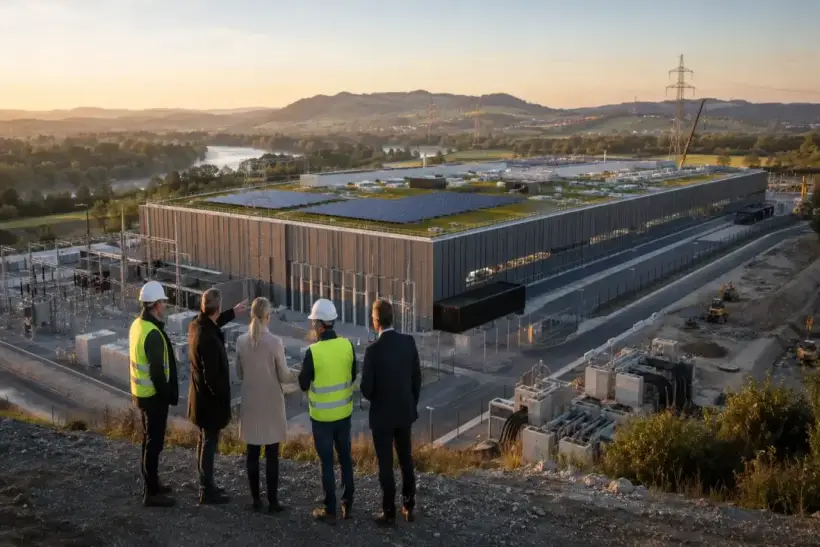
Google has started construction of its first owned data center in Austria, choosing Kronstorf in Upper Austria to expand European infrastructure for cloud services and artificial intelligence. The project is expected to create 100 direct jobs and strengthen the region’s digital profile, while also raising questions over power demand, water use and grid capacity.
Google starts its first Austrian data center
CEE Real Estate Matters reported that Google has broken ground on its first data center in Austria. The company’s official announcement was made on April 23, 2026: the facility is being built in Kronstorf, a municipality in Upper Austria, to meet growing demand for Google’s digital services and artificial-intelligence capabilities.
Google says the site will become part of its broader European infrastructure supporting Search, YouTube, Maps, Workspace and artificial-intelligence tools. For Austria, this marks a shift from a local corporate presence to a major engineering asset tied to data storage, computing capacity and business access to cloud platforms.
Kronstorf waited almost two decades
The Kronstorf project has a long history. Data Center Dynamics reported that Google bought the site about 18 years ago and received planning permission earlier in 2026. The facility is set to span 42,000 square meters on a 70-hectare site, with 29,000 square meters used as data-center space.
Austria’s ORF said the official groundbreaking followed 18 years of planning and that the opening is scheduled for 2027. According to the broadcaster, Google Austria and Switzerland Managing Director Christine Antlanger-Winter did not disclose the construction cost, describing it as a significant investment.
Upper Austria bets on digital infrastructure
Upper Austrian authorities framed the project as a signal for the regional economy. The state government said the April 23 groundbreaking marked the start of construction of Google’s data center in Kronstorf, while Governor Thomas Stelzer linked the investment to job creation, stronger digital infrastructure and momentum for the region’s artificial-intelligence and innovation strategy.
Kronstorf’s municipality also emphasized the economic impact. Once completed, the facility is expected to create 100 direct jobs and thousands more indirect jobs through construction, suppliers and local businesses. For a small municipality, the project could reshape the local employment base and attract other companies if infrastructure and supplier networks develop around it.
Artificial intelligence needs new capacity
The Austrian build fits a broader trend: major technology companies are expanding data-center networks because cloud computing and artificial intelligence require more capacity. A data center is a specialized facility with servers, cooling systems, power supply and network connections used to store and process data for users, companies and applications.
For Google, the new site is not just local infrastructure. The closer computing capacity is to users and businesses, the lower data-transmission latency can be and the more reliable services can become. For Austrian companies, that may matter when using cloud platforms, enterprise applications and artificial-intelligence systems where speed and data protection are becoming competitive factors.
Waste heat is part of the design
The environmental component is central to the official announcement. Google says the site will be ready for off-site heat recovery. Once an offtaker is identified, heat can be provided free of charge to eligible partners to help decarbonize local heating sources.
The facility will also feature a green roof with solar panels. According to the company, those panels will contribute clean energy directly to help power the data center. That does not remove the project’s high energy intensity, but it shows that technology companies are now expected to integrate energy-management features into data-center design.
Water becomes a reputational issue
Google has also announced a fund to improve the water ecosystem of the local Enns River together with the Upper Austrian Fisheries Association. The company links the initiative to its broader goal of replenishing more freshwater than it consumes by 2030.
For data centers, water is becoming as sensitive as electricity. Some facilities use water for cooling, and public scrutiny increases when projects are built near towns or natural resources. The Enns River fund therefore looks less like a decorative measure than part of the social license required for a large technology facility.
Power demand is the central concern
The most sensitive issue for Kronstorf is electricity consumption. ORF, citing Austrian Power Grid, reported that Google’s future data center will consume significantly more electricity than all private households in Upper Austria, with annual use estimated as comparable to about 900,000 private households, compared with fewer than 676,000 households in the region.
The same report said a new 220-kilovolt supply ring and substation upgrades between Ernsthofen and Kronstorf will be needed to handle the load. Austrian Power Grid chief Gerhard Christiner said the site would begin with a major first phase and could require much higher capacity if the campus expands.
The project had a difficult start
The construction start was not entirely smooth. ORF reported that after a financial-police inspection in March, authorities found violations linked to social-insurance rules, trade law and wage-and-social-dumping legislation; Google temporarily stopped work and later said the issues involved subcontractors and that compliance agreements had been negotiated to prevent recurrence.
For a technology group, that is an important reputational issue. A data center may be presented as future infrastructure, but it is built through ordinary contractor chains where labor law, subcontractor control and transparency can matter as much as server efficiency.
Austria enters Europe’s data-center map
The new facility strengthens Central Europe’s role in cloud infrastructure. Europe’s largest data-center hubs have traditionally clustered around Frankfurt, London, Amsterdam, Paris and Dublin. Expansion into Austria shows that demand for computing capacity is moving beyond the established hubs as companies seek sites with industrial capacity, network access, power availability and political stability.
For real estate, this is a separate signal. Data centers are becoming a distinct class of infrastructure property. They require large land plots, high-capacity grid access, cooling systems, redundancy and long-term relations with local authorities. Kronstorf shows how the digital economy is changing land demand outside traditional capital-city office markets.
Training is built into the project
Google announced a multi-year collaboration with the University of Applied Sciences Upper Austria focused on artificial-intelligence curricula and certifications. The company also said it has previously trained more than 140,000 Austrians in digital skills.
That matters because a data center does not create mass employment after construction. The 100 direct jobs are meaningful but not large for an entire state. The broader economic effect will depend on whether the facility helps build training programs, contractors, engineering suppliers and companies that use cloud infrastructure in their own products.
Regional competition is intensifying
Austria is gaining an asset that could anchor a wider digital-infrastructure ecosystem. But competition between European regions for data centers is becoming more complex: governments want jobs, tax revenue and technology status, while residents and grid operators ask about electricity, land, water and the real local benefit.
Kronstorf captures that balance. It is Google’s first data center in Austria, with new jobs, training initiatives and potential heat reuse. It is also a power-intensive project that requires grid investment and will only deliver broader regional value if it becomes part of a local technology cluster rather than a closed server campus.
Google is putting Austria on Europe’s artificial-intelligence infrastructure map, but that status comes with costs. As International Investment experts report, the main risk is that regions often judge data centers by symbolic value and promised jobs, while their real effectiveness depends on grid resilience, contractor transparency, heat reuse, water impact and whether a local technology economy grows around the facility.
FAQ on Google’s Austria data center
Where is Google building its first Austrian data center
Google is building the facility in Kronstorf, Upper Austria. It is the company’s first owned data center in the country and part of its European infrastructure for cloud services and artificial intelligence.
When did construction start
The official groundbreaking took place on April 23, 2026. Local media reported that the facility is scheduled to open in 2027.
How many jobs will the data center create
Once completed, the facility is expected to create 100 direct jobs. Additional indirect employment is expected through construction, suppliers and local businesses.
Why does a data center matter for artificial intelligence
Artificial intelligence requires large computing capacity, servers, data storage and reliable network connections. Data centers process requests, support model deployment and power cloud-based services.
What sustainability measures have been announced
Google says the facility will be ready for waste-heat recovery, will include a green roof with solar panels and will support a fund to improve the Enns River ecosystem. The company also has a goal to replenish more freshwater than it consumes by 2030.
Why is the project controversial
The main concern is electricity demand. Estimates cited by local media suggest the facility may consume more electricity than all private households in Upper Austria, requiring new grid capacity and upgraded energy infrastructure.