







 Vietnam Mortgage Surge Pushes Homes Out of Reach
 Lithuanian Apartment Prices Accelerate Across Major Cities
 London Flats Lose Value Ahead of Leasehold Reform
 Construction of the Batumi–Sarpi Highway Begins in Georgia
 Baltic Property Investment Accelerates in 2026
 Hong Kong and Singapore Renew Their Expat Rivalry
UK imposes visa brake on four countries
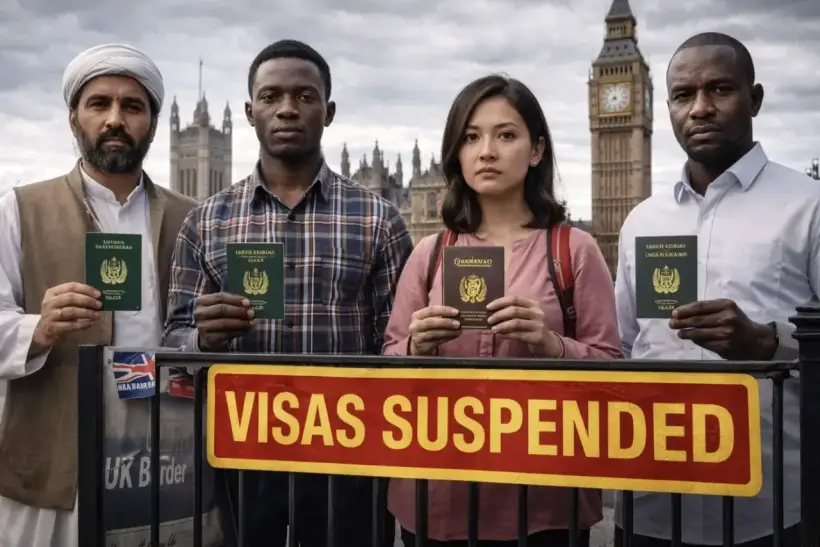
The UK has imposed an emergency visa brake for the first time, suspending selected visa routes for nationals of Afghanistan, Cameroon, Myanmar and Sudan after a sharp rise in asylum claims from people who entered through legal channels. The move is part of a broader tightening of migration policy and took effect on March 26, 2026.
What the UK government announced
According to the Home Office, the government has ended sponsored student visas for main applicants from Afghanistan, Cameroon, Myanmar and Sudan. For Afghan nationals, the Skilled Worker route has also been suspended. In a written ministerial statement, the government said the brake does not apply to applications made before March 26, 2026, and described the measure as temporary and subject to regular review.
The government has presented the step as the first use of an “emergency brake” on visas. In official language, it is framed as a response to abuse of legal entry routes by people who arrive on visas and then move into the asylum system by making protection claims after arrival.
Why London tightened visa rules
The Home Office linked the decision to a steep rise in asylum claims from legal routes. By the year ending September 2025, asylum applications by students from Afghanistan, Cameroon, Myanmar and Sudan had risen to more than 470% of their 2021 level, according to the official announcement. For Afghans, the issue was even more politically sensitive, with the number of Afghan skilled workers claiming asylum said to be higher than the number of work visas being issued.
In parliament, the home secretary also said these four nationalities showed some of the highest ratios of asylum claims to visas issued. The written statement added that, as of September 2025, 15,906 nationals from those countries were receiving Home Office support, including 6,412 people being housed in hotels.
The scale of the pressure cited by the government
The official government release said asylum claims made by people who had arrived through legal routes have more than trebled since 2021 and accounted for 39% of the roughly 100,000 people who applied last year. Over the past five years, 133,760 people have claimed asylum after entering the UK legally, according to the Home Office.
The same release said asylum support is costing more than £4 billion a year. It also stated that nearly 16,000 nationals from the four visa-brake countries are currently supported at public expense, with more than 6,000 of them in hotels. GOV.UK later updated the wording of two statistics for clarity while saying the underlying figures had not changed.
How the measure fits into broader migration reform
The visa brake forms part of the government’s wider Restoring Order and Control package. At the same time, the UK reduced refugee and humanitarian protection leave from five years to 30 months for new adult and family cases, while exempting unaccompanied children. It also imposed visit visa requirements on nationals of Nicaragua and Saint Lucia, citing border and migration concerns.
In a March 5 speech, Home Secretary Shabana Mahmood directly tied the policy to a broader attempt to tighten legal migration and asylum controls. She said she was suspending certain visa routes for Afghanistan, Cameroon, Myanmar and Sudan, where abuse had become unacceptably high in the government’s view.
Why the move is drawing close attention
What makes the decision notable is not only the countries involved but the precision of the instrument. This is not a blanket entry ban. It is a targeted suspension of specific legal routes, mainly sponsored study visas and part of the skilled work channel. That allows the government to project a hard line while still formally preserving other paths, including humanitarian mechanisms and individual asylum procedures.
At the same time, London continues to stress that the UK remains committed to refugee protection. The Home Office said Britain has offered sanctuary to more than 37,000 Afghans through two resettlement schemes since 2021, and that 190,000 visas were granted on humanitarian routes in 2025.
What the visa brake means for students and workers
For new main applicants from Afghanistan, Cameroon, Myanmar and Sudan, the student route is now effectively closed if the application is made after the measure took effect. For Afghans, the restriction is broader because it also covers Skilled Worker visas. For universities and employers, that narrows recruitment options from specific countries. For applicants, it sharply increases uncertainty and raises the importance of alternative humanitarian or protection-based routes.
As International Investment experts report, London’s decision shows the UK is increasingly linking visa policy not only to labor market needs and education exports, but also to pressure on the asylum system. For students, migration advisers, employers and investors, the message is that even legal entry routes can now be rapidly recalibrated by country of origin if the government sees them as a source of secondary pressure on public finances and border management.
FAQ on the UK visa brake
What is the UK visa brake?
It is an emergency mechanism under which the government temporarily suspends selected visa routes for nationals of specific countries because of migration and border-security concerns. The UK first used it in March 2026.
Which countries are affected?
Afghanistan, Cameroon, Myanmar and Sudan. Sponsored student visas for main applicants are suspended for all four, and Skilled Worker visas are also suspended for Afghan nationals.
When did the new restrictions take effect?
The visa brake came into force on March 26, 2026. Applications submitted before that date are not covered by the change.
Why did the UK impose the measure?
The government says it is responding to a sharp increase in asylum claims made by people who entered through legal visa routes and to the financial pressure on the asylum support system.
Is this a permanent visa ban?
No. Official documents say the measure is not intended to be permanent and will be kept under regular review.