







 Germans Seek Temporary Asylum in Russia
 Alta Banka Collapse in Serbia: What Happens to Russian Depositors' Money
 Covivio Hotels Revenue Grows 4.7% as European Markets Split
 Lithuanian Apartment Prices Accelerate Across Major Cities
 Georgia's Tourism Revenue Hits Record High
 Norway's Sovereign Fund Commits €1.5bn to European Warehouses
UK Hotel Taxes Reshape Premier Inn Investment Plans
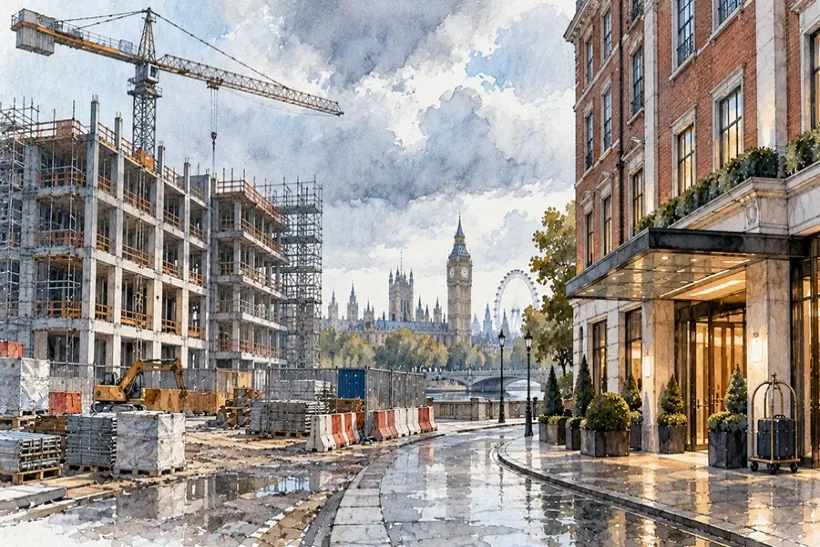
Higher property taxes are already changing hotel development decisions in the United Kingdom. Premier Inn owner Whitbread has withdrawn from some sites in its development pipeline where returns no longer meet its investment requirements. The group has also reduced planned gross capital expenditure by £1 billion over five years. That figure applies to the entire investment programme, not a disclosed value of cancelled hotel construction. The company continues to add rooms through existing properties and hotel acquisitions.
The shift turns what was initially a warning about tax policy into an observed change in capital allocation. Premier Inn's demand has remained resilient, but the economics of building additional hotels have become more selective.
Whitbread drops some planned hotel sites
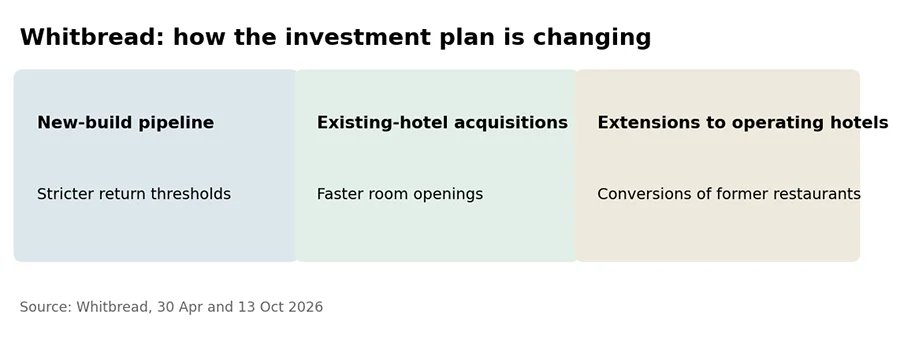
In April Whitbread completed its business review and confirmed it was stepping away from development sites where the UK business rates changes had made potential returns unattractive. It also outlined the exit of approximately 1,500 lower-returning rooms in its operating portfolio. Abandoning a prospective new location is different from closing an existing hotel.
The company did not publish a complete list or a value for the rejected sites, so naming specific cancelled hotels would be unsupported. In its October results, Whitbread retained an investment hurdle of at least 15% for new expansion capital across the UK, Ireland and Germany. This is a corporate investment benchmark, not an expected return offered to private property investors.
A £1 billion cut to capital spending is not a cancellation bill
Whitbread intends to reduce gross capital expenditure by approximately £1 billion compared with its previous five-year plan, and net capex by more than £1 billion. The change covers its broader portfolio, including property transactions, development, conversion and international operations. It should not be reported as £1 billion of hotel construction already cancelled.
The group also aims to recycle £1.5 billion of freehold real estate to support growth. Over time it expects the freehold share of its property holdings to decline from about one half to a range of 30–40%, with more development funded through leases or existing assets. That reduces the capital tied up in property but adds future rent obligations.
|
Whitbread decision |
Scale |
Meaning |
|
Rejecting pipeline sites |
Number undisclosed |
Returns below investment hurdle |
|
Lower planned capex |
£1bn |
Whole-group five-year revision |
|
Property recycling |
£1.5bn |
Funding future growth |
|
Lower-return room exits |
≈1,500 rooms |
Existing hotel estate |
|
Acquire existing hotels |
292 rooms |
Bristol and Plymouth, Oct |
|
Hotel extension rooms |
≈750 rooms |
Current financial-year target |
Business rates add £110 million to the plan
Whitbread's five-year assumptions include around £110 million of additional business rates costs by FY31, compared with FY26. Commercial improvements and operating efficiencies may offset these costs, but the tax increase has already changed which development sites the company considers viable.
Business rates are a recurring property charge calculated mainly from a property's rateable value and an applicable multiplier, subject to reliefs and transitional rules. These costs affect a new hotel's investment model before building starts.
The 2026/27 multipliers frequently quoted in the debate apply to England, not the entire United Kingdom. For qualifying retail, hospitality and leisure premises, the multiplier is 38.2p per £1 of rateable value below £51,000, or 43p for valuations from £51,000 up to £499,999. Properties with rateable values of £500,000 or more fall under a 50.8p multiplier regardless of sector. Scotland, Wales and Northern Ireland operate separate rating systems.
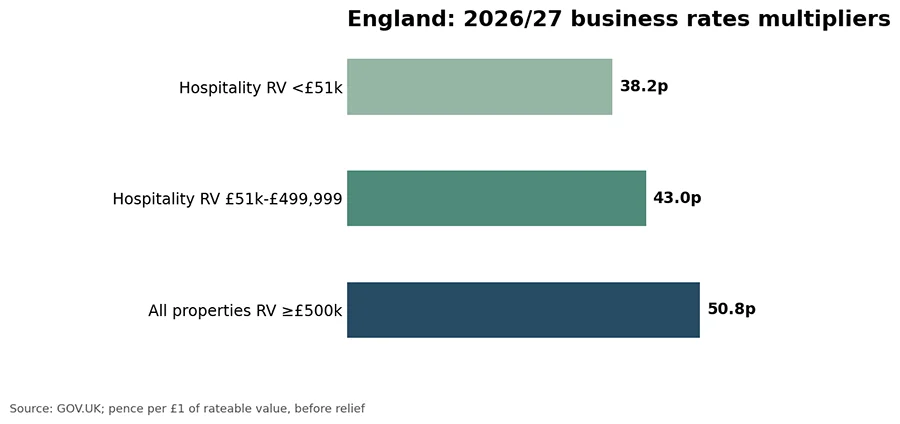
A lower sector multiplier does not automatically reduce a hotel's bill. Revaluation, the expiry of earlier relief and transitional adjustments can outweigh the headline rate cut, particularly at expensive sites. Hotels were also excluded from a separate additional relief package directed at pubs and live music venues, although eligible hotels can still benefit from the general hospitality multipliers.
Revenue rises while profits decline
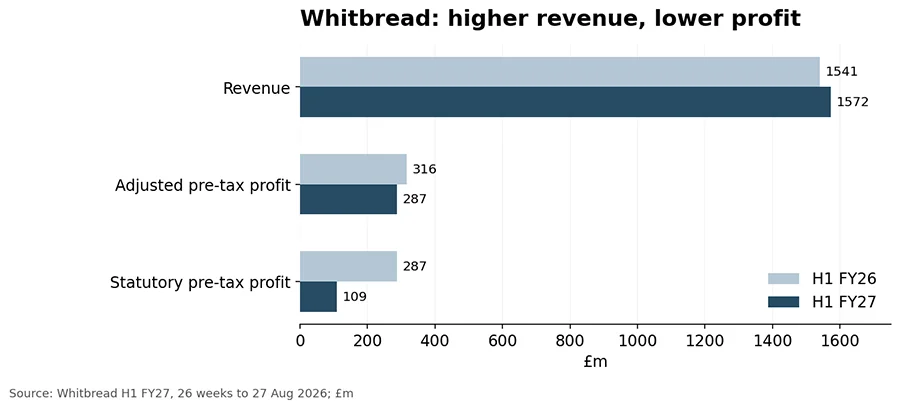
Whitbread reported statutory group revenue of £1.572 billion for the 26 weeks to 27 August 2026, up 2% year on year. Adjusted pre-tax profit declined 9% to £287 million. Statutory pre-tax profit fell 62% from £287 million to £109 million, but the latter includes £178 million in adjusting charges, primarily non-cash impairments associated with the strategic review. The statutory decline must not be attributed to business rates alone.
Within the UK and Ireland, accommodation sales grew around 3%, RevPAR by 2.1%, and occupancy remained close to 81%. Guests are still buying rooms. Rising property taxes, staffing costs, lease interest and depreciation nonetheless reduce the scope for turning higher sales into stronger earnings.
RevPAR is room revenue per available room, not hotel profit. A project can meet occupancy forecasts yet fail its required return once operating expenses, rent, finance and major refurbishment costs are accounted for.
Premier Inn continues opening rooms
At 27 August, Whitbread operated 842 hotels containing 86,724 rooms in the UK and Ireland, with a committed pipeline of 8,075 new rooms and a further 1,269 committed extension rooms. It still aims to reach approximately 96,000 rooms by FY31.
The company is also converting space previously used by branded restaurants. It shut its remaining 197 branded restaurants in September, while retaining a more integrated food service for hotel guests. The programme delivered 211 extension rooms in the first half, with around 750 planned for the financial year. Closing a separately branded restaurant does not automatically mean closing the adjoining hotel.
On 1 October Whitbread announced the acquisition of two trading Future Inns hotels in Bristol and Plymouth, with a combined 292 rooms. Some rooms are expected to reopen as Premier Inn in November. This illustrates why converting existing buildings can be attractive compared with funding a new build from the ground up.
The January warning is now an investment decision
International Investment's original January report covered the anticipated effect of the business rates reform on hotels, restaurants and cafés. Industry bodies warned of rising bills, closures and job losses, while companies sought additional support. By October, Whitbread had explicitly removed lower-returning projects from its development plans.
That is stronger evidence than an industry forecast, but it does not establish a nationwide cancellation of new hotel construction. The relevant distinction is between a confirmed decision by one major operator and the wider impact that would need to be measured across planning permissions, starts and openings.
Independent hotels have less room to adapt
A large group can sell property, switch to leasehold, invest in a different location or transfer funds between national markets. An independent hotel depends more heavily on the performance of a single building, making property taxes, debt and wages harder to absorb.
Travelodge offers a separate illustration of pressure on budget hospitality. Its weaker credit rating has sharpened attention on rent, financial leverage and financing costs. This does not prove the same cancellation decisions as Whitbread, but it reinforces the importance of protecting cash flow.
The implications for property investors
Owners and lenders need to model business rates after revaluation, lease escalations, staffing costs, room demand, capex and financing. High occupancy does not automatically support a new hotel's purchase price or construction budget. A potential sale-and-leaseback also changes who owns the property without removing the operating risks of the hotel business.
European hotel transactions have become more concentrated in higher-quality assets even as the number of properties sold has declined. Whitbread adds a distinct British consideration: local property-tax costs can make new construction less attractive while acquisitions and conversions remain viable.
The development decision happens before a hotel opens
Whitbread is still expanding, but it is allocating less capital to projects that fall short of its required returns. The £1 billion planned capex reduction should be understood as a group strategy, not a published bill for abandoned hotels. What matters for the wider market is that a higher property-tax forecast can remove a project from the pipeline before construction begins.
Whether this eventually reduces hotel supply across Britain will depend on decisions by other operators and developers, financing costs and local demand. For an investor, the immediate lesson is clearer: projected room sales are no longer enough without a robust model of taxes and operating profit.
FAQ
Which Premier Inn projects have been cancelled?
Whitbread confirmed that it had stepped away from some pipeline sites but did not identify or price the full list. Claims about specific cancelled hotels would require separate evidence.
How much is Whitbread cutting hotel investment?
Its previous group-wide plan has been reduced by about £1 billion in gross capex and more than £1 billion in net capex. This is not the cost of cancelled hotel projects alone.
How much extra will Whitbread pay in business rates?
Its plan assumes approximately £110 million in additional business rates costs by FY31 relative to FY26.
What are the hotel business rates multipliers in England?
Qualifying hospitality premises below £500,000 in rateable value use 38.2p or 43p multipliers, depending on the valuation band. Properties at £500,000 and above use 50.8p before reliefs.
Why did Whitbread's profit fall?
Adjusted pre-tax profit declined 9%. Statutory profit fell 62%, in part because of major impairment and other adjusting charges, not simply higher property taxes.
Is Premier Inn still growing its network?
Yes. It has a committed development pipeline, adds extension rooms and acquires existing hotels for conversion.
What should hotel property investors examine?
Future business rates, operating costs, lease terms, renovation needs, demand by season, debt service and returns after all expenses.