











Iran Launches Economic War
Banks and Financial Centers in the Persian Gulf Face Threats
The military confrontation between Iran, the United States, and Israel is gradually turning into a battle for economic leverage. Instead of engaging directly with militarily superior opponents, Tehran has begun targeting the infrastructure on which the modern global economy is built—data centers, airports, seaports, financial districts, and banks, writes The Washington Post.
From Military Bases to Data Centers
In response to U.S. and Israeli military actions that began on February 28, Iran chose targets symbolizing the prosperity and openness of the globalized world. Among the first objects of retaliation were not military bases but Amazon data centers in the United Arab Emirates and Bahrain—visible symbols of these monarchies’ technological ambitions.
The geography and nature of the targets expanded rapidly. The UAE Ministry of Defense reported that since the start of the escalation, Iran has launched 1,600 drones, 15 cruise missiles, and 294 ballistic missiles. Key elements of regional infrastructure forming the backbone of the global economy were hit. Dubai International Airport, one of the world’s busiest, as well as the Jebel Ali port area, the region’s largest container hub, were affected, with cargo movements temporarily halted due to debris from intercepted missiles.
The most symbolic strike hit the Dubai International Financial Centre (DIFC), home to offices of Goldman Sachs and other global banks, as well as the Ritz-Carlton hotel. According to official reports, the damage was minor, but the very fact that the “sacred heart” of regional finance was vulnerable sent a strong signal to the market.
Escalation of War on Banks
Threats and Evacuations
On March 11, 2026, Iranian officials announced impending attacks on banks linked to the U.S. and Israel. Residents of Persian Gulf countries were advised to stay at least 1,000 meters away from banks. The statement followed an attack on an administrative building belonging to Bank Sepah, one of Iran’s largest state-owned banks, which has ties to the country’s armed forces, according to Reuters.
The next day, Citibank temporarily closed most of its branches and financial centers in the UAE. Employees were moved to remote work. In Dubai, staff were evacuated, including offices at the Dubai International Financial Centre (DIFC) and the Oud Metha district, while client services continued online. Other major regional banks also increased security measures and limited staff presence in offices.
Drone Attacks
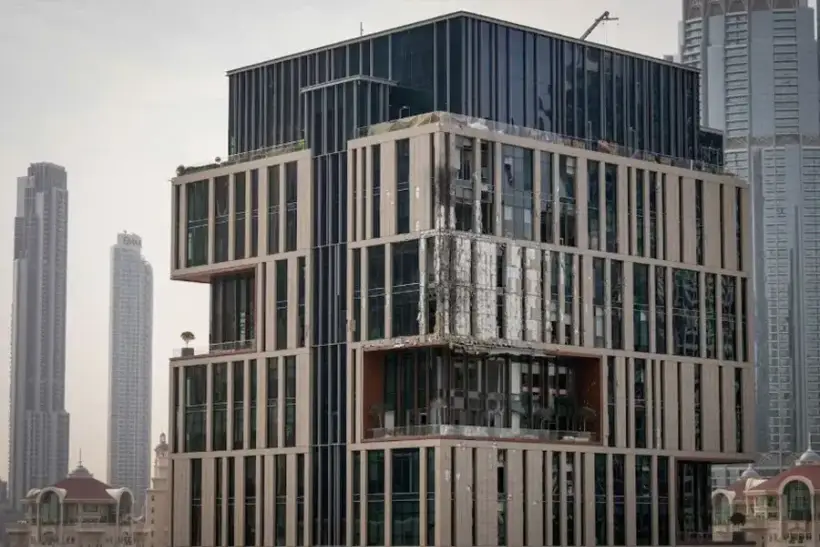
On March 13, debris from a downed Iranian drone landed in the Dubai financial district, damaging the facade of one building. On the morning of March 14, Iranian agencies Tasnim and Press TV reported drone strikes on Citibank offices in Dubai and Manama. Press TV posted a video, clarifying that the footage had been taken several days earlier. There was no official confirmation from Citibank or authorities in the UAE and Bahrain.
New Warnings
On the evening of March 14, a spokesperson for Iran’s Islamic Revolutionary Guard Corps (IRGC), Brigadier General Ali Naeini, confirmed that the attacks on American bank branches were carried out by Iran. He warned that if the opponent launched new strikes against Iranian financial institutions, all American bank branches operating in the region would be considered legitimate targets.
Citibank announced that most of its UAE branches would remain closed due to ongoing threats, with only one branch (Mall of the Emirates, Dubai) operating in a limited capacity.
The Collapse of the “Risk Premium”: How Perceptions of the Gulf Are Changing
For international business, the situation represents a fundamental shift. Richard Nephew, a former U.S. diplomat and now expert at Columbia University’s Center on Global Energy Policy, notes that the Gulf’s main implicit advantage—the absence of risk—is collapsing. “The risk premium for doing business in the Gulf was always considered practically zero. Now it has changed,” he says.
For decades, Dubai and other Emirates built their appeal on absolute security, low taxes, and minimal regulation, attracting large corporations and wealthy expatriates. Mohamed Bahaa, Managing Director at APCO for the Middle East, living in Dubai, describes this lost paradise: “We go out, leave doors open, keys in the car. You don’t even have to worry about your property.” That sense of ease is disappearing.
Financial markets, previously riding a wave of AI-driven optimism and largely ignoring geopolitical risks, are now forced to reassess the situation urgently. Fabio Natalucci, head of the Andersen Institute for Finance and Economics in Washington, emphasizes that the risks were higher than anyone anticipated, and investors are now scrambling to gauge how long this instability will last.
Business Response: Remote Work, Capital Flight, and Safe Havens
The corporate sector has already begun adapting to the new reality. Banks such as Citibank and Standard Chartered instructed employees in Dubai to work remotely. Dean Chen, CEO of CSOP Asset Management, stated that some investors are considering moving assets from the Middle East to Hong Kong.
So far, there has been no mass exodus. Reza Baqir, head of sovereign advisory at Alvarez & Marsal, living in Dubai, acknowledges the situation is extremely challenging but intends to stay. He expects that after the conflict, UAE authorities will offer a “very aggressive set of incentives” to demonstrate that Dubai is open for business again. Nevertheless, his clients are already reviewing financial risks and exercising extreme caution in new deals.
Global Context: The End of the Era of Boundless Globalization
Iran’s attacks on civilian targets fit into a broader trend that has gained momentum since 2008: a reassessment of globalization. The COVID-19 pandemic, the war in Ukraine, and now direct conflict in a key global energy corridor are forcing corporations and states to re-prioritize. The era when companies built ultra-long supply chains in pursuit of efficiency is giving way to resilience strategies.
Demetrios Marantis, a former U.S. trade negotiator, notes that today, companies must account for the risk of unforeseen events across an expanding list of regions. “Businesses really need to pay attention to potential flash points because they’re already flashing,” he emphasizes.
Long-term consequences could be even more serious. Nephew believes that after the war, Gulf states, frustrated that the U.S. launched the campaign without proper consultation, will attempt to reduce dependence on Washington. This could create opportunities for European defense companies. The idea of a U.S.-led unipolar world guaranteeing the safety of trade routes is undergoing serious erosion.
Conclusion
Iran enters an economic war from a position of inherent weakness. Its development has been stifled by sanctions for decades, and its non-oil trade volume is incomparable to neighboring countries. Nevertheless, this is a real attempt to level the playing field and make adversaries pay a higher price for confrontation.
Monica Gorman, a former supply chain specialist in the Biden administration, believes Iran has undoubtedly found ways to inflict real pain. It remains unclear whether Gulf financial hubs can regain their aura of invulnerability or whether the world is entering an era in which economic centers become legitimate targets in the larger geopolitical game.
Analysts at International Investment note that the events are forcing investors and businesspeople to reassess investment directions. Among safe countries highlighted is Georgia, which has remained untouched by geopolitical shocks. The country’s economy is developing successfully, stability is maintained, all financial systems and airports operate normally, and new projects are being implemented.