







 Turkey Is Losing Its Cheap-Holiday Advantage
 Development Is Rewriting Southeast Asia’s Historic Districts
 How Ukraine’s New-Build Housing Market Has Changed Over Four Years
 European Prime Rents Rise as Property Yields Turn Higher
 The Most Expensive Airlines in Europe in 2026
 Housing Prices in Italy Reach a Two-Year High
Protests in Spain: Mallorca Pushes Back Against Mass Tourism
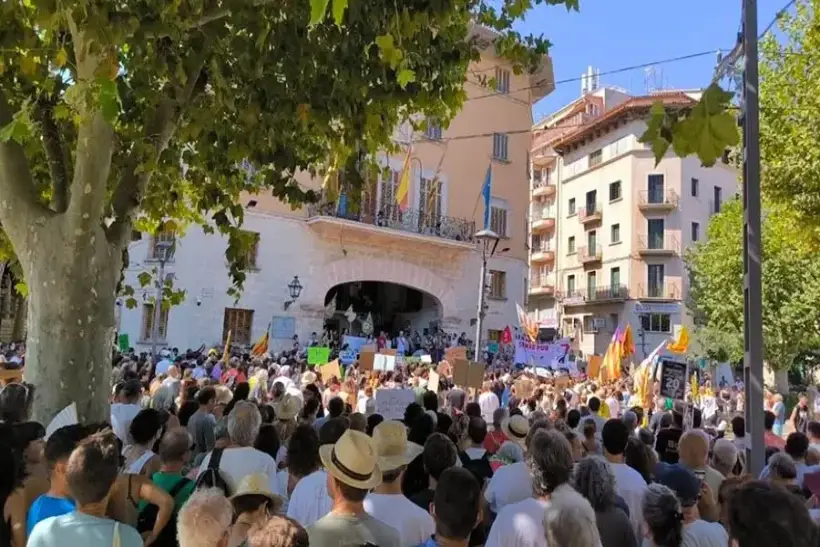
The Olive Press
In Sóller on Mallorca, the second major protest against overtourism this summer took place. Organisers said 2,500 people took part and described the demonstration as historic in scale. The Guardia Civil estimated the turnout at up to 1,500, The Olive Press reports.
What protesters in Sóller are demanding
The protest was organised by Moviment Jove de Soller (Sóller Youth Movement) and Menys Turisme, Més Vida (Less Tourism, More Life). More than 80 civic organisations supported the action. On August 8, protesters marched through Santa Teresa and Sa Lluna to Plaça de la Constitució, chanting “Qui estima Mallorca no la destrueix” — “Those who love Mallorca do not destroy it.” They also expressed solidarity with two women arrested in Santa Maria del Camí over graffiti on the offices of real estate agencies. Businesses in the town centre had to remove their outdoor terraces and market stalls for the day.
Activists Sofia Zamrik and Dani Comas said that living in the town is becoming increasingly difficult. Tourism has become “Sóller’s only economic bet”, they argued. They pointed to traffic congestion, the disappearance of local shops, growing pressure on natural resources and rising rents.
Representatives of Moviment Jove de Sóller told Ultima Hora that the main aim of the protest was to change an economic model in which business interests and tourism revenues take priority over residents’ well-being. They called for affordable housing, functioning public transport, the preservation of local businesses, protection of the territory, and the preservation of Sóller’s cultural and linguistic identity.
The organisers said they intend to continue the campaign across the Balearic Islands. They believe the protest movement should spread “to every neighbourhood and every village”.
Tourism in Sóller: development plan
In 2024, Sóller received more than 200,000 visitors, according to municipal authorities. This is equivalent to 14.4 tourists for every resident. Most visitors arrive between April and October, when tourists are joined by day-trippers from other parts of Mallorca. During this period, the number of visitors regularly exceeds the local population.
The authorities say the town is facing “structural pressure” on housing, infrastructure and public services. There are 75 tourist accommodation places for every 100 residents, one of the highest ratios in Mallorca.
To address the problem, the municipality has proposed a four-year development plan worth €38 million. It includes the modernisation of tourist accommodation, urban regeneration, as well as environmental and landscape projects.
Activists from Moviment Jove de Sóller say that for many years the authorities treated the growth in tourist numbers as an unquestionable benefit. At the same time, they argue, the social, environmental and territorial consequences of this growth were not sufficiently assessed. The protesters acknowledge that developing an alternative to the existing model is the responsibility of government authorities, relevant experts and municipal bodies. However, they say the necessary studies and proposals have existed for several years, while the political will to implement them has been lacking.
Protest in Palma
Earlier, on July 26, a protest against mass tourism was held in Palma. Organisers said 70,000 people took part, while police estimated the turnout at 25,000. The demonstration was larger than similar protests held in 2024 and 2025. Protesters called for a reduction in the scale of foreign visitor arrivals and demanded action over high property prices, declining quality of life and insecure employment with low wages.
The demonstration began at Plaça d’Espanya and proceeded along Via Roma, La Rambla, Carrer de la Unió, Passeig del Born and Carrer d’Antoni Maura. Tensions emerged at Ses Voltes when capacity restrictions prevented some demonstrators from entering the area. Police formed a cordon and subsequently used batons and rubber bullets. Objects were thrown at officers. Eight people received medical attention, two of whom were taken to hospital with minor injuries.
Protests against mass tourism in Spain have also previously taken place in Barcelona, San Sebastián, Málaga, Seville and the Canary Islands. Demonstrations have also been recorded in Toledo, Gijón, Pamplona and Segovia, according to EFE. Óscar Perelli, executive vice-president of Exceltur, notes that public discontent has become less pronounced in regions where the amount of tourist accommodation has declined.
Measures taken by Spanish authorities
Spain is regulating the tourism sector at national, regional and municipal levels. Following reforms to the legislation, decisions on allowing short-term rental properties in apartment buildings are now made by property owners.
Barcelona has increased its tourist tax, while from 2028 the city plans to eliminate short-term tourist rentals altogether. Madrid has introduced the Reside plan, under which new licences for this type of accommodation are not issued in residential buildings in central districts.
The Canary Islands have restricted access to a number of natural areas, including routes in Teide National Park, and tightened rules on short-term rentals. In the Balearic Islands, authorities are prohibited from issuing new permits for tourist accommodation. Existing properties must have a valid licence, the issuance of which has been frozen under an earlier moratorium. The islands also levy an environmental tourism tax.
At the same time, the hospitality industry remains an important part of the Spanish economy. According to the National Statistics Institute, Spain received 96.8 million foreign visitors in 2025, while revenues from the sector reached €134.712 billion.
What this means for investors
Analysts at International Investment note that the number and scale of protests in Spain are increasing each year. This points to growing public demand for limits on tourism pressure, particularly in areas where visitor numbers are putting pressure on housing and urban infrastructure.
For investors, this means higher regulatory risks when investing in property intended for short-term rentals. Authorities are already restricting the issuance of new permits and introducing additional requirements for accommodation facilities. Such measures could become more widespread in the most sought-after destinations.
At the same time, strong demand from travellers remains, meaning Spain is not abandoning the development of its hospitality industry. The market is likely to move towards more controlled growth. When selecting a property, investors will need to consider not only potential returns but also local regulations, the prospects for further changes and the possibility of using the property for long-term rental.