













Housing Prices in Italy Reach a Two-Year High
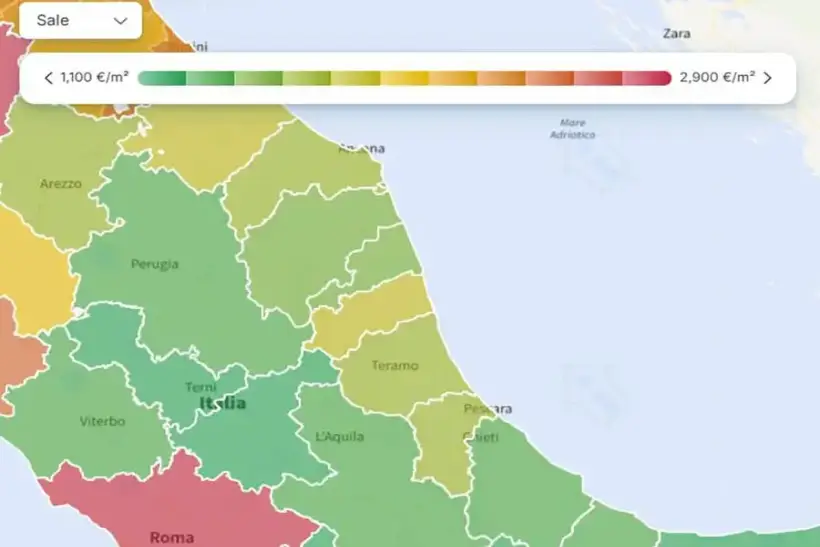
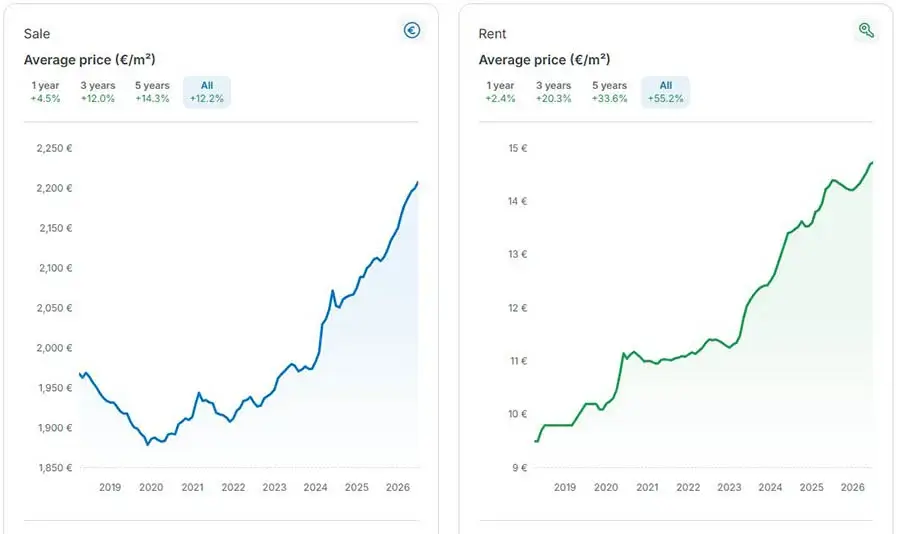
In July 2026, Italy’s residential property market reached its highest levels in the past two years. Over the previous 12 months, asking prices for homes for sale rose faster than rents, while the country’s northern regions remained the most expensive. The most affordable properties are still concentrated mainly in the south, according to Immobiliare.it.
How Much Does Housing Cost Across Italy’s Regions?
Prices on the Sales Market
In July 2026, the average asking price for residential property in Italy reached €2,208 per sq. m, up 4.5% from the same period in 2025. This was the highest level recorded over the past two years. The previous low was registered in September 2024, when the average price stood at €2,061 per sq. m.
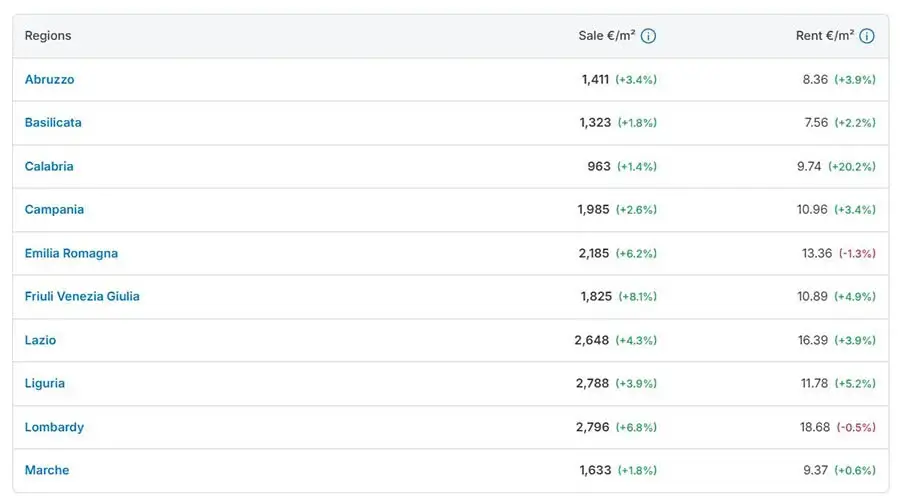
Regional differences remain substantial. Trentino-Alto Adige has the highest level at €3,729 per sq. m, while Calabria is the most affordable at an average of €963. This means that residential property in Italy’s most expensive region costs almost four times as much as in the cheapest one.
Prices increased across most of the country. The strongest growth was recorded in Friuli-Venezia Giulia, where asking values rose by 8.1% to €1,825 per sq. m. Lombardy posted an increase of 6.8%, followed by Veneto at 6.5% and Emilia-Romagna at 6.2%. Aosta Valley was the only region where sellers lowered their asking prices, with the average falling by 5.5% to €2,542 per sq. m.
Residential Rental Rates
The highest rental rates were recorded in Aosta Valley at €23.74 per sq. m per month, up 17.1% year-on-year. Lombardy ranked second at €18.68, followed by Tuscany at €16.95 and Lazio at €16.39.
Molise remains the most affordable region for tenants, where landlords ask an average of €7.44 per sq. m per month. The figure stands at €7.56 in Basilicata, €8.36 in Abruzzo and €8.51 in Sicily.
Calabria recorded the strongest annual increase, with the average rate rising by 20.2% to €9.74 per sq. m. Rents advanced by 17.1% in Aosta Valley and by 6% in both Tuscany and Trentino-Alto Adige. At the same time, they declined by 1.3% in Emilia-Romagna to €13.36 and by 0.5% in Lombardy to €18.68 per sq. m.
Milan Leads Among Regional Capitals
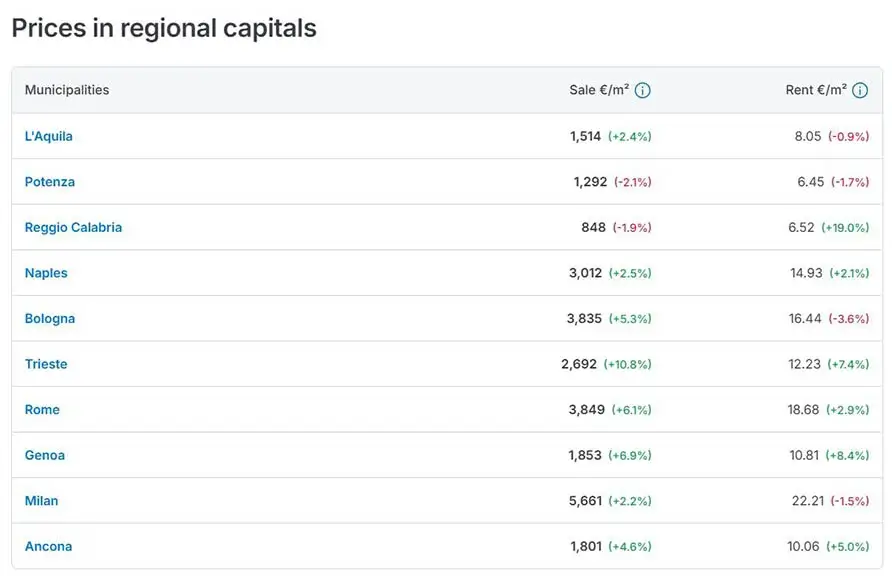
Sales. Among Italy’s regional capitals, Milan remains the most expensive, with homes listed at an average of €5,661 per sq. m in July. It is followed by Florence at €4,751, Rome at €3,849 and Bologna at €3,835. The lowest levels were recorded in southern cities: €848 per sq. m in Reggio Calabria, €1,055 in Campobasso and €1,292 in Potenza.
Trieste led in annual growth, with asking prices rising by 10.8% to €2,692 per sq. m. Turin recorded an increase of 8.7%, Genoa 6.9% and Rome 6.1%. Declines were registered in Potenza, Reggio Calabria, Campobasso and Aosta.
Rent. In Milan, the average rental rate stood at €22.21 per sq. m per month in July. Florence followed at €21.37, Rome at €18.68, Bologna at €16.44 and Venice at €15.97. Among regional capitals, the most affordable rental market is Potenza at €6.45 per sq. m per month, followed by Reggio Calabria at €6.52 and Campobasso at €7.15.
The sharpest annual rise was recorded in Aosta, where rents increased by 30.4% to €11.83 per sq. m. Reggio Calabria posted growth of 19%, Genoa 8.4% and Trieste 7.4%. Milan, by contrast, saw a decline of 1.5%, while Florence recorded a decrease of 0.6%.
Housing Prices in Italy by Listing
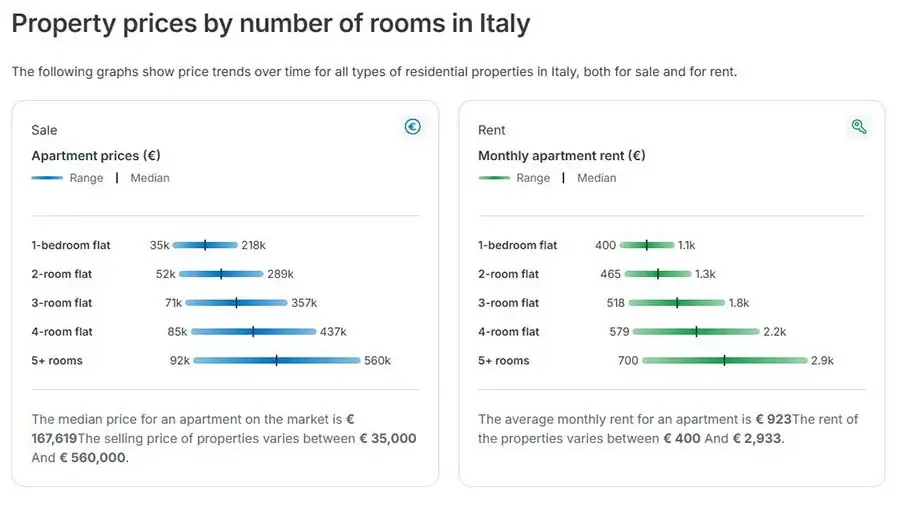
Sales. Immobiliare.it also provides data on apartments currently listed for sale. The median asking price is €167,619. One-bedroom apartments range from €35,000 to €218,000, two-room flats from €52,000 to €289,000, and three-room flats from €71,000 to €357,000. Four-room properties are listed for €85,000–437,000, while homes with five or more rooms range from €92,000 to €560,000.
Rent. Apartment size also has a significant impact on tenants’ costs. Monthly rents for one-bedroom flats range from €400 to €1,100, two-room apartments from €465 to €1,300, and three-room flats from €518 to €1,800. Four-room properties are available for €579–2,200 per month, while homes with five or more rooms range from €700 to €2,900. The average monthly rent across listings is €923.
Rental Yields in Italy Decline
In the third quarter of 2026, the average gross rental yield on residential property in Italy fell from 7.23% to 6.61%, according to Global Property Guide. Among the markets examined, Catania offers the highest average return at 8.75%. Investors can expect 7.84% in Palermo, 6.71% in Turin, 6.59% in Rome and 6.16% in Naples.
Lower returns were recorded in Florence at 5.25% and Milan at 4.97%. This shows that the most expensive markets are not necessarily the most profitable: Italy’s costliest regional capital delivers significantly lower rental returns than more affordable southern cities.
Global Property Guide calculates gross yields before taxes, renovation costs, commissions and other expenses borne by property owners. After these costs are taken into account, net returns are generally 1.5–2 percentage points lower.
What This Means for Investors
International Investment analysts note that current trends point to further divergence within the Italian property market. Housing prices are rising across most regions, while rents are increasing more slowly, contributing to lower average yields. For investors, this means it is becoming increasingly difficult to combine a low entry price, strong cash flow and rapid capital appreciation in a single property.
The most expensive markets may remain attractive for capital preservation and future resale, but rental returns there tend to be lower. Southern cities, by contrast, require less initial investment and in some cases provide stronger current income. Property selection is therefore becoming increasingly strategy-dependent: investors focused on capital appreciation need to pay closer attention to price trends and local liquidity, while those targeting rental income should assess the relationship between acquisition costs and potential cash flow. Falling average yields make such calculations more important and increase the value of local market analysis rather than relying on nationwide averages.