







 European Prime Rents Rise as Property Yields Turn Higher
 The Most Expensive Airlines in Europe in 2026
 Housing Prices in Italy Reach a Two-Year High
 Travellers Increasingly Choose Cooler Scandinavia
 Serbia Property Sales Decline as Transaction Value Rises
 Thailand Rethinks Tourism as Arrivals Lose Momentum
How Ukraine’s New-Build Housing Market Has Changed Over Four Years
Unsplash
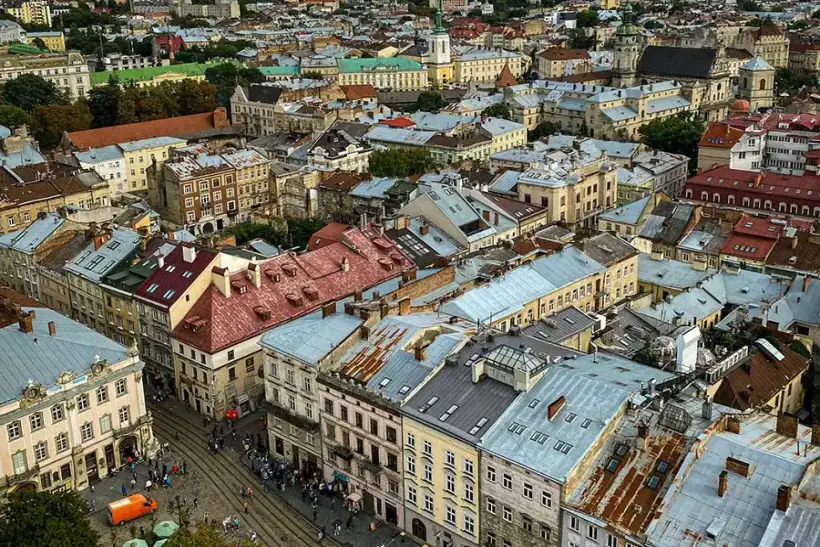
Ukraine’s housing market is gradually recovering after the sharp downturn triggered by the outbreak of hostilities. By July 2026, 2,775 residential projects were under construction across the country, while the strongest price growth over the past four years was recorded in western regions, according to DIM.RIA.
Construction in Ukraine and the Structure of Supply
Since March 2022, 683 residential complexes comprising 1,339 sections have been commissioned in Ukraine. Another 706 projects remain on hold: their sales offices stopped operating after February 2022 and have not reopened.
The pace of completions has gradually increased. In 2022, only 19 residential complexes with 27 sections were completed, compared with 233 projects comprising 449 sections in 2025. By July 2026, 2,775 new-build projects were under construction nationwide. The largest share was concentrated in Kyiv Region, excluding the capital, at 21.3%. Kyiv accounted for 11.2% of projects under construction, Odesa Region for 10.9%, Lviv Region excluding the regional capital for 8.5%, and Ivano-Frankivsk Region for 7.1%.
More than half of the supply, 51.9%, falls into the comfort-class segment. Business-class housing accounts for 20.1%, while economy-class projects make up 6.2%. The remaining 21.8% consists of premium properties, townhouses and cottages. The structure is broadly similar across most regions, although Lviv has a significantly larger business-class segment, accounting for 40.6% of supply compared with 30.3% for comfort-class housing.
Demand for New-Build Housing in Ukraine
New-build housing is searched for most actively in Kyiv, which accounts for 16.7% of all search queries in Ukraine’s primary market. Lviv ranks second with 12%. It is followed by Vinnytsia Region at 8.6%, Kyiv Region at 7.2%, Ternopil Region at 7.1% and Khmelnytskyi Region at 6.4%.
The lowest level of interest is recorded in Sumy and Zaporizhzhia regions, at 0.2% each. Kirovohrad Region accounts for 0.3% of searches, Chernihiv Region for 0.5% and Mykolaiv Region for 0.6%. Buyer activity is therefore noticeably concentrated in the capital and western regions.
At the same time, interest in primary housing has been declining in recent months. According to DIM.RIA, demand for new-build housing fell across the country in July 2026. The sharpest monthly decline was recorded in Zaporizhzhia Region, at 38%. Demand fell by 22% in both Kharkiv and Zhytomyr regions, by 21% in Kyiv and by 20% in Dnipropetrovsk Region.
The decline continued the trend seen in June, when demand fell across most regions. In Kyiv, the indicator also dropped by 21%, while Chernihiv Region recorded a 19% decrease, Zaporizhzhia Region 17%, Mykolaiv Region 16% and Kyiv Region 15%. Cherkasy Region was an exception, with interest in new-build housing rising by 9% compared with May.
State Support and Mortgages in Ukraine
The availability of new-build housing in Ukraine under state support programs varies considerably by region. In Poltava Region, 79% of primary-market properties meet the requirements of the “єОселя” and “єВідновлення” programs. The figure is 51% in Vinnytsia Region, 47% in both Dnipropetrovsk and Zakarpattia regions, 46% in Kyiv Region and 45% in Lviv Region. No such offers are available in the primary market in Chernihiv, Sumy, Kharkiv, Zaporizhzhia, Kherson or Mykolaiv regions.
However, the strongest search interest in housing available through state programs is not concentrated in the regions where such properties account for the largest share of supply. Kyiv generates 22.2% of these searches nationwide, followed by Vinnytsia Region at 12.6%, Kyiv Region at 12.3%, Odesa Region at 8.2% and Khmelnytskyi Region at 7.4%.
Data from Ukrfinzhytlo show how actively the state program is being used in practice. By August 26, 2026, 28,116 loans worth a total of UAH 49.78 billion, or about $1.11 billion, had been issued under the “єОселя” program. The secondary market accounted for 15,178 loans, or 54%. Another 9,115 loans, or 32.4%, were used to purchase properties from developers, while 3,823 loans, or 13.6%, were classified as purchases on the primary market.
Kyiv Region leads in the number of mortgages issued, with 8,107 loans worth UAH 13.88 billion. In Kyiv itself, 6,066 loans totaling UAH 13.68 billion were issued. Lviv Region follows with 1,823 loans, Ivano-Frankivsk Region with 1,360, Odesa Region with 1,224 and Vinnytsia Region with 1,200.
How Housing Prices in Ukraine Have Changed
Since July 2022, primary-market property prices in Ivano-Frankivsk Region have risen by 69.3%, while Lviv Region excluding the city of Lviv recorded an increase of 52%. Prices grew by 38% in Chernivtsi Region and by 34% in both Zhytomyr and Ternopil regions.
A study by economists at the National University of Ostroh Academy, based on LUN statistics, shows that in US dollar terms, housing prices increased by 100% in Kropyvnytskyi, by 87% in Ivano-Frankivsk and by 58% in Lviv. By contrast, the price per square meter fell by 19% in Kharkiv and by 11% in Zaporizhzhia.
The researchers also point to faster price growth for completed properties. In Kyiv, primary-market prices in US dollar terms rose by 6%, compared with 20% on the secondary market. In Lviv, the respective increases were 10% and 24%.
Over the past year, the strongest increase in the average price per square meter of new-build housing was recorded in Ivano-Frankivsk Region, where prices rose by 20% to $1,089 by July. In Vinnytsia and Lviv regions, prices increased by 17% to $1,072 and $1,055 respectively. Zhytomyr and Ternopil regions recorded gains of 16%, bringing average prices to $923 and $834 per square meter.
The Market Remains Dependent on Risk Levels
International Investment analysts note that the geography of hostilities remains a key factor for Ukraine’s housing market. The level of security largely determines population movements, buyers’ willingness to invest in property and developers’ decisions on whether to launch or continue projects. As long as risks differ substantially between regions, a uniform nationwide trend in prices and construction activity is unlikely.
Buyer attitudes toward individual properties are also changing. In an environment of heightened uncertainty, completed apartments and projects at an advanced stage of construction have an advantage because they carry a lower risk of delays.
The market’s future prospects will depend directly on changes in the security situation. Lower risks could gradually bring demand and investment back to regions where activity is currently constrained. If current conditions persist, buyer demand and new construction are likely to remain concentrated in more stable areas. At the same time, further price growth in these markets will increasingly be limited by household purchasing power and access to mortgage financing.