




The Most Expensive Airlines in Europe in 2026
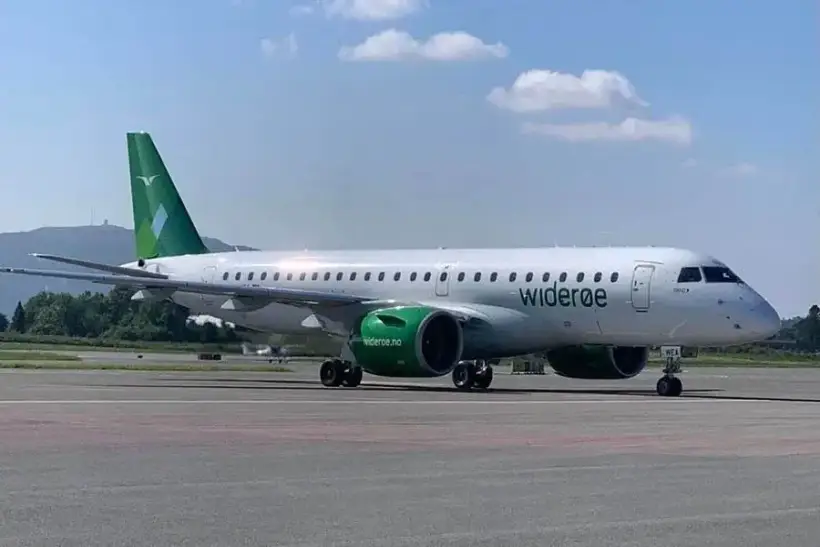
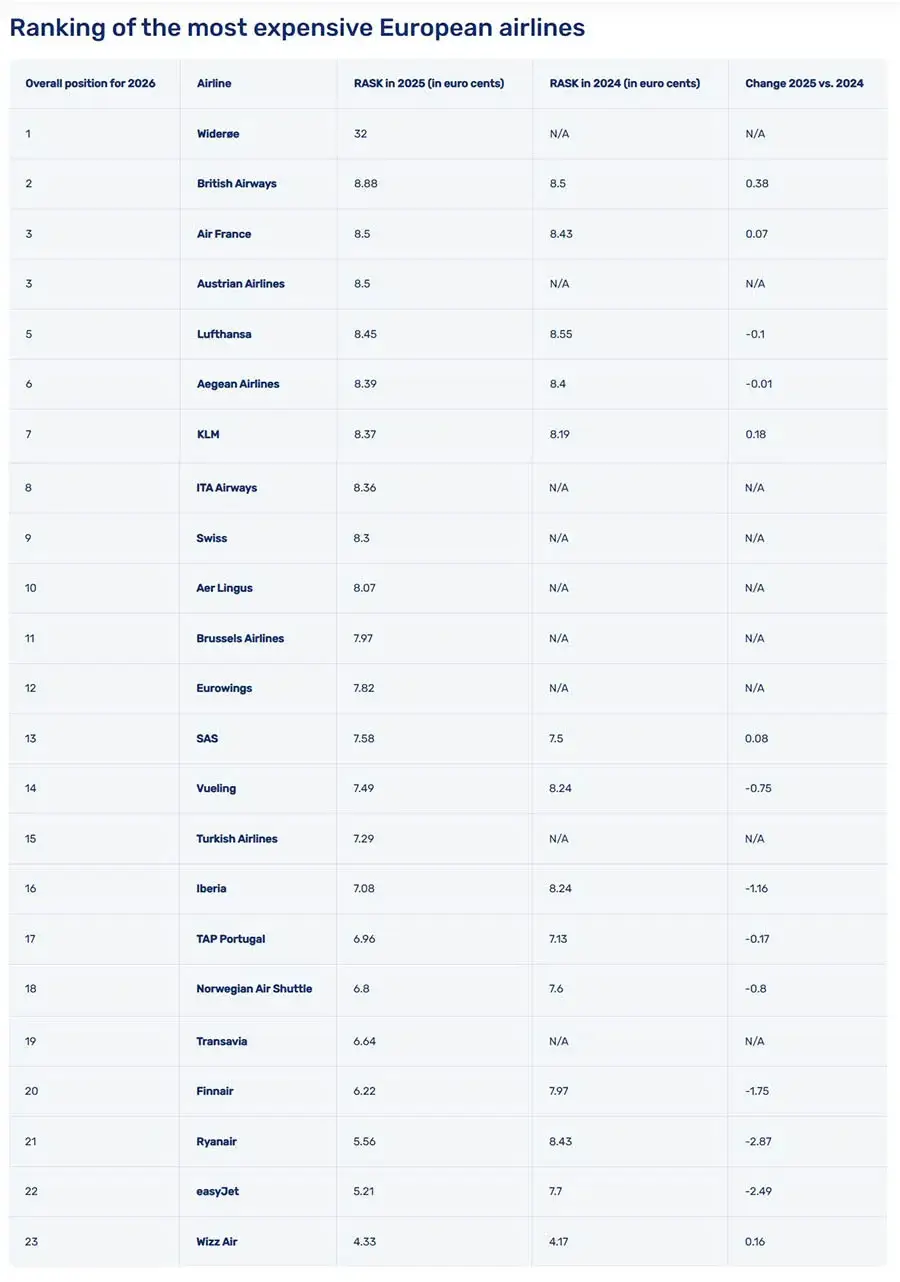
Norway’s Widerøe has become the most expensive airline in Europe by revenue per available seat kilometre. Among high-volume carriers, British Airways ranked first, while Wizz Air, easyJet and Ryanair recorded the lowest figures, according to AirAdvisor.
Widerøe: Highest Revenue per Seat Kilometre
AirAdvisor compared 23 European carriers using RASK, or revenue per available seat kilometre. It is calculated by dividing annual passenger revenue by available seat kilometres and takes into account both base ticket prices and additional passenger charges, including baggage and seat selection fees.
The highest figure was recorded by Norwegian regional airline Widerøe at 32 euro cents per seat kilometre. By comparison, Wizz Air, which ranked last, posted 4.33 euro cents — 7.4 times lower.
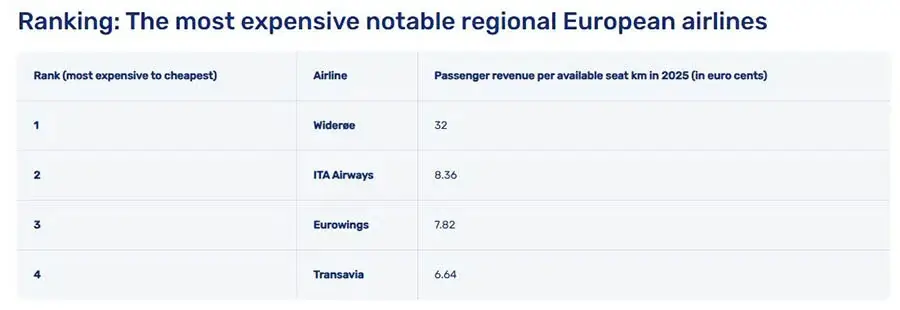
Among regional carriers, ITA Airways followed Widerøe with 8.36 euro cents per seat kilometre. Eurowings recorded 7.82 euro cents and Transavia 6.64. Widerøe therefore stands out sharply even within its own category, with a RASK almost four times higher than that of ITA Airways.
An Alternative in Norway
AirAdvisor notes that the high figures recorded by smaller carriers may be linked to higher operating costs per passenger. Such airlines tend to have smaller fleets, operate fewer flights and often serve remote destinations with limited competition.
For travel within Norway, Norwegian Air Shuttle is suggested as a more affordable alternative to Widerøe on routes served by both airlines. Norwegian’s RASK stands at 6.8 euro cents.
According to Eurocontrol, the average flight distance in Europe is 1,157 km. Over such a distance, the difference between Widerøe and Norwegian Air Shuttle could amount to €291.56 per flight. However, RASK should not be interpreted directly as the average ticket price; it reflects an airline’s revenue relative to the amount of seat capacity it offers.
British Airways Leads Among High-Volume Carriers
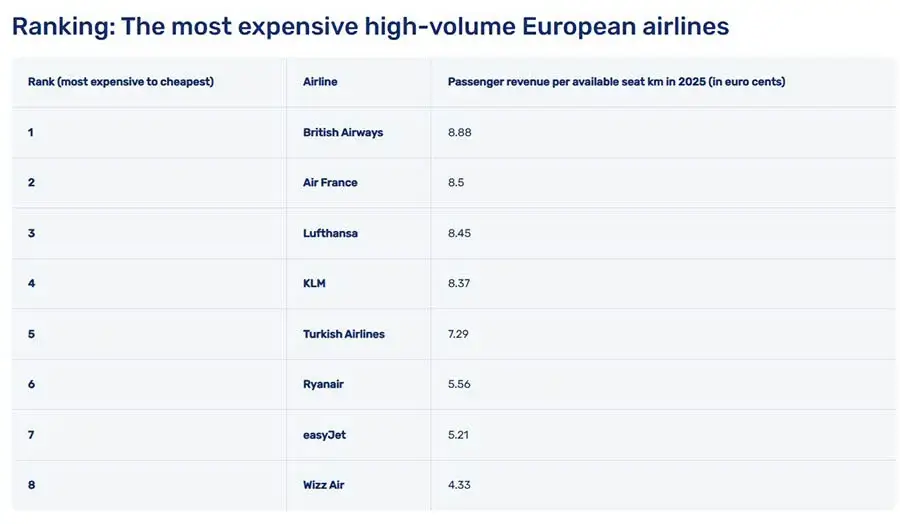
Among high-volume airlines, British Airways ranked first with 8.88 euro cents per seat kilometre. The figure rose from 8.5 euro cents a year earlier.
Air France followed with 8.5 euro cents, up from 8.43 in the previous year. AirAdvisor notes that choosing Wizz Air instead of the French flag carrier on routes served by both airlines could theoretically reduce costs by around €50 on an average European flight.
Lufthansa ranked third among high-volume carriers and fifth overall. Its RASK declined from 8.55 to 8.45 euro cents. The gap between Lufthansa and British Airways is just 0.43 euro cents per seat kilometre, equivalent to around €5 over the distance of an average European flight.
The category also includes KLM at 8.37 euro cents, Turkish Airlines at 7.29, Ryanair at 5.56, easyJet at 5.21 and Wizz Air at 4.33.
Austrian Airlines Enters the Top Three
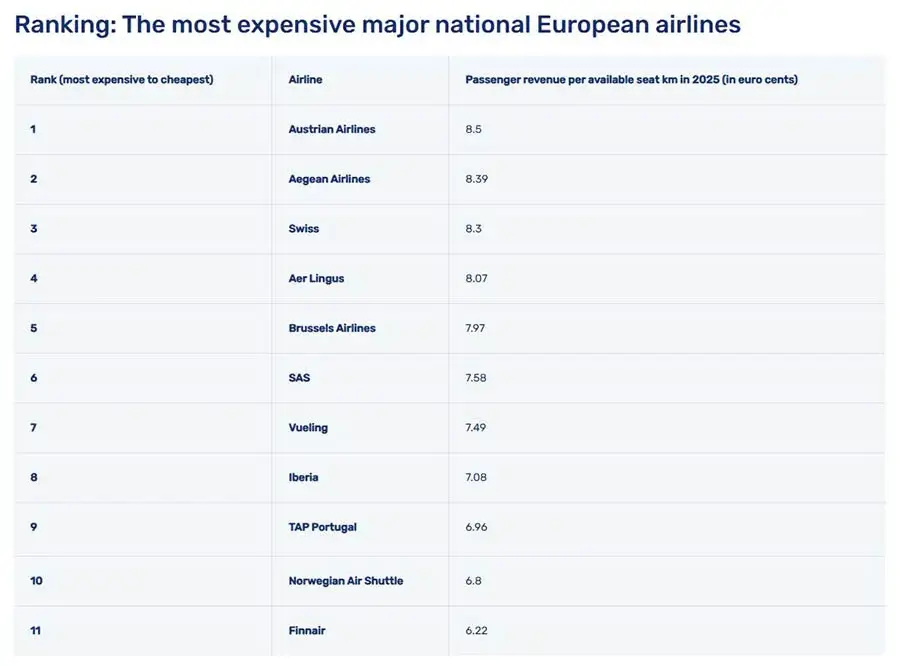
Austrian Airlines ranked first among major national carriers, with a 2025 RASK of 8.5 euro cents. The airline was included in the AirAdvisor ranking for the first time, so no comparable figure for the previous period is available. This result places Austrian Airlines joint third overall with Air France.
Aegean Airlines followed with 8.39 euro cents, compared with 8.4 a year earlier. This is notably above the average for the major national carrier category, which stands at 7.58 euro cents.
SWISS recorded a RASK of 8.3 euro cents. The airline also entered the study for the first time, making it impossible to determine its year-on-year trend.
The ranking continues with Aer Lingus at 8.07 euro cents, Brussels Airlines at 7.97, SAS at 7.58, Vueling at 7.49, Iberia at 7.08, TAP Portugal at 6.96, Norwegian Air Shuttle at 6.8 and Finnair at 6.22.
Ryanair and easyJet Record Significant Declines
AirAdvisor also highlights changes in RASK over time. Among the 14 airlines for which comparable 2024 and 2025 data are available, only five recorded an increase, while nine posted a decline.
The sharpest drop was recorded by Ryanair, where RASK fell from 8.43 to 5.56 euro cents, a decrease of 2.87 euro cents. At easyJet, the figure declined by 2.49 euro cents, from 7.7 to 5.21, while Finnair recorded a drop of 1.75 euro cents to 6.22.
Iberia reduced its RASK from 8.24 to 7.08 euro cents, Norwegian Air Shuttle from 7.6 to 6.8, and Vueling from 8.24 to 7.49. TAP Portugal’s figure declined from 7.13 to 6.96 euro cents.
Increases were recorded by British Airways, Air France, KLM, SAS and Wizz Air. Wizz Air’s RASK rose from 4.17 to 4.33 euro cents, although it still remained the most affordable carrier under the methodology used in the study.
Competition Is Playing a Greater Role in Airfare Levels
Analysts at International Investment note that the lowest RASK figures are more often recorded by large low-cost airlines with high passenger volumes and strong load factors. Smaller regional carriers, by contrast, may generate significantly more revenue per seat kilometre because of their smaller scale, limited route networks and operations on routes with weaker competition.
The decline in RASK among most airlines with comparable annual data points to stronger price competition in the European market and gives passengers more opportunities to find lower fares, particularly on routes served by several carriers. At the same time, airlines are increasingly using algorithms and artificial intelligence for dynamic pricing, adjusting fares according to demand and other factors. As a result, ticket prices can change more rapidly, making genuinely attractive deals harder to secure.