







 Alta Banka Collapse in Serbia: What Happens to Russian Depositors' Money
 Covivio Hotels Revenue Grows 4.7% as European Markets Split
 Lithuanian Apartment Prices Accelerate Across Major Cities
 Georgia's Tourism Revenue Hits Record High
 Norway's Sovereign Fund Commits €1.5bn to European Warehouses
 Market Rout of October 2026: Can Branded Hotels Protect Capital?
Georgia Ranks Among the Top 20 Countries for Relocation in 2026

Tatiana Borodina
Consulting platform Rumavi has released the Global Relocation Index 2026, comparing relocation and living conditions across 192 countries. The study takes into account economic, social and migration-related factors. Georgia ranked among the top 20, outperforming all neighboring countries.
How the Ranking Was Compiled
The Global Relocation Index compares 192 countries across 24 indicators grouped into four categories: finance and taxation, quality of life and healthcare, safety and stability, and relocation and settlement opportunities. The criteria include education, political stability, digital infrastructure, visa regulations, business conditions and property ownership. Each indicator is scored on a scale from 0 to 100. Rumavi also compiled five specialized rankings, including those for families, retirees, entrepreneurs and digital nomads.
The study draws on data from the World Bank, the World Health Organization, Gallup and other international sources. Where comparable statistics are insufficient, Rumavi uses calculated estimates and expert assessments. The most comprehensive data are available for 127 countries, meaning that limitations in the underlying data should be taken into account when comparing the remaining participants.
Georgia Outperforms All Countries in the Region
In the overall index, Georgia scored 69.3 out of 100 and ranked 14th. Results at the top of the table were relatively close: the UAE ranked 13th with 69.4 points, while Brunei, in 15th place, matched Georgia's score of 69.3. Georgia was only 3.5 points behind Estonia (72.8), which topped the ranking.
Georgia also placed ahead of a number of popular relocation destinations. Spain ranked 21st, Switzerland 24th, Finland 27th and Australia 29th. Canada was further down the list at 41st, followed by Germany (50th), Italy (61st) and Greece (67th).
The gap with other countries in the region was particularly pronounced. Armenia ranked 86th with 62.2 points, Azerbaijan 91st (61.5) and Turkey 97th (60.9). Russia was 121st with 58.9 points. Even Armenia, the best performer in this group, trailed Georgia by 7.1 points and 72 places.
Georgia’s Other Strengths
Georgia achieved its strongest result in finance and taxation, scoring 85.8 out of 100. The index gave particularly high marks to affordability, at 92.5, and the taxation of foreign-source income, at 92. Entry and stay conditions received the same score. Citizens of many countries can remain in Georgia visa-free for up to one year, making relocation easier. This is particularly important for remote workers and those who want to spend some time in the country before deciding on a long-term move.
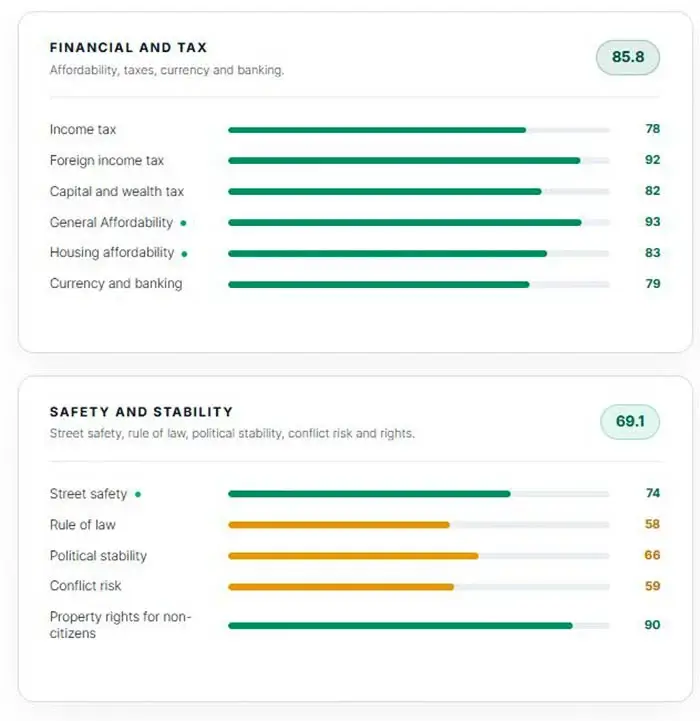
The study also highlights property ownership rules as an advantage. Foreign nationals can purchase residential and commercial property on virtually the same terms as Georgian citizens, with restrictions applying only to agricultural land. Georgia scored 90 points for the protection of foreign property rights.
The tax system is another important factor. Foreign-source income is not subject to personal income tax under certain conditions. The standard rate on income earned in Georgia is 20%, while individual entrepreneurs with small-business status pay just 1%. Combined with moderate living costs and straightforward residence rules, this makes the country more attractive as a relocation destination.
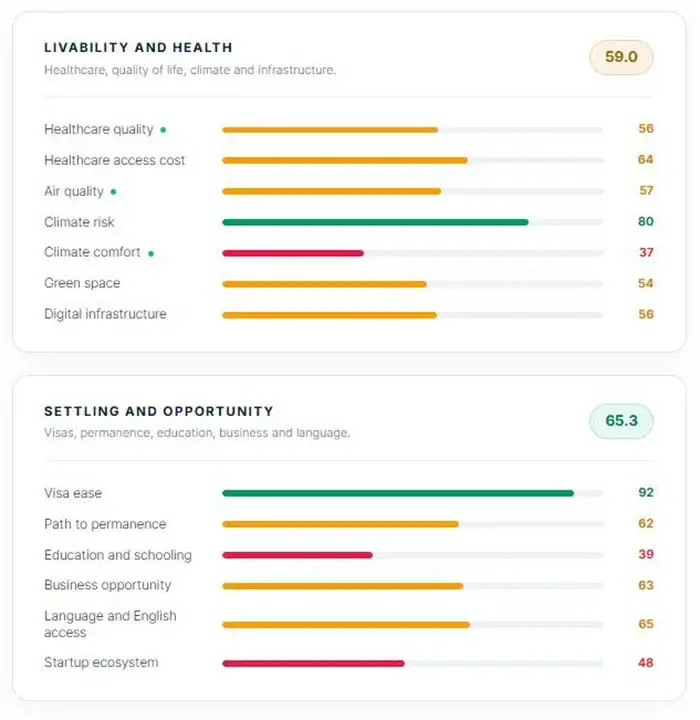
Georgia also received relatively strong scores for safety (74) and climate resilience (80). Political stability was rated at 66, business opportunities at 63 and healthcare affordability at 64. Overall, the country scored 69.1 for safety and stability, 65.3 for relocation and settlement opportunities, and 59 for quality of life and healthcare.
Georgia Ranks in the Top Five for Digital Nomads
Georgia achieved its highest position in the specialized rankings for digital nomads, placing fourth with 75.1 points. Only Malaysia (79.1), Portugal (77) and Thailand (75.4) ranked higher. Georgia was followed in the top 10 by Taiwan, Estonia, the UAE, Spain, Croatia and Lithuania. The gap with other countries in the region was substantial: Azerbaijan ranked 74th (65.3), Turkey 95th (64), Armenia 96th (63.9) and Russia 111th (63).
In terms of tax attractiveness, Georgia ranked sixth with 72.9 points. The top five positions were held by Singapore, Hong Kong, the UAE, St. Kitts and Nevis, and Estonia. Georgia was followed by Switzerland, Qatar, Bahrain, and Antigua and Barbuda. Armenia ranked 65th, Azerbaijan 84th, Turkey 102nd and Russia 116th.
In the retiree category, Georgia ranked seventh with 72 points. Malaysia, Panama, Portugal, Thailand, Costa Rica, and St. Kitts and Nevis were ahead, while the Philippines, Estonia, and Antigua and Barbuda occupied the next three places. Among countries in the region, Armenia was the closest to Georgia at 72nd. Azerbaijan ranked 89th, Turkey 103rd and Russia 130th.
Georgia's position was more modest in the ranking for families, where it placed 39th with 67.1 points. Thailand and Costa Rica were immediately ahead, while the UAE and Cyprus followed. Georgia nevertheless maintained a considerable lead over the other countries in the region: Armenia ranked 71st, Azerbaijan 88th, Turkey 93rd and Russia 98th.
In the entrepreneur category, Georgia ranked 43rd with 67 points. Slovakia (41st) and Montenegro (42nd) were its closest higher-ranked countries, while Chile and Italy followed. Armenia placed 67th, Turkey 78th, Russia 81st and Azerbaijan 98th.
Overall Ranking Results
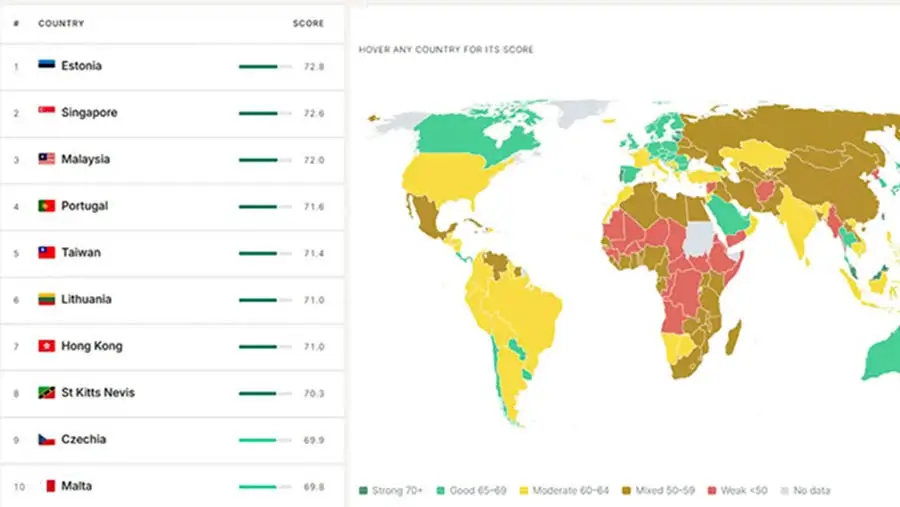
Estonia topped the Global Relocation Index 2026 with 72.8 points, followed by Singapore (72.6), Malaysia (72), Portugal (71.6) and Taiwan (71.4). The gap between first and fifth place was therefore just 1.4 points. Lithuania, Hong Kong, St. Kitts and Nevis, the Czech Republic and Malta also made the top 10. Scores at the upper end of the table were relatively close, with only three points separating first and tenth place.
International Investment analysts note that Georgia competes for potential relocators not only with neighboring countries but also with popular destinations across Europe and Asia. Its advantages are particularly evident for people earning income from abroad and those able to work remotely. Moderate living costs, favorable taxation and long visa-free stays all contribute to its appeal.
Another factor is the ability to purchase property with few restrictions. The market attracts not only people relocating to Georgia but also international investors. Part of this demand is gradually shifting from residential real estate toward the hospitality sector. The highest returns are typically seen in professionally managed, branded hotels in the premium segment.