







 Covivio Hotels Revenue Grows 4.7% as European Markets Split
 Lithuanian Apartment Prices Accelerate Across Major Cities
 Georgia's Tourism Revenue Hits Record High
 Norway's Sovereign Fund Commits €1.5bn to European Warehouses
 Market Rout of October 2026: Can Branded Hotels Protect Capital?
 Residential Property Prices in Tbilisi Rise by 5.9% Year-on-Year
European Shopping Centres Return to Investor Portfolios
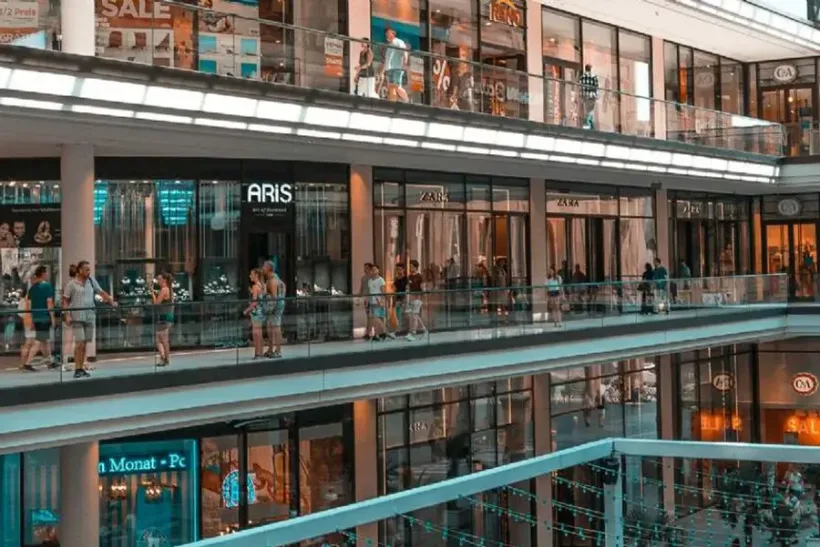
European shopping centres have regained investors' attention. They accounted for 34% of all European retail real estate investment during H1 2026, their highest share since 2022. Average vacancy in prime centres fell for the first time in a decade, while rents in Lisbon and Milan have grown far faster than the European average.
The return of capital does not amount to a recovery for every mall. Prime centres with strong catchment areas and the capacity to adapt are securing tenants and investment. Older assets with weak footfall face refurbishment costs and limited rental growth.
Shopping centres captured 34% of retail investment
European shopping centre investment reached €12 billion in 2025, more than twice its 2023 trough, though still below the peaks of the previous cycle. In H1 2026, the sector represented 34% of investment in European retail property, according to Savills' European Shopping Centre Spotlight.
This is a share of retail property transactions, not a share of all commercial real estate investment. It should not be confused with growth in total market volume: a broader European investment review reported that overall retail investment was down around 12% year on year in H1.
Large transactions are returning. A 70% stake in Poland's Posnania changed hands for approximately €400 million, while the UK's Merry Hill sold for about €340 million. These deals provide price evidence for a sector that struggled with limited transaction liquidity after the rate shock.
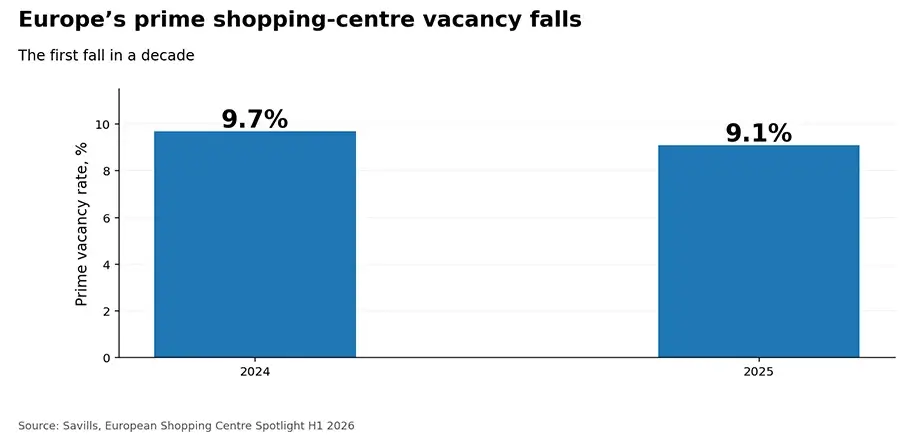
Prime vacancy falls for the first time in a decade
Average prime European shopping centre vacancy declined from 9.7% in 2024 to 9.1% in 2025, a 0.6 percentage point improvement. Helsinki recorded a 3.3-point drop, Madrid 2.3 points, and Manchester and Budapest 2.2 points each. These prime figures should not be treated as a vacancy measure for every European shopping centre.
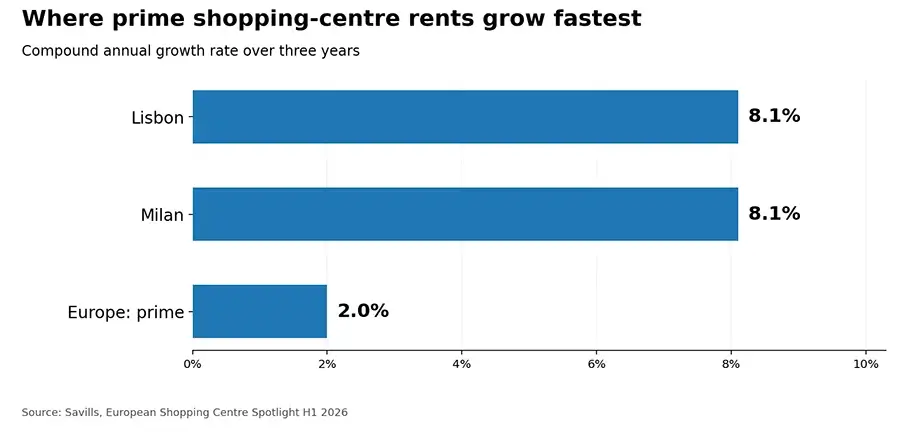
Lisbon and Milan lead rental growth
Prime rents increased at a compound annual growth rate of 2% across Europe over three years. Lisbon and Milan reached 8.1% per year, supported by low vacancy and strong competition for the best space.
|
Market |
Prime vacancy |
Rent CAGR, 3 years |
|
Lisbon |
3.1% |
8.1% |
|
Milan |
1.3% |
8.1% |
|
Europe |
9.1% |
2.0% |
Only 1.3% of prime shopping centre units in Milan were vacant, compared with 3.1% in Lisbon. These conditions strengthen landlords' negotiating positions without implying that retail sales have risen at the same pace as rents.
E-commerce changed the mall rather than eliminating it
In 2025, 78% of EU internet users bought goods or services online, up from 62% in 2015. Physical stores nevertheless retain a role in collection, returns, fitting and customer service. Shopping centres increasingly combine retail with restaurants, healthcare, fitness and leisure to give consumers reasons to visit beyond buying a product.
This change places greater emphasis on active management. Tenant mix, local demographics and the flexibility to convert space have become as important as the number of shops.
New shopping centre development remains limited
Europe's shopping centre floorspace has expanded by just 0.25% a year since 2020, compared with 0.8% in 2017–2020. The current construction pipeline would increase existing floorspace by only around 0.6%. Scarce new supply gives successful centres some pricing protection, but cannot solve operational weaknesses in ageing properties.
Investors are selecting quality, not buying the entire sector
Shopping centre volumes in Italy and the Czech Republic were 196% above their five-year averages in 2025; Spain was 51% above its equivalent benchmark. US funds allocated around €1.1 billion to European shopping centres. Yet capital remains concentrated in assets with reliable income and strong catchments.
The middle tier of shopping centres is particularly exposed. These properties may require significant spending on energy efficiency, interiors and tenant repositioning, without the rental power to recover the investment. A discount to historical value does not in itself create a bargain.
Returns have improved, but benchmarks differ
MSCI's European index recorded a 6.9% total return for regional shopping centres in 2025, including 5.4% from income and about 1.4% from capital value growth, with small rounding differences. Savills places average prime shopping centre yields at about 6.2% after six quarters of compression.
Spain saw prime yields compress by 50 basis points from late 2025, while Lisbon, Milan and London tightened by 25 points year on year. Germany moved in the opposite direction, with yields widening by 20 points in Q2 2026. A past index return and an asset's capitalisation yield are different measures; neither promises a new buyer the same outcome.
The Nordics and Baltics highlight the regional divide
Sweden's retail property investment rose 15% year on year to SEK 2.7 billion in Q1 2026, supported by dominant regional centres and everyday retail. Professionally managed shopping centres in the Baltic capitals reported vacancy of roughly 1.5% to 2.2%. Cyprus offers a counterexample: retail turnover improved while rents and retail property values increased only modestly.
CBRE's study of 162 managed assets across 15 countries also found that retail parks and convenience-focused formats generally performed more strongly than some traditional malls. Its sample is different from the Savills prime series, so their vacancy rates should not be compared as like-for-like figures.
What investors need to examine
Catchment incomes, tenant sales, occupancy costs, lease expiries, concentration risk and prospective refurbishment expenses all affect value. Investors should also assess the building's energy performance and whether units can accommodate new uses without excessive cost.
The European shopping centre recovery is real, but selective. E-commerce did not remove the need for physical retail; it changed what a successful centre must offer. Strong assets can command capital and rent growth, while poorly positioned properties face an expensive adjustment.
FAQ
How much European retail investment went to shopping centres?
Shopping centres accounted for 34% in H1 2026, their highest share since 2022. The figure refers to retail property investment, not all real estate.
Is European shopping centre vacancy falling?
Savills reports average prime vacancy decreased from 9.7% to 9.1% during 2025, the first fall in a decade.
Which cities have the fastest prime rent growth?
Lisbon and Milan recorded 8.1% compound annual growth over three years, versus a 2% European average.
What returns do shopping centres generate?
MSCI reported a 6.9% total return for European regional shopping centres in 2025. That historical index result is not a guaranteed future investment return.
Why do institutional buyers prefer prime malls?
Successful centres offer stronger catchments, occupier demand and greater capacity to manage the tenant mix while maintaining income.