












S&P Cuts Forecast for China Property Market

New Home Sales Seen Falling Up to 14% in 2026
S&P Global Ratings has revised down its outlook for China’s property market just weeks into 2026. While the agency had forecast a 5% to 8% decline in primary home sales in October, it now expects a sharper drop of 10% to 14% this year.
Analysts described the downturn as deeply entrenched, arguing that only the government has the capacity to absorb the country’s mounting inventory overhang.
Sales Have Halved Since 2021
China’s property sector, once accounting for more than a quarter of national economic activity, has experienced a dramatic contraction. Annual sales fell 12.6% in 2025 to 8.4 trillion yuan ($1.21 trillion), less than half the 18.2 trillion yuan recorded in 2021.
The downturn was initially triggered by Beijing’s crackdown on highly leveraged developers. However, consumer demand has yet to recover meaningfully.
Oversupply Keeps Prices Under Pressure
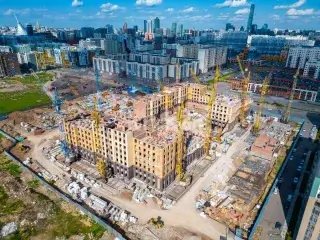
Despite weaker sales, developers continued completing projects, leading to a sixth consecutive year of rising unsold housing stock. S&P projects further price declines of 2% to 4% in 2026 following a similar drop last year.
Falling prices are undermining buyer confidence and reinforcing a negative feedback loop, where lower demand fuels additional downward pressure.
Weakness Spreads to Major Cities
S&P expressed concern that price declines in Beijing, Guangzhou and Shenzhen worsened in the fourth quarter of 2025, with annual drops of at least 3%. These cities were previously viewed as potential anchors for a national recovery.
Shanghai was the only major city to post growth, with prices rising 5.7% year over year.
Rising Risk for Developers and the Economy
If sales fall significantly below S&P’s base case in 2026 and 2027, four of the ten Chinese developers rated by the agency could face downward rating pressure.
Authorities have so far refrained from announcing large-scale new stimulus measures for real estate, instead prioritising investment in advanced technologies. However, analysts argue that growth in high-tech industries is not yet sufficient to offset the drag from property, increasing reliance on exports amid global trade tensions.
China’s property downturn increasingly resembles a structural correction rather than a cyclical slowdown. Persistent oversupply and weakening demand suggest that further inventory liquidation could intensify price pressures and strain developers’ balance sheets.
As International Investment experts note, the trajectory of China’s real estate market points toward prolonged stagnation. Even with potential state intervention, recovery will depend on meaningful inventory reduction, restored buyer confidence, and price stabilisation — conditions that remain uncertain in the near term.