











Foreigners Drive the Main Population Growth in Georgia in 2025
In 2025, Georgia’s demographic balance was maintained through external migration, which offset natural population decline and ensured overall growth, according to the National Statistics Office. The largest groups of foreign arrivals came from Russia, Ukraine, India, Türkiye, and Azerbaijan.
Regional Population Ranking of Georgia
In 2025, Georgia recorded a negative natural population change of -6,452. Overall growth was driven by a positive net migration balance of 17,127. As a result, the population increased by 0.3% as of January 1, 2026, reaching 3.94 million.
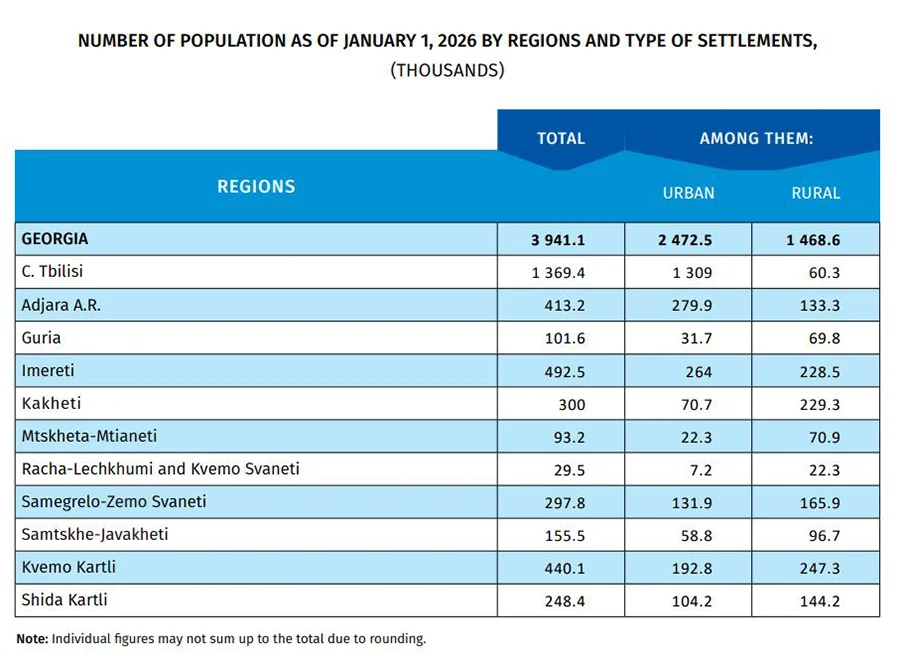
Most residents live in urban areas — 62.7%. Tbilisi leads by population size with 1.36 million people, accounting for more than one third of the country’s total population. Imereti ranks second with 492,500 residents and shows a relatively balanced settlement structure. Kvemo Kartli has over 440,000 residents, where rural population clearly dominates urban areas (192,800 vs 247,300). Adjara brings together 413,200 people, with a more pronounced urban-rural gap (279,900 vs 133,300).
Kakheti remains predominantly rural, with 229,300 of its 300,000 residents living in rural areas. The lowest population is recorded in Racha-Lechkhumi and Kvemo Svaneti — 29,500 people, including 7,200 urban and 22,300 rural residents.
Age and Gender Structure of Georgia’s Population
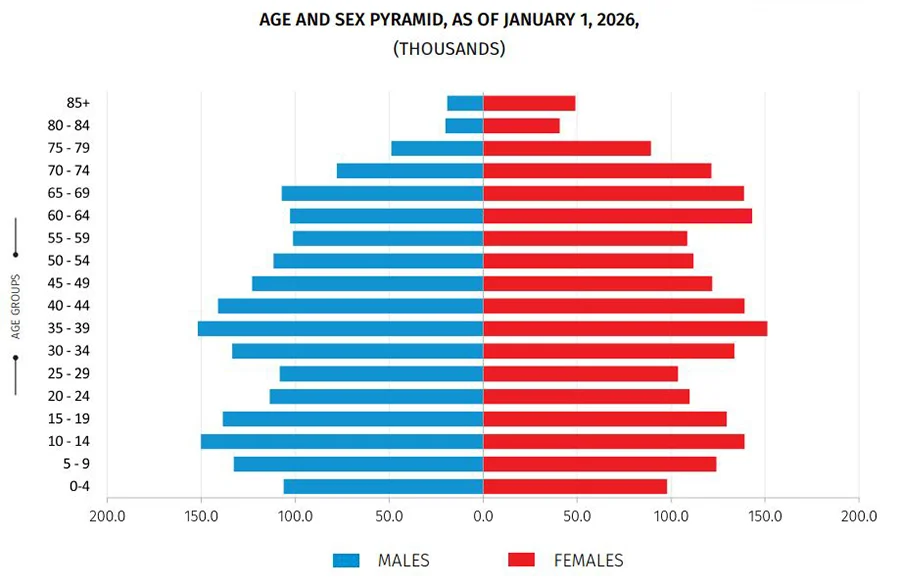
People of working age make up 62.9% of Georgia’s population. Children under 14 account for 19%, while those aged 65 and older represent 18.1%. There are 1.88 million men in the country, who outnumber women in the population under 50 years of age.
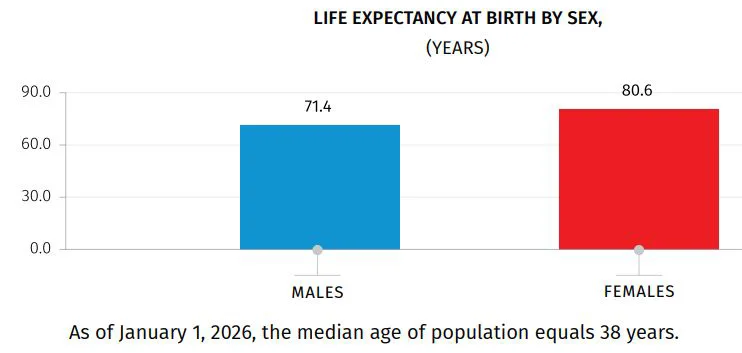
Life expectancy for men is estimated at 71.4 years, while for women — whose number reaches 2.05 million — it exceeds 80 years. As a result, women are more numerous in older age groups. Overall life expectancy stands at 76 years, and the average age is 38.
Foreigners in Georgia
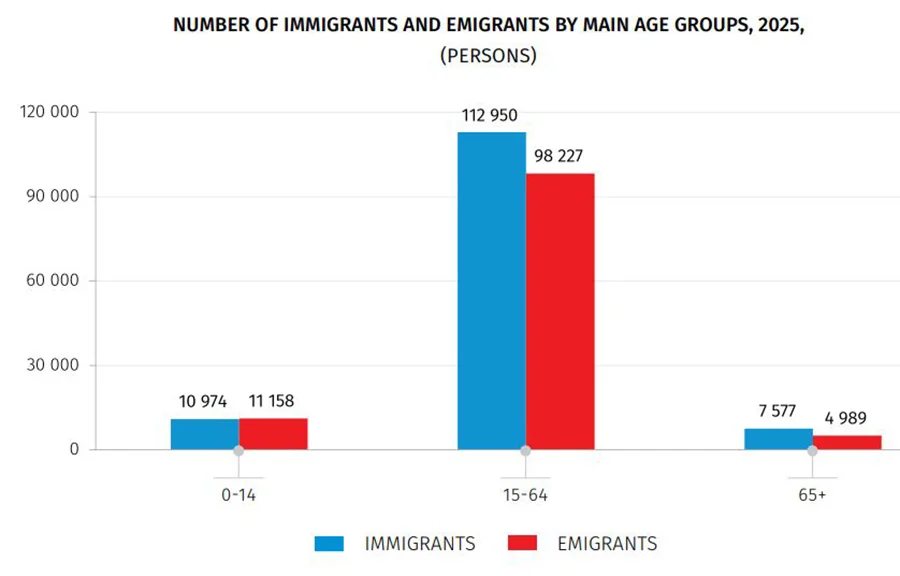
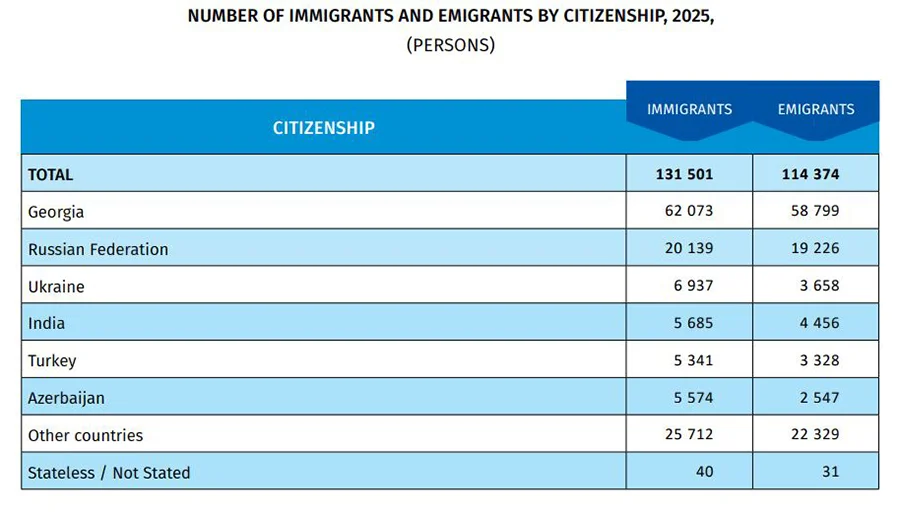
In 2025, 131,501 people entered Georgia, a decrease of 5.8%. The number of those leaving also declined by 3.2% to 114,374. The majority belong to the working-age group (15–64 years), accounting for 85.9%. This increases the impact of migration on both population size and the labor market. Among immigrants, 47.2% are Georgian citizens, while among emigrants the share is 51.4%: 58,799 returned and 62,073 left.
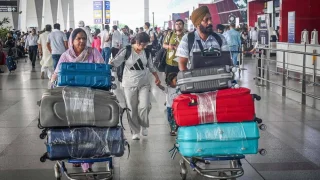
Among foreign nationals, Russian citizens led the inflow with 20,139 arrivals and 19,226 departures. They were followed by Ukrainians (6,937 and 3,658), Indians (5,685 and 4,456), Turks (5,341 and 3,328), and Azerbaijanis (5,574 and 2,547). An additional contribution comes from other countries, accounting for 25,712 immigrants and 22,329 emigrants, reflecting a widening geographic diversity of migration flows.
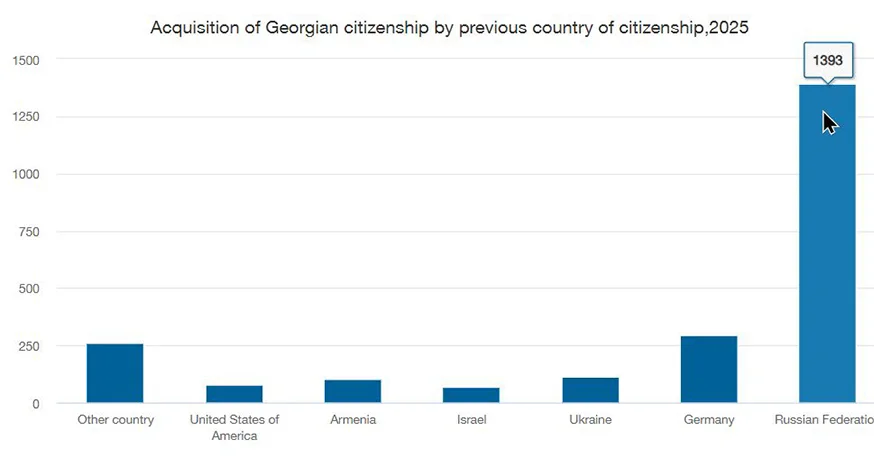
In 2025, 2,333 foreigners acquired Georgian citizenship, including 1,393 Russians, 296 Germans, and 114 Ukrainians. Citizenship was also granted to 104 Armenians, 81 US citizens, and 71 Israelis.
Foreign Inflows Support Key Sectors of Georgia’s Economy
Analysts from International Investment note that migration remains one of the key factors of Georgia’s demographic and economic stability. The government’s approach to regulating entry and residence is gradually changing, with more structured requirements, yet the country continues to maintain strong attractiveness for foreign relocation.
This is supported by a liberal visa regime, relatively low tax burden, business-friendly conditions, and regional security. The real estate market is also a major advantage, with a transparent property transaction system and no restrictions for foreign buyers.
Quality of life adds to this appeal, as the country combines seaside resorts and mountainous regions, a mild climate, rich historical heritage, and a high density of natural attractions. For many newcomers, property purchases become not only an investment decision but also a choice for permanent or seasonal residence.
Shifts in migration flows primarily benefit construction, the rental housing market, banking, services, retail, and tourism. As external demand remains strong, the impact of foreign inflows on Georgia’s economy is expected to grow further.