












China’s Tech Firms Buy Property
China’s real estate market remains in a prolonged downturn, but a new source of demand is emerging inside the sector: companies in artificial intelligence, e-commerce, esports and digital services are buying land, office buildings and commercial assets for headquarters, computing centers, studios and industrial parks. This is not a full turnaround for property, but it is selective support for commercial real estate while housing, developers and land sales remain under pressure.
Emerging sectors become property buyers
Yicai Global reported that companies in fast-growing industries are becoming more active buyers of commercial property in China, with some acquiring land for their own projects and others purchasing completed buildings for conversion. One example is Star Competitive Esports, an operator of esports clubs and related businesses, which bought a commercial plot in Haitang Bay in Sanya for more than CNY680 million, or about $94.6 million. The company plans to invest CNY1.4 billion in a project combining sports, culture and tourism.
Similar demand is coming from e-commerce and digital content. Wuyou Media, a leading livestream commerce operator, acquired a nearby plot at the end of 2024 for more than CNY600 million to develop an international livestreaming base, a global business operations center and an influencer industrial park. JD.com bought land in Hangzhou in April for CNY663 million to build a regional headquarters and a retail center for home appliances and home furnishing products.
Artificial intelligence is buying completed assets
The most telling segment is artificial intelligence, meaning technologies that allow software to process data, generate text, images, code and forecasts, and automate complex tasks. Zhipu AI, one of China’s prominent large-model developers, paid more than CNY360 million for Diamond Mansion in Beijing’s Zhongguancun Software Park, a technology cluster that hosts software and computing-infrastructure companies.
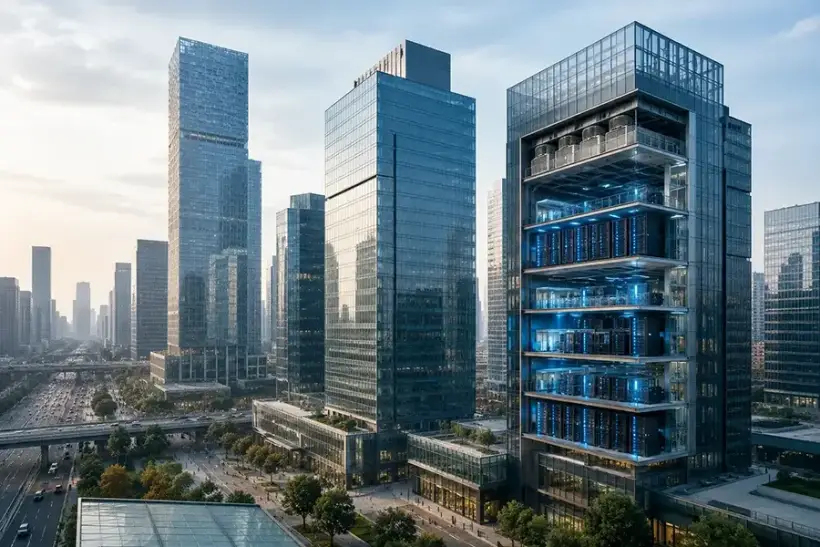
The choice is not only about prestige. Companies working with large AI models need power capacity, cooling, secure server rooms, network infrastructure and the ability to redesign buildings quickly for heavy computing loads. Buying an entire building or developing a site from scratch allows them to avoid standard office layouts that are often not designed for dense equipment use.
Lower prices created a deal window
One key driver is the repricing of office property. Mingyuan Real Estate Research Institute, cited in the source report, estimated that office asset prices in top-tier cities have fallen 30% to 40% from peak levels. For technology companies with strong cash flow, that turns real estate from an expensive luxury into a balance-sheet tool: a building can function as headquarters, collateral, an investment asset and part of a corporate ecosystem.
This demand differs from China’s older property model, where buyers were often households, developers and financial investors. The new buyers are acquiring assets not only for resale or rental income, but to control business infrastructure. For owners of vacant buildings, this creates an exit channel without extreme discounts, but the volume is still too small to offset the housing downturn.
The housing crisis remains the backdrop
China’s National Bureau of Statistics shows how weak the core market remains. In January-April 2026, real estate development investment fell 13.7% year on year, floor space sold in newly built commercial buildings dropped 10.2%, and sales value declined 14.6% to CNY2.3 trillion. That means demand from emerging sectors is supporting selected commercial assets, but not changing the overall direction of the property sector.
Chinese authorities have already made property stabilization a key task for 2026. In December, the policy agenda focused on reducing housing inventory, controlling new supply, acquiring existing homes for affordable housing, reforming the housing provident fund and developing new real estate models. In 100 cities, the time needed to clear housing inventory reached a record 27.4 months in November, underscoring the depth of the supply-demand imbalance.
Commercial real estate is splitting in two
CBRE forecasts that office net absorption in China may rise 10% to 15% year on year in 2026, while commercial real estate investment may increase 5% to 10%. Still, abundant supply remains the main headwind for the office market, and demand growth is expected to come mainly from technology and financial companies supported by policy around artificial intelligence and new productive forces.
That means the market is becoming more selective. Modern buildings in technology clusters, business districts and locations with transport links, power capacity and flexible layouts have a chance to recover. Older offices without engineering upgrades, strong locations or clear industry positioning will compete on discounts rather than demand quality.
Logistics and industrial assets are changing with manufacturing
Demand from emerging sectors is not limited to offices. E-commerce, robotics, electric vehicles, batteries and cross-border trade companies need warehouses, research sites, showrooms and production-logistics hubs. But the market is uneven: some operators are building their own facilities, reducing demand for conventional leased warehouses.
In its 2026 China real estate outlook, annual warehouse net absorption is forecast to fall 20% year on year to about 8 million square meters, as export-linked logistics demand remains sensitive to trade risks and large cross-border e-commerce operators increasingly develop their own facilities.
The five-year plan strengthens emerging industries
Cushman & Wakefield links the 2026 commercial real estate outlook to the start of China’s 15th Five-Year Plan. The firm says the development of “new-quality productive forces” will support demand from technology, media and telecommunications, while AI-powered data centers will continue to attract investor attention. A data center is a specialized facility with servers, networks, storage, cooling and power systems that hosts the digital infrastructure of companies.
This logic makes property part of industrial policy. The key question is no longer only how many apartments households will buy, but where computing power, laboratories, headquarters, warehouses, production lines and service teams for new industries will be located. For cities, that means competing not only for developers, but for technology companies that can bring jobs, tax revenue and demand for supporting services.
Cities use property as an industrial tool
Sanya, Hangzhou and Beijing show three different models in the cited deals. Sanya is betting on tourism, culture, sports and digital entertainment, trying to expand its economy beyond hotels and resorts. Hangzhou is reinforcing its role as an e-commerce and platform-economy hub. Beijing is strengthening Zhongguancun as a technology core, where real estate is not just office space but infrastructure for AI developers.
For local governments, such transactions have two forms of value. They generate land-sale or asset-sale proceeds and help build industrial clusters. If suppliers, startups, service providers and training centers gather around a large buyer, a single transaction can become a source of long-term demand for a district.
New demand will not save the old model
Despite the activity of emerging sectors, it is too early to call a full recovery in Chinese property. Housing still suffers from weak buyer confidence, developer debt, excess inventory and lower expectations for price growth. Commercial property faces high office vacancy and competition among cities for the same tenants.
The difference is that commercial real estate is gaining a new type of buyer. This is not a speculator betting on land appreciation, but a company that needs the asset for operations. That model can be more durable, but it cannot scale instantly: not every technology firm is ready to buy a building, not every office can support servers, and not every city can build an ecosystem around one project.
Property is becoming part of corporate balance sheets
For technology groups, buying a building can improve cost control and reduce dependence on landlords. In a capital market that increasingly values tangible backing, owned real estate can also strengthen creditor confidence. But there is a downside: a large property purchase ties up capital, requires management, renovation and tax payments, and carries depreciation risk if industry demand changes.
The AI segment is especially sensitive. Computing infrastructure becomes obsolete quickly, energy requirements are rising, and competition among model developers remains intense. If a company buys a building for today’s computing architecture, it may need a different power, cooling and network configuration within a few years. The winners will not simply be property owners, but those able to upgrade assets flexibly.
The market is entering an asset-selection phase
Chinese property is gradually ceasing to be a single market in which almost everything rises together. Housing, offices, warehouses, data centers, tourism assets and industrial parks are moving in different directions. Demand from emerging sectors can support selected buildings and districts, but it does not offset falling development investment or weak mass-market housing.
For investors, the main conclusion is that China is becoming a market of selection rather than broad growth. Asset value increasingly depends on whether a property is tied to real industrial or digital demand. A building without a tenant and an industry function remains a problem even in a large city. A building that can become a headquarters, livestreaming center, AI park or computing facility has a new investment rationale.
As experts at International Investment report, the activity of emerging sectors in China’s property market is not evidence that the crisis is over, but a sign that demand is changing: real estate is becoming infrastructure for specific business models rather than a universal financial asset. The critical risk is that authorities and developers may overestimate this demand. A handful of technology-company transactions cannot absorb China’s excess housing and office supply if household confidence and buyer demand do not recover.