











Iceland Home Prices Fall in Real Terms
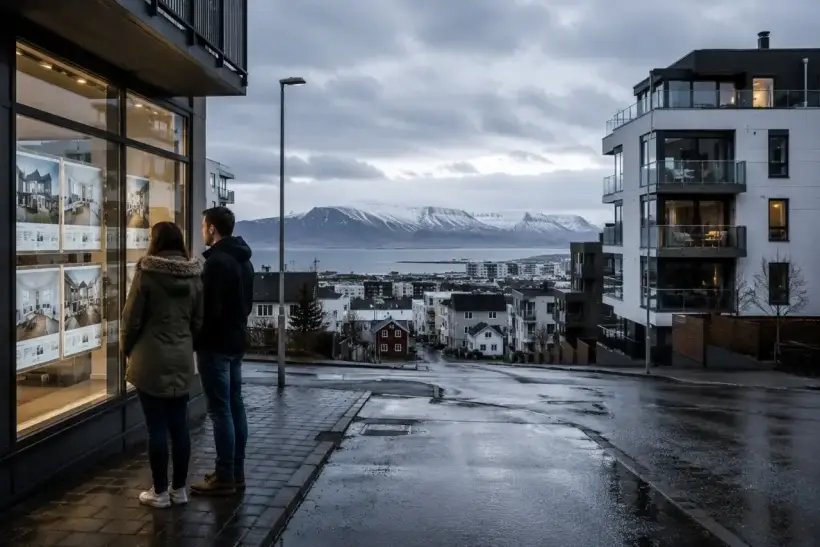
Iceland’s housing market is cooling not through a sharp nominal price slump, but through inflation-adjusted erosion: homes are still becoming more expensive in króna terms, yet prices are rising more slowly than the broader cost of living. For buyers, that brings a modest improvement in real affordability; for sellers, it weakens pricing power; for investors, it shifts the market away from easy capital gains and toward yield, financing costs and liquidity.
Real house prices are declining
Icelandic homes have fallen in real terms even as nominal prices continue to rise modestly. Iceland Review, citing figures from the Housing and Construction Authority, reported that inflation-adjusted house prices declined by 2.63% over the past 12 months. In practical terms, buyers may still be paying more in krónur, but the value of housing relative to the general price level has fallen.
That distinction matters in a market long viewed as structurally tight and expensive. A nominal index can keep rising while the real price of property declines if inflation runs faster than home-price growth. For households, this does not automatically mean affordable housing, because mortgage costs and everyday expenses remain high. For the market, however, it signals that earlier price momentum is no longer being supported by the same level of demand.
Inflation is outpacing property gains
Statistics Iceland said the consumer price index in April 2026 was 5.2% higher than a year earlier, while the index excluding housing costs rose 4.8%. The same release said the cost of owner-occupied housing, measured through imputed rent, increased by 0.8% during the month, while petrol, diesel and international airfares also made notable contributions to April price growth.
For housing, the effect cuts both ways. Inflation reduces the real value of homes already owned if their nominal price rises more slowly than consumer prices. At the same time, persistent inflation keeps pressure on interest rates and therefore on mortgage payments, limiting the number of buyers able to enter the market.
Nominal prices still rise, but momentum has weakened
Iceland has not entered a deep nominal housing downturn. CEIC data based on Statistics Iceland show the house price index reached 821.010 points in April 2026, up from 812.095 in March and the highest reading in a series starting in 2000. Year-on-year house-price growth was 3.7% in April after 3.2% in the previous month.
Still, this is no longer a double-digit growth market. Global Property Guide noted that Iceland’s national residential property price index rose 3.71% year on year in February 2026, down from a recent peak of 11.89% in September 2024. In the capital region, detached houses remained firmer than apartments, with prices up 5.35% and 4.38%, respectively.
Mortgage costs remain the main constraint
The Central Bank of Iceland lists the key interest rate at 7.50%, valid from 18 March 2026, alongside inflation of 5.2% and an inflation target of 2.5%. That combination means monetary policy remains tight and mortgage finance remains expensive for households, particularly first-time buyers and families with limited deposits.
High rates are changing behaviour across the market. Buyers compare homes for longer, borrow more cautiously and push harder for discounts. Sellers who became accustomed to rapid price growth have to adjust expectations. Banks and valuers are more focused on debt-servicing capacity because modest house-price growth no longer offsets high monthly mortgage costs.
Unsold new apartments are building up
Landsbankinn said in its April monthly review that housing prices rose by only 0.1% month on month in February and had been running below general price increases on an annualised basis in recent months. The bank also said purchase contracts fell by roughly 12% during the month, sales of new apartments were slow, and a new estimate from the Housing and Construction Authority showed the stock of unsold apartments was 41% higher than in the previous estimate from September 2025.
That figure is particularly relevant for developers. A growing stock of unsold units means the market is no longer automatically absorbing new supply at previous price expectations. For buyers, it may improve negotiating power, especially in new-build apartments. For developers, it raises holding costs, cash-flow pressure and exposure to bank financing conditions.
Reykjavík remains expensive, but less impenetrable
The capital region remains the centre of demand because of jobs, universities, tourism, government functions and services. Yet the decline in real prices shows that even Reykjavík is not fully shielded from inflation, high interest rates and more cautious demand.
For young families and first-time buyers, the market remains difficult. Even if homes become cheaper in real terms, deposits, mortgage rates and the overall cost of living continue to limit affordability. The cooling market is therefore not yet a social solution to the housing problem. It is more accurately a shift in bargaining power away from sellers and toward more patient buyers.
Rental pressure may persist
A decline in real house prices does not necessarily imply lower rents. With mortgages expensive, some would-be buyers remain in rental housing for longer, supporting demand. Landlords, meanwhile, factor borrowing costs, taxes, maintenance and vacancy risk into rent levels.
Iceland’s market is also sensitive to short-term rentals and tourism demand, because part of the housing stock in popular areas can compete for visitors as well as local tenants. If buying remains difficult while rental demand stays firm, pressure shifts from the sales market to the rental market.
Foreign investors face a less speculative market
For foreign buyers and investors, Iceland remains a small, costly and regulated market with limited supply of high-quality assets. A decline in real prices may look like an entry point, but high financing costs, exchange-rate risk, taxes, maintenance expenses and comparatively low liquidity require a more cautious model.
The main change is that relying solely on rapid capital appreciation is less convincing. Investors must assess net yield after costs, rental prospects, location, property type, energy efficiency, building condition and resale liquidity. In a small market, a poor entry price can take longer to correct than in larger European capitals.
Cooling does not erase the structural housing shortage
Iceland’s correction does not yet look like a distressed sell-off. Nominal prices remain above year-earlier levels, the index has reached new highs, and demand is supported by demographics, urbanisation and the concentration of economic activity around the capital. But the market can no longer ignore inflation, rates and rising supply.
The next quarters will depend on three factors: how fast inflation slows, how the Central Bank adjusts rates and whether developers adapt pricing to weaker demand. If inflation remains above target, real house prices may keep falling even with modest nominal gains. If rates begin to decline sustainably, demand could recover faster, especially in the capital region.
As International Investment experts report, the critical conclusion for Iceland’s housing market is that falling real prices do not equal affordable housing. Inflation erodes property values in real terms, but it also keeps credit expensive and living costs high. Iceland is therefore entering not a cheap-housing phase, but a stress test of pricing power: sellers must accept more moderate expectations, buyers must calculate the full cost of ownership, and investors must focus on real yield and liquidity rather than past capital gains.