







 Israel Cuts Rate to 3.25% for Third Meeting
 Russian and Belarusian Owners List More Latvian Property
 Georgian Law Enforcement Busts Scammers Posing as Real Estate Brokers
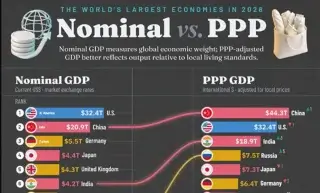 World’s Largest Economies in 2026: GDP and Purchasing Power Rankings
 Turkish Airlines Cancel Flights to Moscow
 Escalation in the Middle East: New US and Iranian Strikes
Cyprus Housing Outpaces EU Average

Cyprus’ housing market is again showing signs of pressure, with home prices and rents rising faster than the European Union average, while the island’s relatively low housing-cost burden no longer fully offsets affordability risks for younger buyers, tenants and mortgage households.
Prices and rents are rising faster than the EU average
Cyprus is entering a new phase of housing pressure not through a sudden speculative spike, but through steady accumulation. Cyprus Mail, citing new Eurostat data, reported that house prices in Cyprus rose 6% year on year in the fourth quarter of 2025, compared with a 5.5% average increase across the European Union. Rents rose 4.2% year on year in March 2026, ahead of the EU average of 2.9%. That means the island is no longer merely tracking the European market; it is beginning to outperform it on core housing-cost indicators.
Eurostat, the EU’s statistical office, uses comparable country-level data to monitor prices, rents, affordability, living conditions and household costs. For Cyprus, the new data matter because the country long looked less overheated than the Baltic states, Central Europe, Ireland or Portugal. That gap is now narrowing not because Europe is weakening, but because Cyprus is accelerating.
A low household burden no longer guarantees affordability
On the surface, Cyprus still looks relatively comfortable. The homeownership rate stood at 69.2% in 2025, slightly above the EU average of 68.5%. The share of people facing excessive housing costs was 2.4%, compared with 7.7% across the bloc. In 2024, Cypriot households spent 11% of disposable income on housing, the lowest share in the EU, versus an EU average of 19%.
Those indicators, however, do not remove the new pressure. Cyprus’ house price-to-income ratio rose 0.6% in 2024, while the EU recorded a 1.7% decline. In practical terms, housing on the island became less affordable relative to income, even though the overall payment burden remains lower than in Europe’s most strained housing markets.
For young families and first-time buyers, this is the more important metric. Low national averages can reflect high ownership among older generations, but they do not show how difficult it has become to enter the market in Limassol, Nicosia, Larnaca or Paphos.
The market is splitting owners and renters
Cyprus’ housing model has long rested on high ownership, family assets and relatively manageable debt burdens. Rising rents are changing that structure. Tenants feel pressure faster than owners because their costs are repriced more often, and new leases reflect current demand, tourism, foreign professionals and limited supply in popular districts.
Even with a low average housing-cost burden, 4.6% of Cyprus’ population was in rent or mortgage arrears, compared with 3% across the EU. That detail matters: the average picture looks comfortable, but a segment of households is already struggling with regular payments. Such gaps usually widen in cities where incomes lag rental growth.
The pressure is strongest where housing demand comes from several groups at once: local buyers, foreign investors, remote professionals, students, tourist rentals and companies relocating staff. In that environment, housing becomes not only a social asset, but increasingly an investment commodity.
Cyprus remains an exception in Europe’s long-run data
Between 2010 and 2024, EU house prices rose 53%, while rents increased 25%. The sharpest house-price increases were recorded in Hungary, Estonia and Lithuania, at 231%, 228% and 179% respectively. Rents rose fastest in Estonia, Lithuania, Ireland and Hungary. Against that backdrop, Cyprus and Italy were the only two EU markets where house prices did not rise over the full 2010–2024 period.
That is why the current acceleration is a significant signal. Cyprus was not the main symbol of Europe’s housing boom, but it is now starting to catch up with the broader trend. If growth continues, the market could quickly move from “relatively affordable” to one where the main issue is the entry barrier for new buyers.
Housing structure also matters. In Cyprus, 69.4% of homes are considered under-occupied, meaning they have more space than the households living in them are deemed to need. That is more than double the EU average of 33.4%. For the market, this points not only to high ownership, but also to inefficient use of the housing stock: some homes are large or underused, while young families and renters face a shortage of suitable units.
Construction is active, but may not solve the shortage
In theory, more supply should cool prices. In Cyprus, however, construction activity does not always match the need for affordable housing. New projects are often aimed at investors, higher-income buyers, foreigners or tourist locations, while demand for permanent urban housing remains tight.
Construction data show that permit activity remains strong. In November 2025, 850 building permits were authorised, covering 1,631 dwelling units. In January–November 2025, building permits reached 7,340, up from 6,442 in the same period of 2024, an increase of 13.9%. The figures point to supply expansion, but they do not answer the key question: where the homes are being built, at what price, and for which buyer.
That distinction is critical. If new supply is concentrated in expensive areas or investment apartments, it can support the construction sector without easing pressure on tenants and first-time buyers. In that case, higher building activity can coexist with worsening affordability.
Demand is supported by growth, tourism and foreign buyers
Cyprus remains one of the stronger economies in the EU. The European Commission projected gross domestic product growth of 3.4% in 2025, 2.6% in 2026 and 2.4% in 2027, pointing to resilient domestic demand, a strong services sector and record tourist arrivals early in the season. Gross domestic product measures the total value of goods and services produced by an economy over a year.
For real estate, this economic strength works both ways. It supports income, employment and bank lending, but it also increases housing demand. As tourism, business services, information technology and international migration expand, pressure concentrates in cities and coastal areas with limited land supply.
Foreign demand is a separate driver. International buyers see Cyprus as a European jurisdiction with a warm climate, English-language business practices, international schools, tax incentives and strong infrastructure for services companies. For the domestic market, however, this means local incomes compete with capital from buyers benchmarked against more expensive housing markets.
Professional indices show investor caution
The RICS Cyprus Property Price Index with KPMG in Cyprus tracks prices and rents across districts and major property types, including residential and commercial assets. In its first-quarter 2026 release, KPMG said the Cypriot economy was performing well, but concerns were rising over the impact of the war in the Middle East, including potential effects on energy costs and tourism. The firm said commercial property sentiment had already weakened, although that had not yet fully appeared in hard price data.
This matters for housing. Even if apartments and houses continue to rise, the market is becoming more sensitive to external shocks. Cyprus depends on tourism, aviation, international services, energy prices and regional stability. Any deterioration in these conditions can quickly change investor sentiment, especially in expensive coastal segments.
The central bank tracks the mortgage-risk channel
The Central Bank of Cyprus publishes residential property price indices based on valuations connected with bank mortgage transactions. The data cover areas under the effective control of the Republic of Cyprus — Nicosia, Limassol, Larnaca, Paphos and Famagusta — and use the first quarter of 2010 as the base period.
This source is important because mortgages link rising prices to household and banking stability. Cyprus is not yet showing classic overheating through widespread payment distress, but faster price and rent growth already requires attention. If housing costs rise faster than incomes, mortgage affordability deteriorates even when employment remains stable.
For banks, that means more cautious assessment of borrowers and collateral. For policymakers, it means distinguishing healthy market growth from a situation where housing is rising faster than households’ ability to pay.
Housing is becoming an EU political issue
Cyprus’ market is developing against a broader European housing debate. Eurostat updated its housing material on May 19, 2026, including tools for analysing prices, rents, affordability, construction and living conditions. That reflects a political shift: housing in Europe is increasingly seen not only as a private asset, but as a factor in social stability.
For Cyprus, this means local pressures will increasingly be measured against EU benchmarks. Short-term rentals, affordable construction, urban planning, mortgage risk and social support are likely to receive more attention in cross-country comparison.
As International Investment experts report, Cyprus’ main vulnerability is not the current housing-cost share, which still looks low by European standards, but the speed of market change. When prices and rents rise faster than the EU average, while incomes and affordable supply fail to adjust at the same pace, the country risks a delayed affordability crisis. It may not appear immediately in headline macroeconomic statistics, but it can emerge through later home ownership for younger families, greater rental dependence, pressure on urban budgets and a wider gap between existing property owners and new buyers.