













Foreign direct investment in Georgia increased by nearly 48% in early 2026
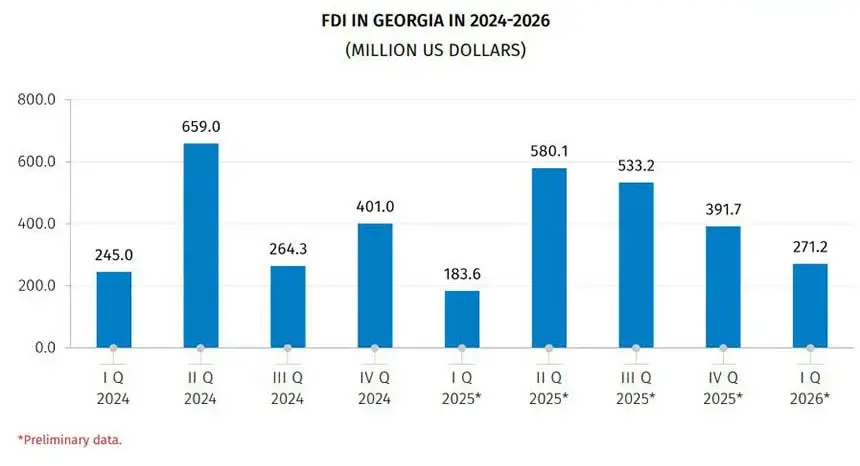
In the first quarter of 2026, foreign direct investment in Georgia amounted to $271.2 million. This is 47.7% higher compared to the same period in 2025, according to the National Statistics Office of Georgia (Geostat). The country remains attractive for foreign capital due to sustained economic growth, a stable and predictable business environment, transparent and straightforward market entry rules, and high returns in several sectors.
FDI dynamics in Georgia
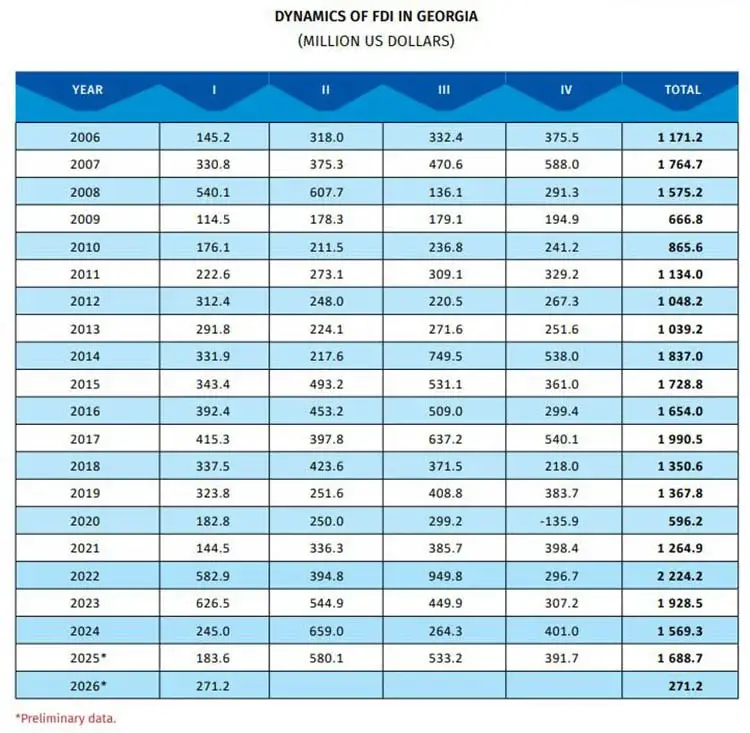
Data from the past 10 years shows an uneven trend in foreign direct investment (FDI) in Georgia. At the beginning of the period, inflows gradually increased, reaching local peaks in 2007 and 2014 at $1.76 billion and $1.84 billion, respectively. This was followed by periods of correction. In 2017, another peak was recorded at $1.99 billion, after which a decline followed, including a low in 2020 ($596.2 million).
In 2022, the indicator reached a record level of $2.22 billion, then decreased to $1.93 billion in 2023 and $1.57 billion in 2024. In 2025, the volume partially recovered to $1.69 billion. The beginning of 2026 showed a noticeably stronger performance: in the first quarter, investment inflows amounted to $271.2 million compared to $183.6 million a year earlier.
Structure of foreign investment in Georgia
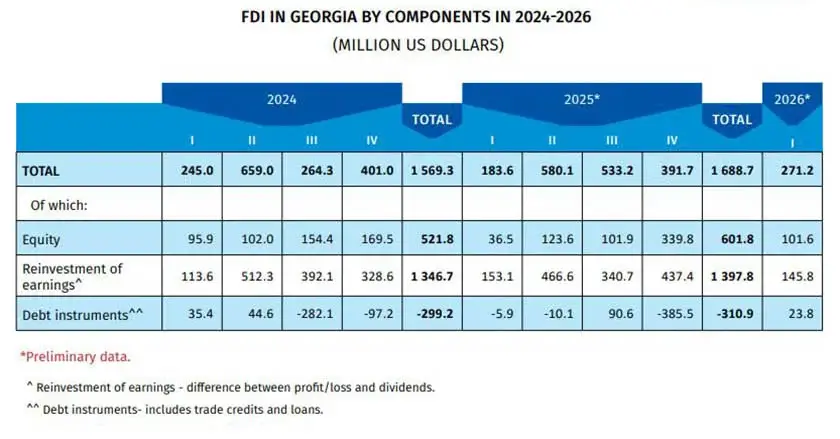
In the first quarter of 2026, the structure of foreign direct investment (FDI) in Georgia was largely driven by reinvested earnings, which amounted to $145.8 million, or 53.8% of the total. This means that more than half of all foreign investment came from companies already operating in the country that chose to retain and reinvest their profits for further business development.
Equity investments reached $101.6 million, accounting for 37.5% of total FDI. This component reflects direct capital injections into companies, both through the expansion of existing projects and new contributions to share capital.
Debt instruments totaled $23.8 million, or 8.8%. Unlike the previous year, when this indicator was negative, the return to positive territory points to improved external financing conditions and contributed to the overall growth of FDI.
Overall, the investment structure continues to rely heavily on reinvested earnings, while equity inflows provide a stable secondary source of capital. Debt instruments remain the smallest component, although their recovery served as an additional factor supporting positive dynamics in the reporting period.
Which countries invest in Georgia
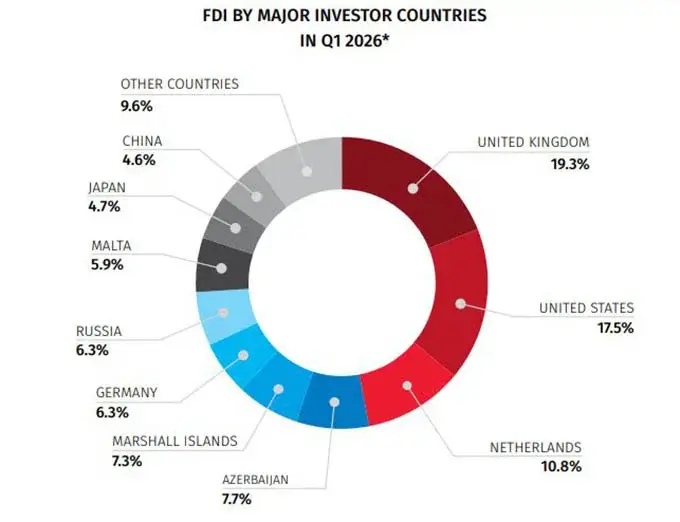
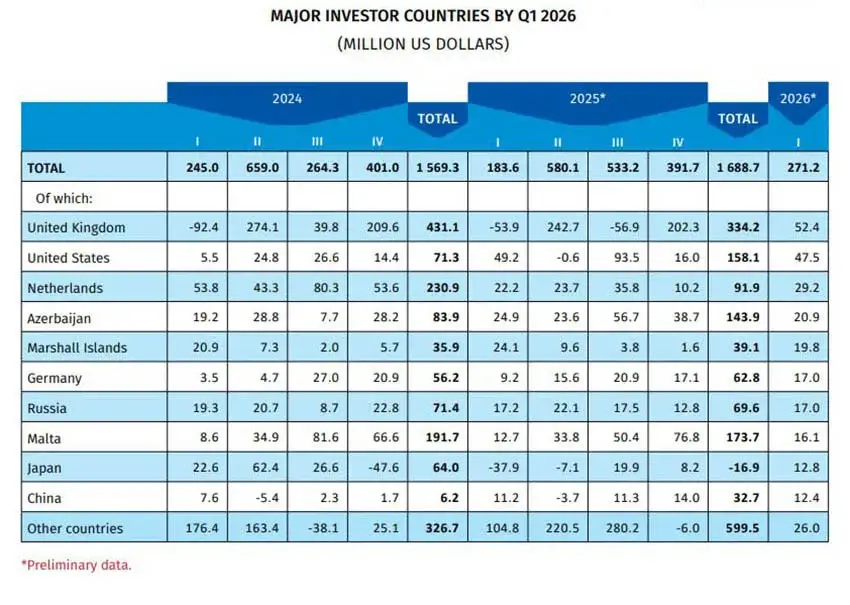
In the first quarter of 2026, the structure of foreign investment sources remained concentrated around a limited number of key countries. The United Kingdom led with $52.4 million. After negative figures in 2024 and a decline in 2025, the country returned to positive territory, generating the largest investment inflow in the reporting period.
The United States ranked second with $47.5 million. A steady upward trend is visible here, moving from a weak performance in 2025 to stronger results at the beginning of 2026. The Netherlands came third with $29.2 million, showing a more stable pattern without sharp fluctuations and maintaining a consistent level of investment.
Azerbaijan accounted for $20.9 million. After growth in 2025, the figure declined in the first quarter of 2026, although the country continues to maintain a notable presence among investors. The Marshall Islands invested $19.8 million, reflecting the typical volatility associated with offshore jurisdictions.
Germany and Russia recorded identical results of $17 million each. In both cases, the trend remains relatively stable, with no significant changes in recent periods. Malta posted $16.1 million. After higher levels in 2024 and a decline in 2025, the country continues to maintain a stable position in the investment structure.
Japan reported $12.8 million, recovering after a negative result in 2025. Chinese investment in Georgia also recovered, reaching $12.4 million.
Overall, the United Kingdom, the United States, and the Netherlands accounted for 47.6% of total foreign direct investment. This confirms that the bulk of capital continues to be generated by a limited group of key investor countries.
The most attractive sectors for investment in Georgia
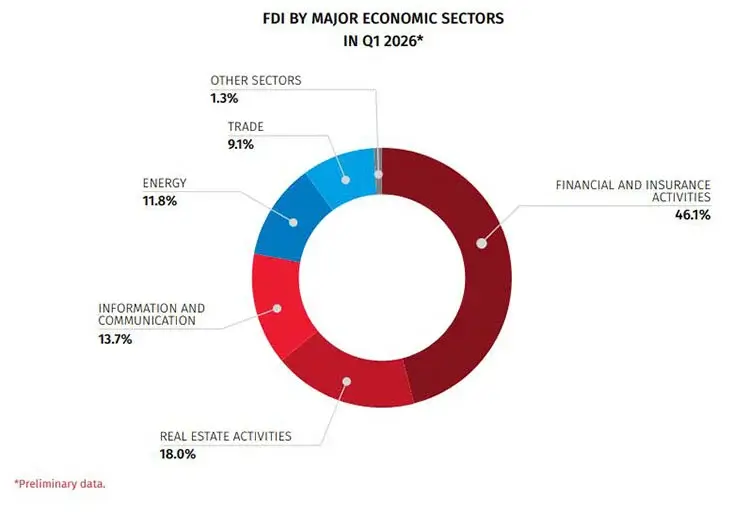
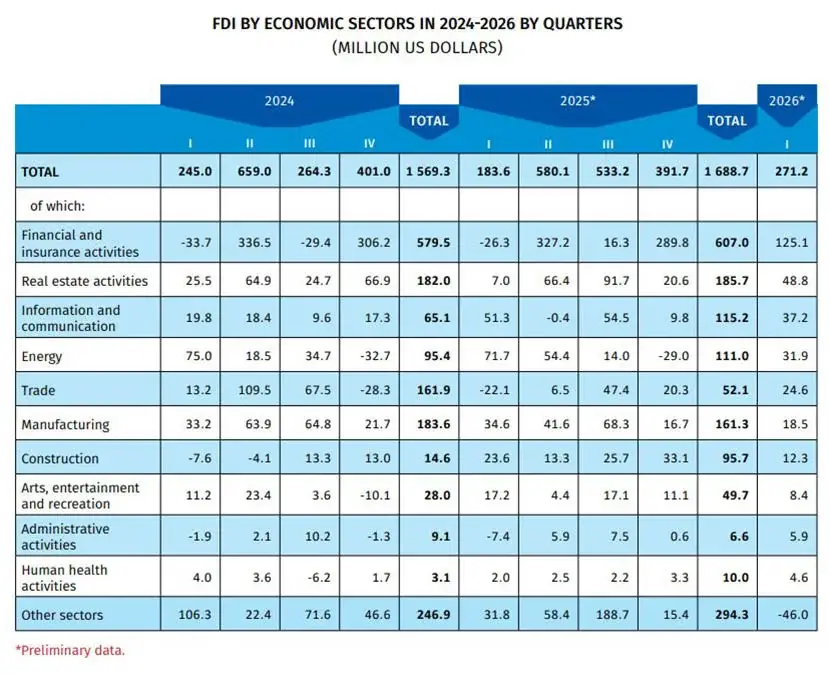
The most attractive sector for foreign investors was financial and insurance activities. In the first quarter of 2026, this sector received $125.1 million, accounting for 46.1% of total FDI. This means that nearly every second dollar of foreign investment flowed into the financial sector.
The second-largest segment was real estate activities, which attracted $48.8 million or 18% of total inflows. The third-largest recipient of foreign capital was the information and communication sector, which received $37.2 million, or 13.7% of total foreign investment.
Significant inflows were also recorded in energy ($31.9 million), trade ($24.6 million), and manufacturing ($18.5 million). Construction received $12.3 million, arts, entertainment and recreation $8.4 million, administrative activities $5.9 million, and human health activities $4.6 million.
The combined share of the three largest sectors — financial and insurance activities, real estate activities, and information and communication — reached 77.8% of all foreign direct investment in Georgia in the first quarter of 2026.
Conclusion
First-quarter data indicates a recovery in investment activity after a relatively weak start to 2025. The increase in foreign direct investment was driven primarily by higher equity inflows and improved dynamics in debt instruments. At the same time, FDI remains highly dependent on reinvested earnings from foreign companies already operating in the country.
The data also shows a high concentration of investment both by country of origin and by sector. Nearly half of all inflows came from three countries, while more than three-quarters were concentrated in three key sectors — financial services, real estate, and information and communication.
Analysts at International Investment note a weakening interest in residential real estate, where declining returns are being recorded. At the same time, market pressure is increasing due to an oversupply and ongoing active construction in the country. Investment focus is gradually shifting toward the hotel sector, which benefits from rising tourist flows and higher occupancy rates. Premium hotels show the highest returns, while their number in Georgia remains limited, creating additional opportunities for investors.