







 Covivio Hotels Revenue Grows 4.7% as European Markets Split
 Lithuanian Apartment Prices Accelerate Across Major Cities
 Georgia's Tourism Revenue Hits Record High
 Norway's Sovereign Fund Commits €1.5bn to European Warehouses
 Market Rout of October 2026: Can Branded Hotels Protect Capital?
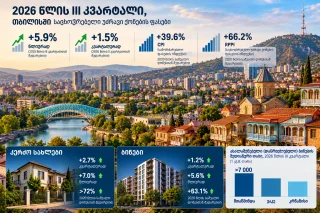 Residential Property Prices in Tbilisi Rise by 5.9% Year-on-Year
Estonian Developers Expand in Riga

Estonian property developers are expanding their residential portfolios in Latvia. Invego, Reterra and Hepsor are increasing their exposure to Riga, where land remains cheaper than in Tallinn according to developers active in both markets and some projects can move through permitting more quickly. Latvia's housing market is already strengthening, however: prices rose 11.4% year on year in Q2 2026, while an expanding new-build pipeline is increasing competition among developers.
Estonian developers increase their Riga exposure
Latvia is becoming an increasingly important foreign residential market for Estonian developers. Lower land costs in Riga, a smaller share of modern housing in the existing stock and the potential for shorter development timelines are among the main attractions.
Luminor Bank partner relations manager Elar Ollik said new developments still represent a smaller proportion of Riga's housing stock than they do in Tallinn, giving developers more room to expand. He also pointed to improving borrowing capacity among Latvian households.
Permitting is another factor. Invego CEO Kristjan-Thor Vähi estimates that detailed planning and building permits can take roughly one-third as long in Latvia as in Estonia. Reterra CEO Reigo Randmets cited a more extreme comparison: six years to obtain a permit for the Hipodroomi project in Estonia versus seven months for the company's latest Latvian permit. Randmets himself described those cases as extreme and acknowledged that purchasing power is lower in Latvia and that homes are not necessarily easier to sell in Riga, ERR reported.
Riga's advantage is therefore primarily about development costs and timelines rather than guaranteed stronger demand.
Latvian home prices rise 11.4%
Latvia's lower housing price level does not mean the market has been stagnant.
Residential prices increased 3.9% quarter on quarter and 11.4% year on year in Q2 2026. New dwellings were only 1.7% more expensive than a year earlier, while existing homes rose 13.3%, according to Latvia's Central Statistical Bureau.
The distinction matters for developers because most of the current national price growth is coming from the secondary market rather than new construction.
Quarter on quarter, new dwellings increased just 0.7%, compared with 4.6% for existing homes. The headline double-digit annual housing increase therefore should not be treated as equivalent growth in Riga new-build prices.
Riga's new-build market has recovered
More than 2,100 new apartments changed hands in the Riga region in 2025, generating transaction volume of more than €310 million. Developers reduced completed unsold stock while starting more projects.
A fully finished apartment in a new Riga-region development cost around €2,770 per sq m on average, according to Colliers. The consultancy expects a substantial volume of new supply to enter the market during 2026 and 2027 as recently launched schemes reach completion.
This figure should not be directly compared with average asking prices for Tallinn new builds because the methodologies, geographic coverage and transaction stages differ.
The data nevertheless illustrate why developers increasingly treat Riga as a separate growth market rather than simply a cheaper version of Tallinn.
Tallinn remains a much more expensive new-build market
Approximately 3,200–3,300 new apartments were offered across 106 Tallinn developments in Q2 2026, around 12% more than a year earlier.
Developers sold 325 new apartments during the quarter, 13% fewer than in Q2 2025. The average asking price reached €5,329 per sq m, up 5.6% year on year. District averages ranged from about €4,050 per sq m in Haabersti to €6,740 in Pirita.
The figures were published by Arco Vara, which also pointed to higher development costs and tighter building requirements as factors supporting asking prices.
High prices and a large number of competing projects make Tallinn an increasingly demanding market. Developing in both Riga and Tallinn allows companies to spread their exposure across two housing markets with different land costs, price levels and supply conditions.
Invego commits €38 million to Nordale
Nordale in Riga's Mežciems district is one of the largest recent examples of Estonian expansion.
Invego plans to invest €38 million in the first phase, which will contain 159 homes and commercial premises. The wider development will be built in several stages across several hectares near Biķernieki forest and the historic Riga Film Studio area.
The company has also signed a €29.8 million construction contract including value-added tax with Aimasa for the first phase.
Invego announced the project and its investment volume in March 2026 on its corporate website.
The scale of Nordale shows that Estonian expansion into Latvia has moved beyond isolated apartment buildings.
Invego and Reterra advance Miera Rezidences
Another major development is Miera Rezidences on Miera Street in Riga, jointly developed by Invego and Reterra.
The project represents about €40 million of investment and will provide 172 apartments in two phases. It received its building permit in May 2026.
The developers began marketing the project earlier and said almost 1,000 potential buyers had registered interest. Expressions of interest should not be confused with completed sales contracts.
Details of the permit and project scale were published by Invego.
The development also illustrates another route into a foreign market: two Estonian companies are sharing capital and development risk on the same Riga scheme.
Hepsor expands its Latvian pipeline
Hepsor is also increasing its residential development activity in Riga.
At the end of June 2026, the group had 513 apartments under construction in Estonia and Latvia, including 223 in Latvia.
The company plans to start the Starta 17 development in Riga, which is intended to deliver 255 homes in several phases. A second phase at Braila iela 23 is expected to add another 35.
In July, Hepsor also signed a preliminary agreement to acquire properties on Meža iela for a planned 48-apartment development, with construction scheduled to start in the second half of 2027.
Across all of its markets, Hepsor signed initial and final sale agreements for 129 apartments during H1 2026, 36% more than a year earlier, according to its half-year report.
The 129 contracts were group-wide and should not be presented as Latvian sales alone, but the construction pipeline confirms the growing importance of Riga within Hepsor's portfolio.
Faster permits can reduce financing costs
Development timelines have a direct impact on project economics.
A developer commits capital to land, design and preparatory work well before apartments are completed and handed over to buyers. If a site spends several years in detailed planning or permitting, capital remains tied up and financing expenses increase.
Randmets told ERR that a five-year detailed planning process could add roughly €1,000 per sq m to the eventual apartment price. This is a developer's estimate illustrating the potential cost of delay rather than a standard surcharge applying to all Estonian housing projects.
Actual approval times depend on the site, planning status, project size, infrastructure requirements and possible appeals.
It would therefore be misleading to conclude that every Latvian development is approved three times faster than an equivalent Estonian project. The comparison reflects the experience of individual developers.
More construction will increase competition in Riga
Riga's lower price level may become less of an advantage as additional projects reach the market.
Nordale will add 159 homes in its first phase alone, while Miera Rezidences will deliver 172. Hepsor is preparing and constructing hundreds of units, and local and other international developers are expanding their pipelines as well.
Companies attracted by lower competition are therefore contributing to a larger supply themselves.
Purchasing power remains crucial. Cheaper land improves project economics only if units can be sold at sufficient prices and at an adequate pace.
The latest official housing data also show that Latvia's rapid headline price increase is being driven mainly by existing homes. New-dwelling prices rose just 1.7% year on year in Q2, leaving developers with less scope to offset higher construction costs through rapid price increases.
As International Investment experts report, expansion into Latvia is a logical way for Estonian developers to diversify across two neighbouring markets, but cheaper land does not automatically make a project more profitable. Riga combines lower entry costs with lower purchasing power and a growing supply pipeline. For investors, the cost of a specific site, permitting time, sales pace and competing supply at completion are more important than the headline price difference between Riga and Tallinn.
FAQ: Riga and Tallinn new-build markets
Why are Estonian developers expanding in Latvia?
Developers cite cheaper Riga land, a smaller share of modern housing in the existing stock and shorter approval periods for some projects. They also acknowledge that Latvian household purchasing power is lower.
How fast are Latvian housing prices rising?
Housing prices increased 11.4% year on year in Q2 2026. New dwellings rose only 1.7%, while existing homes increased 13.3%.
How much do new apartments cost in Riga?
In 2025, a fully finished apartment in a new Riga-region development cost around €2,770 per sq m on average. Actual prices vary considerably by location and market segment.
How much do Tallinn new builds cost?
The average asking price was about €5,329 per sq m in Q2 2026. This is an asking-price measure and is not directly comparable with Riga's average transaction price.
Which Estonian developers are active in Latvia?
Invego, Reterra and Hepsor are among the companies currently expanding residential development portfolios in Riga and its surrounding area.
How much is Invego investing in Nordale?
The first phase involves €38 million of investment and will provide 159 homes plus commercial premises.
How large is Miera Rezidences?
The Invego and Reterra project represents about €40 million of investment and includes 172 apartments. It received its building permit in May 2026.
Why do permitting times matter to developers?
Long approval periods keep capital tied up before construction and sales revenue can be realised, increasing financing and site-holding costs.