







 Vietnam Mortgage Surge Pushes Homes Out of Reach
 Lithuanian Apartment Prices Accelerate Across Major Cities
 London Flats Lose Value Ahead of Leasehold Reform
 Construction of the Batumi–Sarpi Highway Begins in Georgia
 Baltic Property Investment Accelerates in 2026
 Hong Kong and Singapore Renew Their Expat Rivalry
French Inflation Moves Back Toward Two Percent
France Sees Inflation Pick Up Again
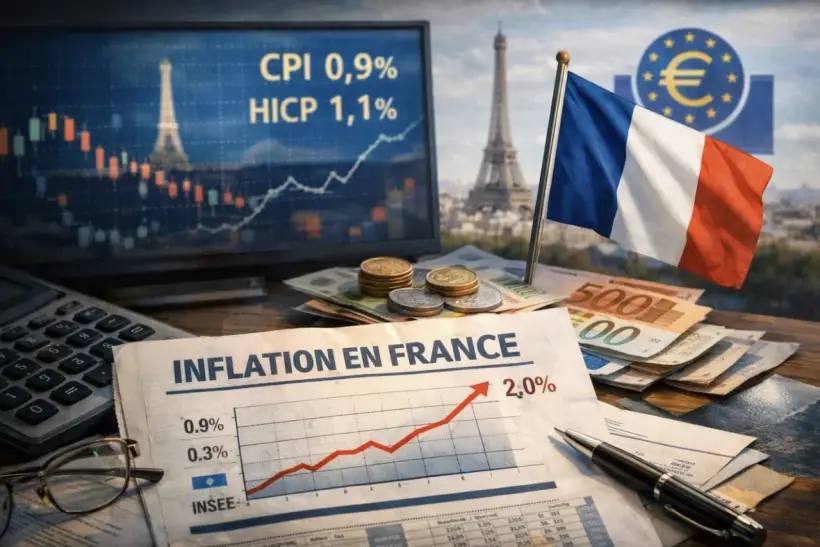
French inflation is accelerating again after an unusually weak start to the year, and markets are increasingly focused on whether price growth will move back toward the European Central Bank’s 2% target this spring. According to INSEE, France’s national statistics institute, consumer prices rose 0.6% month on month and 0.9% year on year in February 2026, after a 0.3% annual reading in January. The harmonised index of consumer prices, or HICP, which is the comparable European inflation gauge, increased 1.1% after 0.2% a month earlier.
Why France’s Inflation Rate Accelerated
INSEE attributes the rebound primarily to energy. Energy prices were still falling on an annual basis, but the drop was much less pronounced in February, at minus 2.9% after minus 7.6% in January. The agency said that reflected a base effect linked to electricity prices, which had fallen sharply in February 2025. Manufactured goods also exerted less downward pressure because the timing of winter sales in 2026 shifted more discounting into January and less into February.
That matters because France had briefly looked like one of the euro area’s softest inflation stories at the start of 2026. Bloomberg reported on February 27 that French inflation rose more than economists expected and reinforced the case for the ECB to keep rates steady rather than cut further. In that earlier report, Bloomberg said consumer prices had outpaced the median forecast in its survey of economists.
INSEE Outlook and the Return to the ECB Target
While the Bloomberg article in your link is not directly accessible, the broader narrative of French inflation returning toward 2% is consistent with the official late-March backdrop. The Banque de France said in its first-quarter 2026 survey that median one-year-ahead inflation expectations among businesses rose to 2%, while medium-term expectations over a three-to-five-year horizon remained anchored at 2%. For markets, that is a meaningful signal: actual inflation is still below target, but expectations have already moved back to the level the ECB defines as price stability.
The ECB itself states that price stability is best maintained by aiming for 2% inflation over the medium term. That means even if France’s monthly readings remain volatile because of energy, seasonal sales, fuel or tax effects, investors will focus less on a single monthly jump and more on whether the trend is becoming durable enough to sit close to that benchmark.
CPI and HICP: What the Inflation Measures Mean
In the French context, it is important to distinguish between CPI and HICP. CPI is the national consumer price index used to track price changes for households in France. HICP stands for Harmonised Index of Consumer Prices and follows a common European methodology that allows comparisons across EU member states. INSEE explains that both are instruments for measuring inflation, but HICP is especially important for euro-area policy comparisons. From 2026 onward, the HICP framework also reflects methodological changes linked to updated European regulation, including the coverage of categories newly integrated into the index.
For readers, the practical takeaway is straightforward. When analysts refer to French inflation, they may be talking about two closely related but not identical measures. France’s national CPI was 0.9% year on year in February, while the HICP reading was 1.1%. The difference is small, but HICP is more directly tied to the wider euro-area policy debate.
What Rising Inflation Means for Rates and Growth
The inflation story matters because France’s economy is still growing slowly. The European Commission’s latest country forecast said French economic activity was expected to slow to 0.7% in 2025 and expand by only 0.9% in 2026. In that environment, even a moderate inflation rebound complicates policy choices. Cutting rates too early could risk reigniting price pressures, while keeping policy too tight for too long could weigh further on domestic demand.
INSEE’s own economic dashboard showed that the next French consumer-price release was due on March 31, 2026. That made the end of March a crucial test for markets trying to decide whether February’s rebound was mainly a one-off base effect or the start of a broader move back toward the 2% zone.
As International Investment experts report, the French inflation rebound matters well beyond macroeconomics headlines. It affects mortgage pricing, property financing, corporate borrowing and consumer credit across one of Europe’s largest economies. The closer inflation moves to 2%, and the more sustainable that move appears, the less room the ECB may have for aggressive policy easing. For investors, the key issue is not simply that inflation is rising again, but what is driving it, especially the relative role of energy, services and base effects.
FAQ
What happened to French inflation in February 2026
INSEE said annual CPI inflation rose to 0.9% from 0.3% in January, while HICP increased to 1.1% from 0.2%.
Why did inflation accelerate
INSEE pointed mainly to a less pronounced fall in energy prices due to an electricity-related base effect, alongside a smaller drop in manufactured goods prices because of the timing of winter sales.
What is a base effect
A base effect occurs when current annual inflation changes partly because the comparison month a year earlier was unusually low or high. In this case, February 2025 electricity prices had fallen sharply.
What does the ECB’s 2% target mean
The European Central Bank says price stability is best maintained by aiming for 2% inflation over the medium term.
What is the difference between CPI and HICP
CPI is France’s national consumer price index, while HICP is the harmonised European measure used for cross-country comparison and euro-area policy analysis.