







 Vietnam Mortgage Surge Pushes Homes Out of Reach
 Lithuanian Apartment Prices Accelerate Across Major Cities
 London Flats Lose Value Ahead of Leasehold Reform
 Construction of the Batumi–Sarpi Highway Begins in Georgia
 Baltic Property Investment Accelerates in 2026
 Hong Kong and Singapore Renew Their Expat Rivalry
French inflation picked up in March
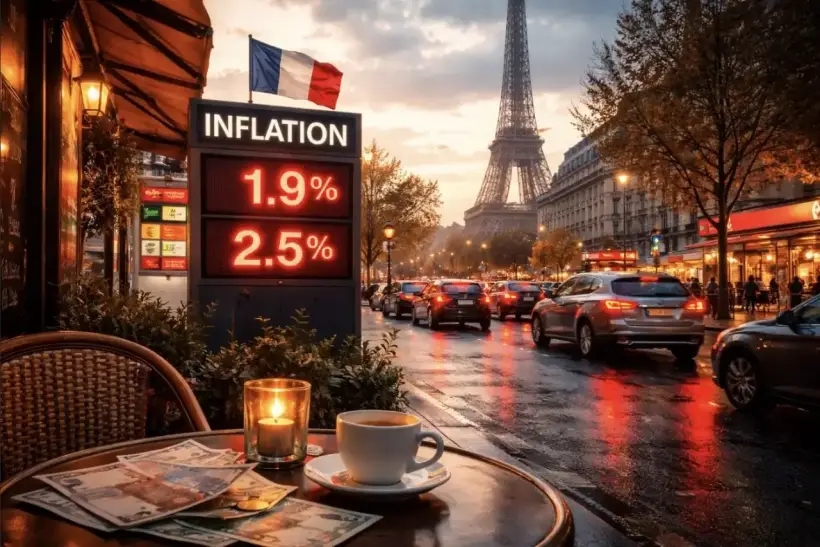
French inflation accelerated in March to its highest level since August 2024 as the energy shock triggered by the war around Iran and higher oil prices started feeding into consumer prices. Bloomberg reported on March 31 that the renewed rise in French inflation was driven by the war-related jump in energy costs, adding France to the broader list of European economies hit by the same external shock.
According to preliminary figures, France’s harmonised inflation rate rose to 1.9% year on year in March from 1.1% in February. That was the highest reading since August 2024. Market aggregators based on the preliminary national release also showed France’s headline CPI rising to 1.7% from 0.9% a month earlier.
Energy prices are reshaping France’s inflation path
France’s price trend had already begun to turn in February. INSEE said consumer prices rose 1.0% year on year in February after 0.3% in January, largely because the decline in energy prices became less pronounced owing to a base effect from electricity prices that had fallen sharply in February 2025. March data suggest the energy component is no longer just a favorable base effect fading away, but a renewed external inflation driver.
The broader European backdrop confirms that shift. Eurostat said euro-area inflation accelerated to 2.5% in March from 1.9% in February. AP reported that energy prices reversed course and rose 4.9% in March as the war involving Iran heightened supply concerns around the Strait of Hormuz. France’s inflation rebound therefore fits into a wider energy-price shock rather than a purely domestic development.
Why France’s inflation rebound matters for the ECB
The March move matters not only for France, but also because the country remains one of the largest price setters in the euro area. When even French inflation, which had stayed relatively subdued, begins to accelerate meaningfully, pressure on the European Central Bank rises at a time when markets had been expecting a calmer inflation path.
The Wall Street Journal reported that euro-area inflation reached its highest level in more than a year, while AP said investors and analysts were increasingly focused on the risk that the ECB may need to respond more forcefully if energy costs start generating second-round effects through wages, transport and services. That matters for France because the inflation rebound is occurring alongside weaker confidence and higher household price expectations.
How the Iran war fed into French consumer prices
The link between French inflation and the conflict runs mainly through oil and energy markets. Bloomberg and other international reports say the war around Iran has sharply increased crude prices and heightened fears over supply disruptions through the Strait of Hormuz. The Guardian reported on March 31 that Brent crude rose above $118 a barrel during the day. That raises pressure on fuel, transport and a range of imported cost components across Europe, including France.
The ECB’s March staff projections already laid out an energy-stress scenario in which oil could peak at $145 a barrel in the second quarter of 2026, while gas could reach €106 per MWh. Under that scenario, headline inflation in the euro area would be significantly higher than in the baseline by 1.8 percentage points in 2026, 2.8 points in 2027 and 0.7 points in 2028. Even if France’s inflation remains more moderate than in some other countries, that still points to a much more fragile price outlook over coming quarters.
Why France still looks less inflationary than parts of Europe
Despite the rebound, France remains below the euro-area average. Its 1.9% harmonised inflation rate is still well under the bloc-wide 2.5% figure. That suggests France has so far been relatively better shielded from a full pass-through of the energy shock into the consumer basket. But the change in direction matters more than the level itself, because France had been one of the more stable large euro-area economies on inflation.
There is also a France-specific risk around expectations. Bloomberg reported on March 26 that French economic confidence had weakened and households’ inflation expectations had surged to the highest level since September 2022. If those expectations become entrenched, the energy shock may turn from a short-lived spike into a broader repricing of goods, services and household spending behaviour.
What the March data mean for the French economy
For French households, the March inflation figure mainly means more expensive energy and a higher risk that transport and living costs will rise further in the second quarter. For businesses, it is a signal that logistics and input costs may climb at a time when European demand remains weak and financial conditions could become tighter. For policymakers, it suggests that the path back to comfortably low inflation may be interrupted sooner than markets had assumed at the start of the year.
At the same time, the March acceleration does not amount to a return to the inflation crisis of 2022 and 2023. Even after the rebound, French inflation remains far below the peaks of recent years. The problem is that the new increase is being driven not by overheating domestic demand, but by an external geopolitical shock that monetary policy can only partly address. That makes even a moderate increase more difficult for policymakers than a higher but more predictable domestic inflation cycle.
As International Investment experts note, March’s pickup in French inflation is not dramatic in absolute terms, but it is important because it marks a clear change in direction. France had remained one of the more stable large euro-area economies on inflation, which is why even a rise to 1.9% in HICP terms now reads as a meaningful warning. The critical issue is no longer the March figure itself, but whether the shock stays concentrated in energy or starts spreading into transport, services and broader inflation expectations.
FAQ
What was France’s inflation rate in March 2026
France’s harmonised inflation rate rose to 1.9% year on year in March from 1.1% in February, according to preliminary figures. That was the highest level since August 2024.
Why did French inflation accelerate
The main reason was higher energy prices linked to the war around Iran and the resulting jump in oil prices across Europe.
What do INSEE figures show about France’s CPI trend
INSEE had already recorded CPI at 1.0% in February after 0.3% in January, with energy playing a major role. March preliminary figures suggest that upward trend intensified.
How does France compare with the euro area
France’s 1.9% HICP remains below the euro-area average of 2.5%, but both France and the wider bloc are moving in the same direction because of higher energy prices.
Could the ECB tighten policy because of this inflation rebound
Markets are increasingly considering that possibility, especially if the energy shock begins to spill over into broader price pressures.
Why are the March data important for France
They show that even France’s relatively moderate inflation profile can be disrupted quickly by an external commodity shock, making the near-term price outlook less predictable.