







 Vietnam Mortgage Surge Pushes Homes Out of Reach
 Lithuanian Apartment Prices Accelerate Across Major Cities
 London Flats Lose Value Ahead of Leasehold Reform
 Construction of the Batumi–Sarpi Highway Begins in Georgia
 Baltic Property Investment Accelerates in 2026
 Hong Kong and Singapore Renew Their Expat Rivalry
Hungary Eyes June Rate Window
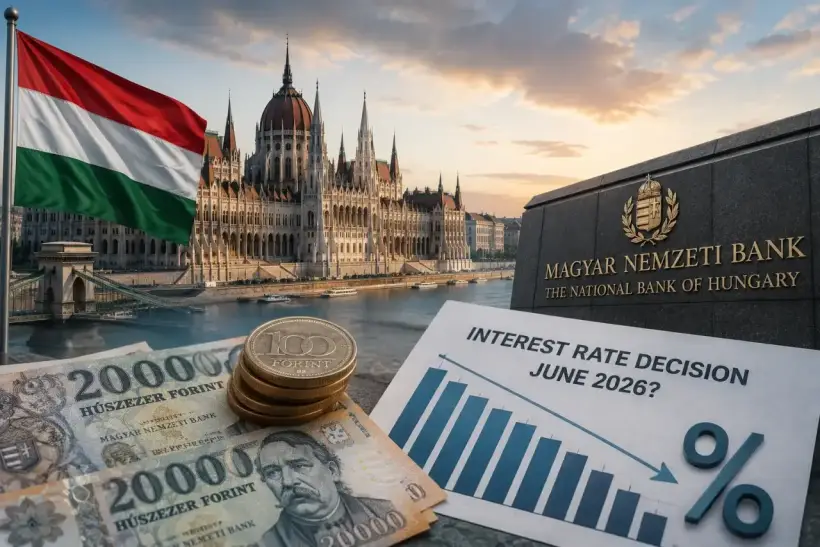
Hungary’s central bank is again balancing currency stability against the need to ease financial conditions for a weak economy. Bloomberg reported on May 7, 2026, that Budapest may look to June as the next possible window for a rate move after the forint strengthened.
A stronger forint revives the rate-cut debate
The forint has become the main argument for a cautious return to monetary easing. According to the European Central Bank, the exchange rate stood at 355.85 forints per euro on May 7, 2026, the strongest level in the one-year series available on the regulator’s page; the weakest point in that period was 406.13 forints per euro.
For Hungary, the exchange rate matters directly for inflation. A stronger forint reduces the cost of imported goods and energy, helping the central bank contain price growth without raising borrowing costs further. That is why currency stability has become one of the key variables in monetary decisions.
The base rate remains high by regional standards
After a 25-basis-point cut in February, the National Bank of Hungary’s base rate stands at 6.25%. That was the first reduction in almost 18 months, but the central bank quickly returned to a cautious stance.
The high rate keeps forint assets attractive for investors. Hungary still offers a positive yield spread over the euro area, supporting demand for local-currency bonds and deposits. For the domestic economy, however, expensive credit means weaker demand, slower corporate investment and pressure on the housing market.
The policy calendar puts June in focus
The official schedule of the National Bank of Hungary shows policy meetings on May 26 and June 23, 2026. The minutes are scheduled for publication on June 10 and July 8.
That makes June the key market reference point. The May meeting may preserve a cautious tone, while the June decision could offer more room for action if the forint remains strong, inflation does not accelerate and external risks do not worsen.
Inflation has eased, but risks remain
Conditions for cautious easing look better than in 2024 and 2025. Hungary previously suffered some of the most painful inflation in the European Union, while a weak forint amplified import-price pressure. The central bank has emphasized that its new leadership focused on stability and trust, producing lower inflation, a stronger forint and record-high reserves.
Still, the problem is not fully resolved. Hungary remains sensitive to energy prices, external trade, fiscal spending and political risk. Even with a stronger currency, policymakers need evidence that disinflation is durable rather than temporary.
The economy needs cheaper credit
High rates support the forint but restrain growth. The European Commission previously projected Hungarian inflation to moderate from 4.5% in 2025 to below 4% in 2026 and 2027, while warning that inflationary pressures and fiscal deficits remain elevated.
For the government and businesses, a rate cut would be an important signal. Cheaper credit could support investment, consumption and construction. But premature easing could weaken the forint and revive inflation risks, especially if investors conclude that the central bank is responding to political pressure rather than data.
Markets expect a cautious signal, not a sharp pivot
The key question is not whether Hungary will cut aggressively, but whether the central bank will start defining a new path. The February move proved that easing is possible. The following months showed that Budapest is not ready to trade currency stability for a rapid revival of lending.
ING analysts, according to financial-market coverage, expected the central bank to keep the 6.25% base rate through 2026, linking the cautious stance to geopolitical uncertainty, energy prices and Hungary’s vulnerabilities.
The forint has become a policy and investment indicator
The currency’s strength matters beyond inflation. It reflects investor expectations about the budget, European Union funds, regulatory independence and Hungary’s ability to stabilize economic policy. In a country where the exchange rate has often served as a confidence gauge, the forint now sets the boundaries of monetary policy.
If the currency remains strong, the central bank gains room to reduce rates carefully. If the forint weakens quickly, policymakers may need to return to firm guidance and high yields on local-currency instruments.
Hungary remains a high-yield, high-risk market
Hungarian bonds and the forint remain attractive to investors seeking yield in Central Europe. But that appeal depends on a delicate sequence: high rates support the currency, a stronger currency helps reduce inflation, and lower inflation creates room for future cuts.
Any break in that chain could shift market behavior. Higher energy prices, fiscal slippage, difficult negotiations with the European Union or political instability could quickly reduce the room for easing.
As experts at International Investment report, Hungary is approaching June with a rare combination of a strong currency and an economy that needs less expensive credit. But that does not mean a new rate-cutting cycle is automatic. The central bank’s main risk is losing market confidence before inflation is fully under control. For investors, Hungary remains an opportunity, but no longer a simple high-yield trade: returns will depend on the durability of the forint, fiscal credibility and the central bank’s ability to act independently.
FAQ
Why could Hungary cut rates in June 2026?
The main reason is the stronger forint, which lowers inflation pressure and gives the central bank more room for cautious easing.
What is Hungary’s current base rate?
After the February 2026 cut, the National Bank of Hungary’s base rate stands at 6.25%.
Why does the forint matter for monetary policy?
A strong forint reduces import costs and helps lower inflation. A weaker forint can increase price pressure and force the central bank to keep rates high.
When are the next Hungarian central bank meetings?
The next policy meetings are scheduled for May 26 and June 23, 2026.
What would a rate cut mean for investors?
A rate cut could support the economy and bonds, but it may weaken the forint if markets see the move as premature.