













Hungary Narrows Its Budget Hole
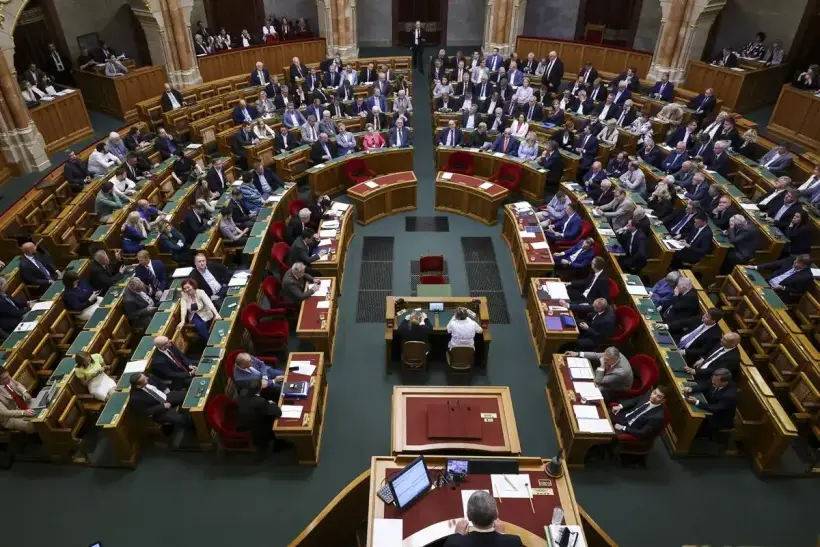
Hungary ended June with a monthly surplus and reduced its cash-based budget gap to about $10.8 billion. The improvement is notable after a weak first half of the year, but it does not remove the central risk: by May, the country had already used around 90% of its full-year cash deficit target, while the 2026 deficit goal remains demanding at 3.7% of GDP.
June surplus helped, but did not fix the budget
Bloomberg reported that Hungary narrowed its budget gap to $10.8 billion after recording a surplus in June. For Hungarian public finances, that is an important pause after several months of pressure: revenues and expenditures are not moving evenly, while debt-service costs and social commitments continue to weigh on the balance.
Open data show that by the end of May, Hungary’s cash-flow-based general government deficit had reached HUF 3,806.3 billion, equal to 90.2% of the full-year target. The central budget was HUF 3,694.8 billion in the red, social security funds had a HUF 182.4 billion deficit, while separate state funds posted a HUF 70.9 billion surplus. In May alone, the budget had already recorded a small monthly surplus of HUF 43.5 billion.
The June surplus therefore looks less like a full turnaround and more like a temporary improvement in the path. It reduces pressure for several weeks, but it does not erase the accumulated gap. Hungary still needs to contain spending in the second half of the year, otherwise the annual target will quickly become difficult to defend again.
The annual target remains under pressure
Hungary’s parliament approved the 2026 budget with revenue of HUF 39,563 billion and expenditure of HUF 43,781 billion. The planned deficit is HUF 4,219 billion, or about 3.7% of GDP under the EU’s accrual-based methodology. The budget assumes GDP growth of 4.1% and average annual inflation of 3.6%.
Those assumptions now look tight. The cash deficit had nearly reached the full-year guide by May, and a monthly surplus does not change the seasonality of spending. The second half of the year still includes payments related to programmes, subsidies, interest costs, investment commitments and sector support.
The National Bank of Hungary wrote in its public finance report that the 3.7% of GDP deficit target for 2026 can be achieved only with strict budgetary discipline. Its projection range is 3.7–4.0% of GDP, meaning there is still a risk of overshooting even in the baseline assessment.
The deficit is falling after a difficult 2025
Hungary entered 2026 from a weak fiscal starting point. The Hungarian Central Statistical Office estimated the 2025 general government deficit at HUF 4,059 billion, or 4.7% of GDP. Total revenue was HUF 37,082 billion and total expenditure was HUF 41,141 billion.
That is better than during the energy and inflation shock, but still above the level needed for a stable normalization path. Hungary remains under the EU’s Excessive Deficit Procedure, with Brussels expecting consistent deficit reduction and expenditure control. In an October report, the European Commission said the procedure had been held in abeyance because Hungary had acted in compliance with the Council recommendation, but monitoring remains in place.
For investors, the message is simple: one good month is not the same as restored fiscal sustainability. What matters is not June alone, but whether the government can repeat expenditure restraint in August, September and the fourth quarter.
Debt remains high
The 2026 budget assumes that public debt will decline to 72.3% of GDP by the end of the year from a targeted 73.1% at end-2025. That is movement in the right direction, but the debt level remains high for a country seeking to reduce vulnerability to interest rates and currency swings.
Interest expenditure remains a major item. The 2026 budget set debt-service costs at around HUF 3,362 billion, down from HUF 3,876 billion in 2025. That helps the balance, but it does not free the budget: even after the decline, the amount is large enough to compete with investment, infrastructure and social spending.
The longer the deficit stays high, the more the treasury depends on the cost of borrowing. Hungary is helped by a stronger forint and expectations of lower interest rates, but markets will judge the country by actual budget execution rather than fiscal messaging.
Growth does not guarantee budget revenue
Hungary’s problem is that the budget was built on fairly strong growth. The 2026 GDP growth assumption is 4.1%, but for the budget, the composition of growth matters as much as the headline rate. If consumption expands, VAT revenue rises. If employment and wages grow, labour-related revenues improve. If growth relies on import-heavy investment or weak domestic demand, budget revenue can underperform.
That is why cash-flow data are dangerous for the government. They show how much money actually arrived and how much actually left the treasury. Even with positive macro forecasts, the budget can overheat quickly if spending is front-loaded and tax receipts arrive more slowly.
Hungary has faced this problem before: a high deficit limits room to support the economy, while aggressive savings can weigh on growth. The balance is delicate: shrink the gap without choking the recovery.
The EU wants discipline, not one-off surpluses
The European context matters for Hungary. EU rules require gradual correction of excessive deficits, and the procedure makes Hungary’s fiscal path part of its relationship with Brussels. For the country, this is not only a reputational issue: access to EU funds, funding costs and investor confidence depend on whether the budget looks manageable.
In its report on the Excessive Deficit Procedure, the European Commission assessed Hungary’s implementation of recommendations and its fiscal adjustment path. Such monitoring does not respond to a single month; it looks at the annual and medium-term path: deficit, debt, expenditure, quality of measures and realism of forecasts.
The June surplus improves the picture, but it is not proof of a durable turnaround. For Brussels and markets, the more important question is whether the government is prepared to cut or delay expenditure if revenues begin to fall short again.
The forint gets support, but fiscal risk remains
Currency markets usually respond positively to signs of fiscal discipline. A lower deficit reduces the risk of additional borrowing and pressure on the government bond market. In 2026, the forint has already received support from expectations of more predictable policy and lower external risk, but budget data remain one of the factors that can quickly change sentiment.
A stronger forint helps lower imported inflation pressure and improves confidence in local-currency assets. But if the deficit starts widening quickly again, the effect can reverse: investors may demand higher yields, while the currency market begins pricing in renewed spending risk.
For Hungary, this is especially sensitive because of the economy’s structure. The country depends on external financing, exports, European supply chains and sentiment toward Central European markets. A fiscal mistake can quickly become not only a budget problem, but also a currency problem.
The second half of the year is the real test
The June surplus is good news. It shows that the budget can record monthly improvements and that the gap can be narrowed without emergency measures. But fiscal policy is judged by sustained execution, not isolated months.
In the second half of 2026, Hungary has to pass several tests: contain current expenditure, avoid derailing investment commitments, keep the confidence of debt markets, meet EU expectations and avoid suppressing economic growth. Any one of these factors can widen the budget gap again.
The most dangerous scenario would be treating one surplus month as a substitute for structural measures. If the deficit had already reached around 90% of the annual cash guide by May, June’s improvement only buys time. That time needs to be used for expenditure control, not for declaring victory.
As International Investment experts report, Hungary’s June surplus is a useful signal for markets, but a weak basis for complacency. The budget problem has become smaller in absolute terms, but its structure has not disappeared: high debt, large interest costs, reliance on tax receipts and EU requirements remain in place. The critical takeaway is simple: Hungary has won a month, not the budget year.