







 Vietnam Mortgage Surge Pushes Homes Out of Reach
 Lithuanian Apartment Prices Accelerate Across Major Cities
 London Flats Lose Value Ahead of Leasehold Reform
 Construction of the Batumi–Sarpi Highway Begins in Georgia
 Baltic Property Investment Accelerates in 2026
 Hong Kong and Singapore Renew Their Expat Rivalry
Indonesia pushes deeper into data centers
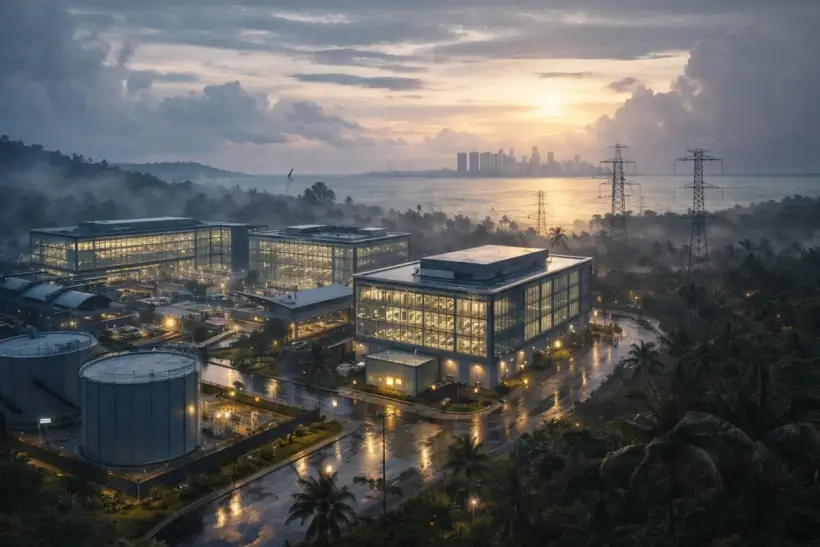
Indonesia is accelerating its drive to become a regional data center hub as demand surges from cloud computing, artificial intelligence and the country’s expanding digital economy. Channel News Asia reports that nearly 200 data centers of varying sizes are already operating nationwide, but the investment boom is increasingly exposing hard limits in water supply, power systems and environmental sustainability.
Indonesia data center market growth
Indonesia is positioning itself as one of Southeast Asia’s main destinations for digital infrastructure investment. That push is supported by a large domestic market, demand for local data storage, available land and relatively competitive construction costs. Research and Markets says the Indonesian data center market was valued at $2.81 billion in 2025 and could reach $6.08 billion by 2031, expanding at a compound annual growth rate of 13.73%. The same market overview says Jakarta had 38 operating and 13 upcoming facilities as of September 2025, with construction costs of around $8 million to $9 million per megawatt.
The Indonesian government has framed the sector as a core part of national digital transformation. In August 2025, the Directorate General of Digital Infrastructure said the country had 185 data centers with a combined capacity of 274 megawatts and was targeting more than 2,000 megawatts by 2029. Officials linked the expansion to growth in cloud adoption, ecommerce, fintech and wider domestic digital demand.
Why global tech groups are moving in
One of Indonesia’s biggest attractions is the scale of its digital economy. Channel News Asia says the country’s position as Southeast Asia’s largest digital market, combined with access to land and electricity, has made it attractive to large cloud operators. In West Java, Microsoft is building a 48-megawatt data center in Karawang International Industrial City as part of its $1.7 billion investment commitment in Indonesia. The company plans additional facilities on the same site, creating a major cluster.
Microsoft has already launched its first cloud region in the country, Indonesia Central. The company says the region includes three availability zones with independent power, cooling and networking. Microsoft cited IDC estimates saying the broader ecosystem around the new region could generate about $15.2 billion in new economic value between 2025 and 2028 and create more than 106,000 jobs. That has strengthened the government’s case for further digital infrastructure expansion.
Jakarta and Batam are playing different roles
Indonesia’s market is increasingly developing along two tracks. BMI Country Risk and Industry Research, cited by TNGlobal, says Jakarta remains the country’s structural core for hyperscale and enterprise demand, while Batam is emerging as a secondary node shaped by compliance needs, low-latency workloads and spillover demand from Singapore. The analysis adds that Indonesia’s data localization rules, especially for government and financial data, are a major driver of in-country hosting demand.
Batam’s role is centered on Nongsa Digital Park. The park’s official website says it is part of Batam’s special economic zone and located about 35 minutes from Singapore, giving it clear geographic advantages for cross-border infrastructure. Oracle also launched its Indonesia North cloud region in Batam in 2025, adding weight to the island’s position as a Singapore-linked digital infrastructure base under Indonesian jurisdiction.
Water and power risks are rising
The strongest warning signs are now coming from utilities rather than demand. Asia News Network reported that the boom in data centers, amplified by the artificial intelligence buildout, is sharply increasing water demand for cooling systems. Hendra Suryakusuma, chairman of the Indonesian Data Center Provider Organization, said water would become the sector’s second strategic issue after energy.
That concern is especially acute in Batam. BP Batam says the island’s clean water system relies on six main reservoirs and has production capacity of 3,487 liters per second. Earth Journalism Network notes that Batam depends almost entirely on rainwater, which makes rapid industrial expansion more sensitive to dry-season stress and reservoir pressure.
The projected numbers are already significant. Katadata, citing BP Batam, says that by 2032 the nine planned data centers in Nongsa Digital Park with a combined IT load of 285 megawatts would need around 29 million liters of water per day. Adding about 3 million liters for the NeutraDC-Nxera site would lift total consumption to roughly 32 million liters a day, equivalent to about 8.4% of Batam’s current total water supply.
Can infrastructure keep pace with demand
Power reliability is the other central constraint. State electricity company PLN said in 2024 that it was ready to support Indonesia’s data center expansion with reliable and cleaner electricity and could supply data centers from at least two separate substations for redundancy. The Ministry of Communications and Digital Technology has also linked the sector’s future growth to competitive electricity, supportive regulation and the creation of special economic zones for data centers.
Even so, industry analysts say infrastructure will determine how far the boom can go. BMI argues that Batam’s long-term upside will be tempered by grid limits, water constraints and environmental, social and governance pressures. In other words, Indonesia’s ambition to become a regional hub is credible, but sustained expansion will depend on whether utilities and local authorities can scale power, cooling and water systems as fast as operators are scaling server capacity.
What this means for Southeast Asia
Indonesia is trying to benefit from a regional moment in which Singapore remains central to digital infrastructure but faces tighter land, energy and regulatory limits. Batam is capturing some of that overflow demand thanks to its location and special economic zone framework, while Jakarta remains the primary domestic market. At the same time, stricter local data storage requirements and the growth of artificial intelligence services are making in-country infrastructure more valuable.
As experts at International Investment report, Indonesia now looks like one of Asia’s fastest-growing digital infrastructure markets, but its ability to become a full regional hub will depend less on headline investment announcements than on whether water, power, redundancy and sustainability issues are solved in parallel with server expansion. For investors, that means the opportunity remains strong, but infrastructure quality is becoming just as important as cloud demand.
FAQ
Why is Indonesia attracting more data center investment?
Because it combines a large digital economy, domestic demand for cloud services, land availability, lower construction costs and policy support for local data infrastructure.
Why is Batam important in this story?
Batam sits close to Singapore, is part of a special economic zone and is increasingly used for low-latency, compliance-driven and Singapore-linked workloads.
What is the biggest constraint on Indonesia’s data center boom?
Water, power and sustainability are emerging as the key bottlenecks, especially on Batam where water resources are limited.
How much water could Batam’s major data centers consume?
Current projections cited by Katadata and BP Batam suggest around 32 million liters per day by 2032 across ten large facilities.
Which major companies have already committed to Indonesia?
Microsoft has committed $1.7 billion and launched Indonesia Central, while Oracle has opened the Indonesia North region in Batam.