







 Vietnam Mortgage Surge Pushes Homes Out of Reach
 Lithuanian Apartment Prices Accelerate Across Major Cities
 London Flats Lose Value Ahead of Leasehold Reform
 Construction of the Batumi–Sarpi Highway Begins in Georgia
 Baltic Property Investment Accelerates in 2026
 Hong Kong and Singapore Renew Their Expat Rivalry
Indonesia Growth Beats Forecasts Despite Risks
Growth surpasses expectations
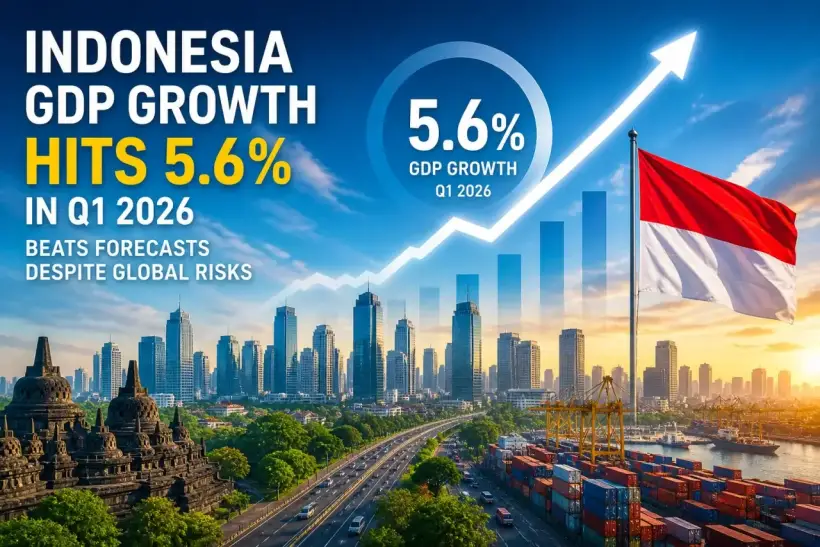
Indonesia’s gross domestic product, a measure of total economic output, grew 5.61% year-on-year in the first quarter of 2026, beating forecasts of around 5.3% and accelerating from 5.39% in the previous quarter.
Bloomberg reported that the stronger-than-expected data came despite global economic headwinds, including conflict-related uncertainty and volatile commodity markets.
Domestic demand drives expansion
Household consumption remains the main engine of growth, accounting for more than half of Indonesia’s economy. McKinsey analysis shows that consumer spending and government stimulus have been key drivers in recent quarters, a trend that continues into 2026.
Investment and fiscal spending are also contributing, particularly through infrastructure development and social programs aimed at sustaining economic activity.
Resilience amid global uncertainty
Indonesia’s growth comes despite rising geopolitical tensions and economic volatility worldwide. The country’s diversified economic base — spanning industry, agriculture and services — helps buffer external shocks.
According to the International Monetary Fund, Indonesia’s economy is expected to maintain growth of around 5% in 2026, consistent with its long-term trajectory.
External risks remain
External demand and commodity markets still pose risks. A slowdown in global trade or weaker demand for exports such as coal and palm oil could limit growth momentum.
OECD analysis suggests that heightened trade tensions or weaker global demand could weigh on Indonesia’s outlook despite strong domestic fundamentals.
Government targets steady expansion
The government continues to target growth of around 5.4% in 2026, relying on domestic demand and gradual recovery in export sectors.
Indonesia remains the largest economy in Southeast Asia and one of the most significant emerging markets globally.
As experts at International Investment report, Indonesia’s latest data confirms structural resilience but also highlights limited upside potential. Growth remains stable around 5%, but accelerating beyond that level will require productivity gains, industrial investment and reduced dependence on commodity exports. The key risk for 2026 is a deterioration in external demand that could slow growth even if domestic consumption remains strong.
FAQ
How fast did Indonesia’s economy grow in 2026?
GDP grew by 5.6% year-on-year in the first quarter of 2026.
What is driving the growth?
Main drivers include household consumption, government spending and investment.
What is GDP?
GDP measures the total value of goods and services produced in an economy.
What are the risks to Indonesia’s economy?
Key risks include global uncertainty, weaker export demand and commodity price volatility.