







 Israel Cuts Rate to 3.25% for Third Meeting
 Russian and Belarusian Owners List More Latvian Property
 Georgian Law Enforcement Busts Scammers Posing as Real Estate Brokers
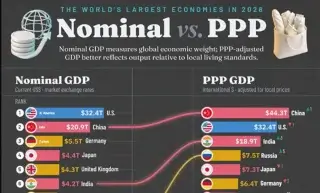 World’s Largest Economies in 2026: GDP and Purchasing Power Rankings
 Turkish Airlines Cancel Flights to Moscow
 Escalation in the Middle East: New US and Iranian Strikes
Indonesia Turns Visas Into Capital

Indonesia’s Golden Visa has become one of Southeast Asia’s most visible investment-migration tools, drawing Rp52.1 trillion, or roughly $3 billion, through 1,274 permits by May 18, 2026, though almost the entire amount came from corporate investors, making the real test not residency numbers but whether the capital produces jobs, technology transfer and regional development.
The Golden Visa is now an investment-policy tool
Indonesia is using the Golden Visa not as a mass migration route, but as a filter for capital, companies and skilled foreigners. The visa grants long-term residence for five or 10 years, while the state’s goal is to attract investors, global talent, entrepreneurs and project participants capable of bringing technology, employment and international networks.
VietnamPlus, citing Indonesian authorities, reported that the program had attracted nearly $3 billion in investment since launch and had become part of the country’s strategy to strengthen competitiveness. The report said the mechanism targets foreign nationals who can stay in Indonesia for the long term and participate in economic development, rather than simply benefiting from easier entry.
For Indonesia, this marks an important shift. A country with more than 270 million people and a fast-growing domestic market is competing not only for tourists, but also for managerial expertise, regional headquarters, technology projects, production chains and capital that can be tied to real investment.
Official data show corporate dominance
The program’s headline figure has now been confirmed by immigration authorities. Indonesia’s Directorate General of Immigration said the Golden Visa had attracted Rp52.1 trillion in investment by May 18, 2026, since its launch on July 25, 2024. The amount came from 1,274 issued permits, with the largest contribution from the corporate investor category E28D at Rp50.884 trillion. Individual investors not establishing a company accounted for Rp179.4 billion, while individual investors establishing a company contributed Rp130.3 billion.
That structure matters more than the total amount. The program is formally open to different applicant categories, but in practice it works mainly as a channel for companies opening businesses, branches or subsidiaries in Indonesia. If almost all investment comes from the corporate category, the program will be judged not by the number of wealthy residents, but by whether declared investments become production, services, employment and tax revenue.
For the government, this is both a success and a risk. Corporate applications bring larger sums and fit better with industrial policy, but they require monitoring. An investment commitment on paper and actual capital deployed into the economy are not the same thing.
Entry thresholds separate investors from wealthy migrants
Indonesia’s Golden Visa has several investment routes. The official immigration authority previously stated that an individual investor establishing a company in Indonesia must invest $2.5 million for a five-year stay permit and $5 million for a 10-year permit. For directors and commissioners of corporate investors, thresholds are higher: the company must invest $25 million for a five-year permit and $50 million for a 10-year permit. For foreigners who do not establish a company, requirements include placing funds or purchasing government bonds, public-company shares or mutual funds worth $350,000 for five years and $700,000 for 10 years.
This design differs sharply from many European schemes, where residence was often tied to real estate purchases. Indonesia is trying to direct capital beyond housing or passive asset holding and into a broader investment framework. That lowers the risk of directly inflating property prices, though it does not remove it entirely, especially in Bali, Jakarta and other popular locations.
For applicants, the thresholds also mean the program is not built for mass relocation. It is a tool for wealthy investors, company owners, executives and people Indonesia wants to retain for longer than standard visa regimes allow.
Indonesia is competing for capital with a strong domestic market
The Golden Visa is part of a broader investment cycle. Indonesia’s Ministry of Investment and Downstreaming, known as BKPM, publishes quarterly realized-investment reports, including 2025 data, which serve as a key indicator of how far the country can turn investment promises into actual projects.
For Indonesia, this is especially important because of the economy’s scale. The government is promoting domestic processing of raw materials, electric-vehicle supply chains, batteries, digital services, tourism and the new capital city of Nusantara. All of these areas require not only money, but management teams, technology, logistics and long-term investor willingness to operate in a complex regulatory environment.
That is why a migration privilege is becoming part of industrial policy. If an investor receives the right to live in the country for five or 10 years, the state expects more than a money transfer; it expects management decisions, business networks and a local presence.
The economy is growing, but capital competition is intensifying
The macroeconomic backdrop remains relatively strong. Statistics Indonesia reported that gross domestic product grew 5.12% year on year in the second quarter of 2025, accelerating from 5.05% in the same period a year earlier. Gross domestic product measures the total value of goods and services produced by an economy over a given period.
Growth around 5% makes Indonesia one of Asia’s more resilient large economies. But that is also why competition for capital is becoming tougher. Singapore, Malaysia, Thailand, Vietnam and the Philippines are all trying to attract investors with their own tax, visa, industrial and infrastructure incentives.
Indonesia’s pitch rests on market size, natural resources, a young population and a strategic location between the Indian and Pacific oceans. The Golden Visa is meant to make entry easier for those willing to treat the country not as a temporary base, but as a long-term platform.
Bali is both showcase and risk
In practice, much of the international attention around Indonesia is linked to Bali. The island remains a global brand for tourism, remote work, premium housing and entrepreneurial communities. In 2026, international media also reported Indonesian plans to develop a low-tax financial center in Bali’s Kura Kura Special Economic Zone, intended to strengthen capital inflows and compete for investors with other regional hubs.
For the Golden Visa, this creates a strong marketing effect. Investors can understand Indonesia more easily through the familiar image of Bali than through the full complexity of an archipelago of thousands of islands. But the same dynamic raises concentration risks. If long-term foreign residents and capital flow mainly into Bali and Jakarta, the program could increase pressure on housing, land, infrastructure, the environment and local communities.
Bali already faces road congestion, water constraints, rising rents and tension between the tourism economy and everyday life for residents. The program’s investment success should therefore be measured not only by the number of permits issued, but also by whether capital spreads beyond the most overheated zones.
Tourism supports the brand, but the visa is broader
Indonesia’s tourism sector remains an important part of the investment narrative. The Ministry of Tourism, Bank Indonesia and Bappenas published Indonesia Tourism Outlook 2025/2026, emphasizing a transition toward quality and sustainable tourism. Quality tourism means not just more arrivals, but higher visitor spending, better flow management, environmental sustainability and benefits for local economies.
The Golden Visa could reinforce that shift if it attracts investors into hotels, medical tourism, education, digital services, yachting infrastructure, environmental projects and managed resort development. But if it leads mainly to villa purchases, short-term rentals and higher land prices in popular districts, its economic effect will be more debatable.
For the government, the challenge is to direct long-term residents toward activities that create added value rather than merely competing with locals for property and services.
The program requires enforcement
The weakest point of any Golden Visa is the gap between declared capital and actual economic benefit. An investment can be formally counted while producing limited impact if it creates few jobs, transfers little technology, pays limited tax or remains parked in financial instruments without a real operating business.
Indonesia’s model tries to reduce this risk through categories tied to company creation and corporate investment. But the high volume in the E28D category also means the state must monitor beneficial owners, source of funds, business-plan implementation, employment, actual capital expenditure and alignment with national priorities.
This is especially important for a country trying to move from a resource-based economy toward a more complex industrial and services model. If the Golden Visa becomes only a fast track to status, it will be vulnerable to criticism. If it is linked to real projects, it can become an investment-competition tool.
Regulatory predictability is the main test
Foreign investors look beyond visa duration and market size. They need predictable rules, property protection, tax clarity, permits, labor regulation, foreign-exchange procedures, banking compliance and the ability to repatriate profits. In countries with fast-changing regulatory environments, even an attractive visa does not always offset operating risks.
The U.S. State Department’s 2025 Investment Climate Statement on Indonesia said the country seeks to become an attractive foreign direct investment destination, with young demographics, a fast-growing digital economy, strong domestic demand and abundant natural resources among its main advantages. Such assessments also underline the importance of regulatory transparency and implementation quality for investors.
The Golden Visa therefore cannot replace institutional reform. It works as an entry door, but it does not solve issues around courts, licensing, local permits, tax practice and regional competition. The larger the declared investment, the more important administrative quality becomes.
Southeast Asia is competing for residence capital
Indonesia is developing the program as many countries reconsider investment migration. In Europe, some Golden Visa routes have been closed or tightened because of housing inflation, money-laundering risks and political criticism. In Asia, governments are more often using long-term visas to attract capital, specialists and entrepreneurs.
Indonesia’s advantage is scale. Its disadvantage is the complexity of an archipelagic economy, infrastructure gaps between regions and the need for coordination between central and local authorities. For investors, choosing Indonesia should depend not only on residence status, but also on sector, region, partner and legal structure.
If the program develops through companies rather than only wealthy individuals, it may become less a rival to European real estate-for-residence schemes and more a regional strategy for attracting production and technology capital.
The real issue is investment quality, not the headline number
A roughly $3 billion figure is impressive for a migration program, but it is not the same as automatic economic success. The real indicators are how much of the money is already deployed in operating projects, how many jobs are created, how much tax is paid, which technologies are transferred and which regions benefit.
Corporate concentration deserves particular scrutiny. If a small number of large applicants account for most of the total, the program can look statistically successful while remaining economically narrow. If the permits are tied to projects in manufacturing, the digital economy, healthcare, tourism and education, the impact will be deeper.
As International Investment experts report, Indonesia’s Golden Visa looks stronger than many older European models because it is formally oriented toward business and capital rather than passive real estate purchases. But its main risk is not weak demand; it is weak verification of investment quality. If Rp52.1 trillion turns into companies, jobs and technology chains, the program will be a development tool. If much of the capital remains in status-seeking, financial or property assets with limited multiplier effects, Indonesia will get attractive statistics without sufficient economic impact.
FAQ
What is Indonesia’s Golden Visa?
Indonesia’s Golden Visa is a long-term stay permit for foreign investors, entrepreneurs, corporate executives, talent and selected applicant categories. It can be issued for five or 10 years.
How much investment has the program attracted?
According to Indonesia’s immigration authority, the program had attracted Rp52.1 trillion, or roughly $3 billion, through 1,274 issued permits by May 18, 2026.
What are the investment thresholds?
An individual investor establishing a company needs $2.5 million for a five-year permit and $5 million for a 10-year permit. Corporate investors require $25 million or $50 million respectively. Applicants not establishing a company can qualify through financial placements from $350,000 to $700,000.
How is Indonesia’s program different from European Golden Visas?
It is more focused on business, corporate investment and long-term economic presence, while many European programs historically relied heavily on real estate purchases.
What are the main risks?
The main risks are formal compliance without real economic impact, concentration of capital in Bali and Jakarta, property-price pressure, weak source-of-funds controls and dependence on regulatory quality