







 Covivio Hotels Revenue Grows 4.7% as European Markets Split
 Lithuanian Apartment Prices Accelerate Across Major Cities
 Georgia's Tourism Revenue Hits Record High
 Norway's Sovereign Fund Commits €1.5bn to European Warehouses
 Market Rout of October 2026: Can Branded Hotels Protect Capital?
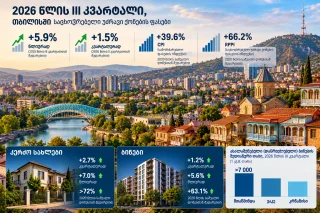 Residential Property Prices in Tbilisi Rise by 5.9% Year-on-Year
Indonesia Property Market Could Reach $156.2 Billion
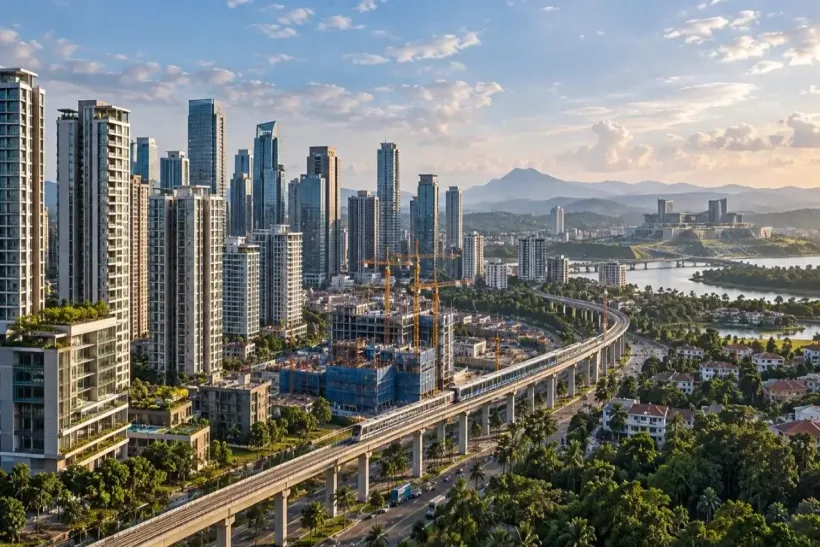
Indonesia’s real estate market could expand from an estimated $105.5 billion in 2026 to $156.2 billion by 2034, according to IMARC Group. Long-term growth is being linked to housing construction, infrastructure spending, the development of the new capital Nusantara and tourism. Current official indicators are more subdued, however: primary residential prices rose by less than 1% year on year in the second quarter, while home sales remained below their 2025 level.
Indonesia real estate market forecast reaches $156.2 billion
IMARC Group estimates Indonesia’s real estate market at $100.4 billion in 2025 and $105.5 billion in 2026. The research company projects it to reach $156.2 billion by 2034, implying a compound annual growth rate of 5.03% between 2026 and 2034.
The estimate covers residential, office, retail, hospitality and industrial property. Residential real estate accounted for an estimated 58.02% of the market in 2025, while Java represented about 56%. The figures were published in an IMARC market-research release on September 28 and should be treated as private-sector estimates rather than an official Indonesian government forecast.
The projection implies an increase of roughly $50.7 billion over eight years. Urban development, transport infrastructure, housing demand, tourism, logistics facilities and the construction of Nusantara are among the factors expected to contribute to expansion.
A larger overall real estate market does not necessarily mean that individual homes will appreciate at a similar rate. Growth can also come from additional construction, commercial development, industrial property and higher transaction volumes.
Indonesia home prices remain subdued
Bank Indonesia’s official residential survey shows a considerably softer housing market. Primary residential property prices increased by 0.69% year on year in the second quarter of 2026, compared with 0.62% in the first quarter.
Primary-market sales still contracted by 2.36% from a year earlier. The decline was nevertheless far smaller than the 25.67% contraction recorded in the previous quarter. Sales of small and large homes improved, while the medium-sized segment remained weaker.
Mortgages accounted for 70.05% of primary-home purchasing schemes. Developers continued to rely heavily on their own resources, which covered 73.28% of their project financing.
Financing conditions also remain relevant. Bank Indonesia kept its benchmark BI-Rate at 5.75% on September 23, with the Deposit Facility rate at 4.75% and the Lending Facility at 6.50%. Overall bank lending increased by 13.65% year on year in August.
Indonesia’s economy continues to grow above 5%
The broader economy remains supportive of longer-term property demand. Indonesia’s gross domestic product expanded by 5.29% year on year in the second quarter of 2026 and by 3.73% from the previous quarter. Growth for the first half reached 5.45% compared with the same period in 2025.
Java remained the center of economic activity, accounting for 56.47% of national GDP in the second quarter. The island’s economy grew by 5.65% year on year, by Badan Pusat Statistik Indonesia.
The concentration of jobs, business activity and infrastructure helps sustain demand in Java’s major metropolitan markets. Investment data, however, indicate that new capital spending is becoming increasingly distributed across other Indonesian regions as well.
Housing shortage remains a structural issue
Indonesia still has a substantial housing deficit. National statistics cited by the Ministry of Housing and Settlement Areas show that 12.39% of households, or around 9.29 million, did not own their homes in 2026. That was down from 13% in March 2025.
A separate measure tracks households that own their properties but live in homes that do not meet adequate-housing standards. Their number fell from about 18.77 million in 2025 to 18.01 million in 2026.
The figures demonstrate substantial underlying housing need, but they should not be interpreted as equivalent to market-rate purchasing demand. A significant part of the shortage involves households that depend on subsidized mortgages, public assistance or lower-cost construction.
Subsidized mortgages remain below the annual target
Indonesia’s FLPP housing finance facility is one of the main mechanisms used to support lower-income homebuyers. By late September 2026, financing had been completed for 160,070 homes, equal to 45.73% of the annual target of 350,000 units.
Only 17 of the financed properties were vertical housing units, with detached or landed homes accounting for virtually all of the remainder. Authorities were seeking to accelerate the program during the final quarter, with identified near-term demand of 48,679 units and potential supply of about 28,165.
The scheme forms part of the government’s broader Three Million Houses housing agenda and illustrates the extent to which affordable housing demand continues to depend on public financing mechanisms.
Tax relief is supporting new-home purchases
Indonesia also extended a value-added tax incentive for qualifying new housing throughout 2026. For a new ready-to-occupy house or apartment priced at no more than 5 billion rupiah, the government covers 100% of the VAT due on the portion of the selling price up to 2 billion rupiah.
The benefit applies to one qualifying property per individual under the scheme’s conditions. Eligible foreign nationals may also use the incentive if they have an Indonesian tax number and meet the legal requirements governing foreign residential ownership.
Housing is receiving additional support through Kredit Program Perumahan, a government-backed housing credit program. Disbursements had reached 17.74 trillion rupiah by June 28, compared with 167.97 trillion rupiah distributed through the government’s broader portfolio of credit programs.
Indonesian investment exceeds 1 quadrillion rupiah
Realized investment across the Indonesian economy reached 1,010.6 trillion rupiah in the first half of 2026, an increase of 7.2% year on year. Foreign direct investment contributed 507.6 trillion rupiah and domestic investment 502.9 trillion.
Housing, industrial estates and office buildings ranked among the five leading investment sectors. Regions outside Java attracted 50.2% of first-half investment, slightly ahead of Java’s 49.8%. The projects recorded during the period were associated with almost 1.45 million direct jobs.
The figures do not represent property investment alone, but they indicate the broader capital expenditure supporting new industrial centers, infrastructure and urban development beyond Indonesia’s traditional core markets.
Nusantara creates a new property cluster
Construction of Nusantara, Indonesia’s new capital in Kalimantan, is creating a separate residential and commercial development pipeline. Estimated investment in the project had reached 72.39 trillion rupiah by May 2026.
By July, 67 private businesses had signed cooperation agreements with the Nusantara Capital Authority. Nine private projects had been completed and six were under construction, including apartment and mixed-use developments. Public-private partnership preparations also covered seven housing projects and six road projects.
Nusantara is not yet comparable with Jakarta as a mature private property market. Its development will depend on infrastructure delivery, the relocation of government functions and the emergence of a permanent residential and business base.
Bali tourism supports hospitality property
Bali continues to provide a distinct tourism-related source of property demand. The island received 697,809 international visitors in July 2026, an increase of 15.34% from June. Australian passport holders represented 25.01% of arrivals.
Occupancy at star-rated hotels reached 67.29%, up 2.42 percentage points from June but 0.46 percentage points below July 2025. Non-star hotels and other accommodation recorded occupancy of 42.53%.
These indicators are particularly relevant for hotels, rental apartments and villas. Visitor growth alone, however, does not establish property appreciation or investment returns, which depend on local supply, operating costs, occupancy and the legal structure of ownership.
Foreign property ownership remains restricted
Foreign nationals can own certain forms of residential property in Indonesia, but the legal framework differs from that available to Indonesian citizens. Government Regulation No. 18 of 2021 requires qualifying foreign owners to hold the appropriate immigration documentation.
Permitted structures include houses held under Hak Pakai, or right-of-use title, as well as certain apartment units. The rules do not give foreign buyers unrestricted freehold ownership of land on the same basis as Indonesian citizens.
The distinction is particularly relevant in Bali and other markets heavily promoted to overseas investors, where a project may involve right-of-use, leasehold or another legal structure rather than direct freehold land ownership.
As International Investment experts report, the $156.2 billion figure is best read as a long-term scenario for expansion of Indonesia’s overall real estate sector rather than a forecast of comparable gains in residential property prices. Primary-market prices are currently rising by less than 1% a year and sales remain below their year-earlier level. Indonesia’s housing shortage creates substantial potential demand, but much of that demand is sensitive to subsidies and financing costs. Investors therefore need to separate national market-growth projections from the economics, ownership structure and achievable returns of an individual property.
FAQ: Indonesia real estate market
How large could Indonesia’s property market become by 2034?
IMARC Group projects the market at $156.2 billion by 2034, compared with an estimated $105.5 billion in 2026. It is a private market forecast rather than an official government projection.
Are house prices rising quickly in Indonesia?
Current price growth is modest. Primary residential property prices increased by 0.69% year on year in the second quarter of 2026.
Does Indonesia have a housing shortage?
Yes. Around 9.29 million households did not own their homes in 2026, while about 18.01 million owner-occupier households lived in housing that did not meet adequate-housing standards.
Does Indonesia subsidize homebuyers?
Yes. Support includes the FLPP subsidized mortgage facility, housing credit programs and VAT relief for qualifying newly built homes and apartments.
Can foreigners buy property in Indonesia?
Foreign nationals can own certain residential properties subject to immigration, title and other legal requirements. They do not receive unrestricted freehold land ownership on the same terms as Indonesian citizens.
What is happening in Bali’s property market?
Bali continues to benefit from high international tourism, supporting hospitality and rental property demand. Tourist numbers alone should not be treated as a measure of real estate prices or returns.
How is Nusantara affecting real estate?
The new capital is generating residential, commercial and infrastructure projects and had attracted an estimated 72.39 trillion rupiah in investment by May 2026. It remains an emerging property market rather than a mature alternative to Jakarta.