










Monaco Holds Luxury Home Prices
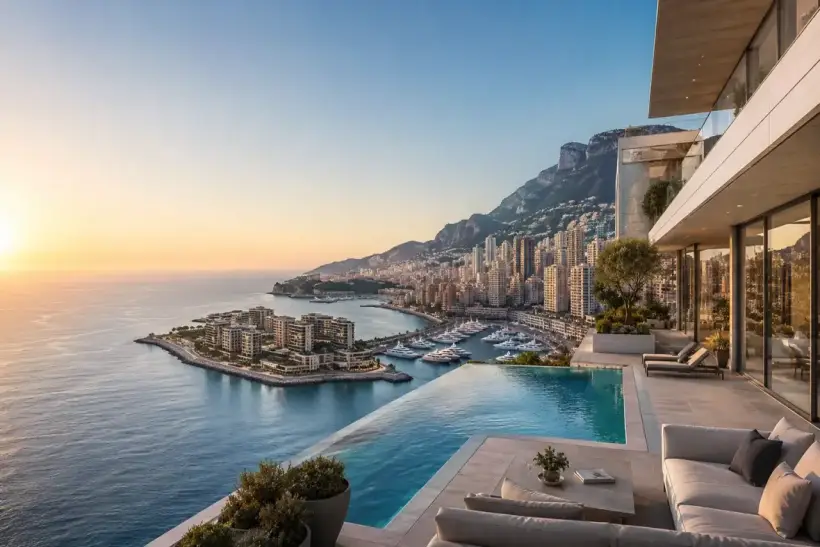
Monaco’s luxury real estate market is not showing broad price erosion in 2026, but it is entering a stricter phase of selection: buyers are still prepared to pay record prices for sea views, large floorplates and service, while weaker assets with ambitious pricing are facing more resistance.
Monaco is moving from frenzy to discipline
The Monaco prime market remains one of the most expensive residential markets in the world, but its tone is less urgent than during the post-pandemic demand surge. Polarius International Real Estate describes 2026 not as a downturn but as a recalibration: transactions continue, international capital remains active, but buyers are scrutinizing orientation, building quality, service infrastructure, privacy and long-term liquidity more closely.
Liquidity in real estate means the ability to resell an asset without a material discount. In Monaco, that matters because the market is small, supply is physically constrained and a pricing mistake can cost millions of euros.
The main shift in 2026 is not the disappearance of demand. It is the refusal to pay any price simply for a Monaco address. Premiums are still attached to scarcity, turnkey condition, panoramic views, terraces, parking, security and strong buildings. Assets without those features are moving more slowly, even inside one of Europe’s most prestigious jurisdictions.
Average prices remain above €57,000 per square meter
Official data confirm the market’s resilience. Monaco’s statistics institute reported that after a 14.8% jump in 2024 to €58,402 per square meter, the average price slipped only 1.4% in 2025 to €57,569, remaining at a historically high level.
Even compared with the most expensive districts of Paris or London, Monaco sits in a separate category. Pricing reflects not only housing quality, but also tax treatment, security, political stability, limited land and the value of residency.
The average price also conceals wide differences by district and asset quality. Older apartments without views or large terraces can trade well below the top tier, while new-build apartments and penthouses in the best schemes can move far above the headline average.
Larvotto has crossed the €70,000 threshold
Savills’ Monaco 2026 report states that the average price per square meter in the Principality stands at €57,569, while Larvotto crossed €70,000 per square meter for the first time as Mareterra units entered the resale market. Total transactions reached 493 in 2025, with a combined value of €5.9 billion, while average rents rose 9.1% to €124.88 per square meter per month.
Larvotto is Monaco’s seafront district, close to the beach and new ultra-prime developments. Its price growth reflects not only location prestige but also the structural shortage of large, newly built apartments with open sea views. Buyers are not only acquiring a home; they are buying rare access to new product in a country of just over two square kilometers.
Mareterra has become a market-defining project. The new district, built on land reclaimed from the sea, includes residences, villas, public spaces and environmental engineering systems. It increased supply, but did not remove scarcity. Instead, it raised buyer expectations for architecture, service, sustainability and building quality.
New builds define the top of the market
Monaco’s new-build segment does not behave like an ordinary city market. It depends on rare delivery cycles. When a major scheme is released, the statistics move sharply; once that supply is absorbed, scarcity returns. In 2025, 64 new-build homes were sold, down from 101 in 2024, when Mareterra heavily influenced the market, but still above the 10-year average.
The size of transactions is more revealing. According to Savills’ market review, 35 of the 64 new-build sales in 2025 exceeded €20 million, and five were above €100 million. The average new-build sale price rose 12% to €40.8 million. This shows that the upper end is not merely resilient; it is increasingly concentrated around large family apartments, penthouses and villas.
For buyers, the entry threshold is rising. A turnkey Monaco property is not just a furnished home. It means modern engineering, service, security, parking, management infrastructure, energy performance, privacy and a clean legal structure.
The resale market has rebounded
The resale market is especially important because it reflects owner behavior as well as new supply. In 2025, Monaco recorded 429 resales, up 17.5% from the previous year, while total resale value rose 49.1% to €3.2 billion. Larger assets drove the increase: the resale value of homes with four or more bedrooms rose 80%, while villa resales reached €312.2 million, more than tripling year on year.
That is a key signal for 2026. Buying activity has not disappeared; it has shifted toward larger and better-quality assets. Smaller apartments remain part of the market, but demand is moving toward family-sized homes where space, layout, outdoor areas and year-round usability matter more than seasonal use alone.
Rental pressure is pushing some buyers into ownership
Rising rents are reinforcing purchase demand. Monaco has a chronic shortage of rental homes, especially three- and four-bedroom apartments. Many units are rented before they appear on the open market because waiting lists are already in place. At an average rent of about €124.88 per square meter per month, a large apartment becomes a major annual expense.
For long-term residents, the calculation is straightforward. If rents are rising and suitable homes are scarce, buying becomes a way to secure tenure and control housing costs. That means some purchase demand is coming not from new arrivals, but from existing residents upgrading within the Principality.
Tax remains a core source of demand
Monaco’s tax system remains one of the central supports of demand. The Principality’s official portal states that there is no wealth tax, annual property tax or council tax, and that residents, except French nationals governed by the 1963 bilateral convention, are not liable for personal income tax.
Personal income tax is a tax on individual earnings, including salary and investment income. For international entrepreneurs, family offices and globally mobile wealthy residents, the absence of such a tax is part of a broader financial strategy. But the tax factor only works alongside genuine residence, banking compliance, residency requirements and the tax rules of other jurisdictions.
That is why a Monaco property purchase is rarely only an investment transaction. It is often part of a broader decision about residence, tax planning, family security, access to European infrastructure and long-term capital preservation.
Monte-Carlo keeps the deepest market
Monte-Carlo remains Monaco’s most recognizable district for international buyers. The casino, hotels, retail, restaurants, business infrastructure and central location support its liquidity. In 2025, it accounted for the largest share of resales, showing the depth of demand even at very high prices.
La Rousse, Fontvieille and La Condamine form the next layer of liquid markets. La Rousse benefits from large residential towers, views and proximity to Larvotto. Fontvieille attracts buyers with its more modern urban profile and marina. La Condamine is valued for the port, city life and limited supply. Jardin Exotique and Les Moneghetti remain relatively more accessible, but their prices would still be considered ultra-prime in most global cities.
The risk is shifting to overpriced secondary stock
The main risk in Monaco in 2026 is not a broad market fall. It is overpaying for an asset that no longer meets the market’s quality threshold. Older apartments without views, weak layouts, limited parking, high renovation costs, insufficient service and unrealistic vendor expectations are more visible against the backdrop of new projects.
During a frenzy, these weaknesses can be hidden by scarcity. In a calmer market, buyers see them immediately. They compare Monaco not only with neighboring buildings, but also with Dubai, London, Zurich, Miami, Singapore and the French Riviera. Monaco remains unique, but buyer capital has become more demanding.
Monaco is a capital-preservation market, not a yield market
Investors need to understand that Monaco is rarely bought for high rental yield. Even with rising rents, entry prices are so high that net yields are usually lower than in many other markets. The main logic is capital preservation, residency access, asset protection, quality of life, safety and long-term liquidity.
That separates Monaco from resort markets where investors focus on occupancy, seasonality and operating profit. In the Principality, property often functions as part of a family or entrepreneur’s balance sheet. That makes pricing more resilient, but the entry decision requires far deeper analysis.
As experts at International Investment report, the critical conclusion is that Monaco remains Europe’s most defensive ultra-prime residential market in 2026, but resilience does not mean universal investment safety. Buyers are not paying for square meters alone; they are paying for scarcity, jurisdiction and liquidity. The best assets can hold value and appreciate, while secondary apartments without views, service or strong layouts risk sitting on the market. Entry is justified only after checking legal status, building quality, running costs, resale liquidity and whether the asset truly supports residency needs.
FAQ: Monaco Real Estate in 2026
What is happening to Monaco real estate in 2026?
The market is not showing broad price declines, but it is becoming more selective. Buyers remain active, yet they are demanding stronger quality, views, service, privacy and liquidity.
How much does property cost in Monaco?
Official statistics put the average price at €57,569 per square meter in 2025. Larvotto has crossed €70,000 per square meter, while the best assets can trade far above those levels.
Why is Monaco property so expensive?
The main reasons are extremely limited land, high security, political stability, favorable taxation, international demand and a chronic shortage of high-quality new supply.
What is Mareterra?
Mareterra is Monaco’s new seafront district built on reclaimed land. It added a limited number of ultra-prime residences, villas and public spaces, raising expectations for new-build quality.
Is Monaco property good for rental investment?
Monaco has a strong rental market, but because purchase prices are extremely high, net yields are often lower than in other markets. The main reasons to buy are capital preservation, residency, security and liquidity.