







 Australia’s Spring Auctions Rise but Remain Well Below 2025
 Number of Foreigners Holding Turkish Residence Permits Exceeds 1.27 Million
 Demand from Russian Tourists for Holidays in Georgia Rises by 20–25%
 Montenegro Property Buying Costs in 2026
 Four in Ten Companies Would Not Choose Slovakia
 Gulf Countries Prepare Unified Tourist Visa
Nordic Property Investment Rises 16% as Rates Stay High
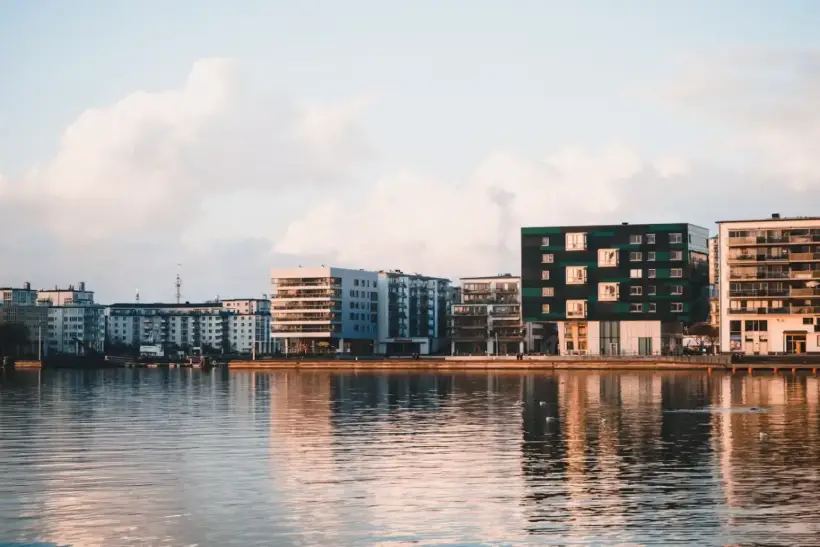
Real estate investment across the four Nordic markets tracked by Colliers accelerated in 2026, with transactions in Sweden, Norway, Finland and Denmark reaching €22 billion in January through July, up 16% year on year. The recovery remains highly uneven. Finland has gained 60%, Sweden 31% in local-currency terms and Norway only 4%, while Danish investment is down by a quarter. The rebound in transactions has also coincided with another increase in long-term market rates, meaning improved liquidity has yet to bring back cheap financing.
Nordic real estate transactions reach €22 billion
The four markets recorded 68 large property transactions worth about €2.4 billion in July. Investment volume for the first seven months of 2026 reached €22 billion, compared with roughly €19 billion a year earlier, while trailing 12-month volume climbed to €37.1 billion, the August update from Colliers Research shows. The regional comparison covers transactions above €5 million in Sweden, Norway, Finland and Denmark; Iceland is not included in the dataset.
Sweden generated €18.3 billion, or about 49% of the trailing 12-month total. Norway accounted for €7 billion, Denmark for €6.1 billion and Finland for €5.7 billion. Sweden's market is therefore almost three times the size of Finland's by this measure and remains the main source of Nordic transaction liquidity.
July was considerably quieter than June. Sweden recorded 29 deals worth around €1.4 billion, Norway 18 deals worth €0.5 billion, Denmark 11 worth €0.3 billion and Finland ten worth roughly €0.1 billion. The weaker month did not reverse the year-to-date recovery, but it highlighted the influence a small number of large deals can have on Nordic transaction totals.
That concentration is also visible among the largest transactions of the past 12 months. They include the transfer of SBB's Nordic public-sector property portfolio to PPI at an underlying value of about SEK32 billion, Wihlborgs' SEK13.3 billion agreement for Castellum's Skåne portfolio and a €900 million Finnish residential portfolio transaction. A handful of deals of this size can materially alter annual investment statistics in the smaller Nordic economies.
Sweden remains the region's largest property market
Swedish investment volume reached SEK124.9 billion in January through July, 31% above the same period in 2025. Trailing 12-month volume stood at SEK203.7 billion. July produced 29 transactions worth SEK15.3 billion, although the month's total was 21% below July 2025.
Stockholm accounted for 38% of Swedish investment over the latest 12 months, followed by Skåne at 19% and Västra Götaland at 12%. Foreign investors represented 27% of acquisitions by volume, compared with 16% for foreign sellers, indicating net inward cross-border investment during the period.
One of July's biggest residential transactions involved Slättö's acquisition of the Norrbodahöjden project in Upplands-Bro. Developer Bonava put the underlying property value at approximately SEK1.3 billion. The project comprises just over 500 rental apartments as well as commercial premises and parking. Construction is scheduled to start in autumn 2026, subject to a building permit.
Another transaction illustrates the scale of portfolio activity returning to Sweden. In June, Castellum signed an agreement to sell properties in Malmö, Lund, Helsingborg, Ängelholm and Burlöv to Wihlborgs at an underlying value of SEK13.32 billion. The portfolio contains around 635,000 square metres of lettable space and has an economic occupancy rate of 87.5%. Offices represent 59% of its value and warehouse and light-industrial assets another 21%. Closing is planned for October 1 and remains subject to conditions, meaning the agreement has been signed but the transfer has not yet been completed.
The combination of large portfolio agreements and deeper liquidity around Stockholm has allowed Sweden to retain almost half of the regional market. July's 21% year-on-year decline nevertheless shows that the recovery is not linear and remains sensitive to the timing of major transactions.
Finland records the strongest growth
Finland has posted the fastest growth of the four markets. Investment volume increased 60% year on year to €3.6 billion in January through July and reached €5.7 billion over the latest 12 months. July itself was much quieter, with ten transactions worth about €100 million. Industrial and public-sector properties dominated activity, while retail, residential and mixed-use deals were also recorded.
Cross-border capital is a defining feature of Finland's recovery. Foreign investors accounted for 57% of acquisitions over the latest 12 months, while foreign sellers represented 25%. The Helsinki Metropolitan Area, including Helsinki, Espoo and Vantaa, generated 50% of transaction volume and Tampere another 13%.
The headline growth rate needs to be viewed alongside the scale of the largest deals. On April 1, Lumo Homes completed the acquisition of a 4,761-apartment portfolio from pension insurer Varma. The debt-free transaction price was approximately €900 million, with consideration paid partly in cash and partly through newly issued shares.
That single transaction is equivalent to roughly one quarter of Finland's entire January-to-July investment volume. The 60% increase therefore reflects a genuine return of capital but also shows how strongly a few portfolio deals can influence a relatively small national market.
Norway grows 4% as financing stays expensive
Norwegian investment reached NOK42.5 billion in January through July, 4% above the comparable 2025 period. Trailing 12-month volume stood at NOK82.1 billion. July generated 18 transactions worth NOK6.4 billion, including two Equinor-leased office properties in Trøndelag and a newly built automotive logistics facility in Drammen.
Oslo accounted for 38% of transaction volume over the latest 12 months, Akershus 21% and Trøndelag 11%. International investors play a much smaller role than in Finland: foreign buyers represented only 10% of acquisitions and foreign sellers 9%. Norway consequently remains a predominantly domestic investment market.
The cost of borrowing remains a significant constraint. Norges Bank kept its policy rate unchanged at 4.25% on August 13. Headline inflation was 3% in July and CPI inflation adjusted for tax changes and excluding energy products was 2.7%. The central bank said inflation had slowed more than expected but continued to leave open the possibility of another rate increase.
Norway therefore differs from the other three markets both in its weaker transaction growth and in its higher long-term funding costs. The ten-year swap benchmark in the August market report was around 4.5%, compared with 3.1% to 3.4% in Sweden, Finland and Denmark.
Denmark remains the only market in decline
Denmark is the clear outlier. Investment volume fell 25% year on year to DKK26.1 billion in January through July. Trailing 12-month activity amounted to DKK45.3 billion, while July generated 11 transactions worth DKK2.4 billion.
The market is highly concentrated geographically. The Capital Region represented 76% of year-to-date volume, Central Denmark 11%, Southern Denmark 6% and Zealand 4%. Foreign buyers accounted for 45% of investment volume and foreign sellers for 33%. Unlike the Swedish, Norwegian and Finnish figures, the Danish cross-border percentages in the report are calculated on a year-to-date basis rather than over the trailing 12 months.
Investor risk profiles also point to caution. Around 69% of year-to-date volume was classified as core, referring to lower-risk, stabilised properties with relatively predictable cash flows. Another 23% involved value-add assets where buyers expect to increase value through management, redevelopment or repositioning. Opportunistic and owner-user transactions made up the remaining 8%.
In July, PensionDanmark announced a project with developer SVANEN in Herlev comprising 229 rental homes, a communal building and one commercial unit. Construction is expected to start in early 2027 and finish in mid-2029. The regional transaction data estimates the investment at around DKK0.8 billion.
Long-term interest rates are rising again
The main constraint on the property recovery is increasingly visible in debt markets. Ten-year interest-rate swaps rose across all four countries in July. Sweden recorded an increase of 38 basis points, Finland and Denmark 31 basis points each, and Norway 24 basis points. One basis point equals 0.01 percentage point.
At the time of the August report, ten-year swap rates were around 3.1% in Sweden, 3.2% in Finland, 3.4% in Denmark and 4.5% in Norway. For commercial property investors, these benchmarks matter because long-duration market rates influence the cost of fixed-rate debt and the return investors require from income-producing assets.
Monetary conditions have not eased materially since the property report was compiled. Riksbank kept Sweden's policy rate at 1.75% on August 20, with the decision applying from August 26. The central bank said summer growth and inflation had been stronger than forecast in June and maintained the possibility of a rate increase later in 2026.
Finland's short-term financing conditions are determined by euro-area policy. The European Central Bank left its deposit facility rate unchanged at 2.25% on July 23, with the main refinancing rate at 2.40% and the marginal lending facility at 2.65%. Policymakers continued to highlight uncertainty over energy prices and the inflationary effects of the Middle East conflict.
Danish monetary policy is tied closely to the country's fixed exchange-rate regime against the euro. Danmarks Nationalbank raised its current-account and certificate-of-deposit rates by 25 basis points to 1.85% in June and its lending rate to 2%. The move followed the ECB's June increase and was designed to leave the monetary-policy spread with the euro area unchanged.
Economic growth supports property, but recovery remains uneven
The macroeconomic backdrop remains broadly supportive. The April outlook from the International Monetary Fund projects real GDP growth of 2% in Sweden this year, 1.5% in Norway, 1% in Finland and 2% in Denmark. The property-market report puts the combined Nordic forecast for these four countries at about 1.6%.
Labour-market conditions vary considerably. June unemployment was reported at 8.7% in Sweden, 4.6% in Norway, 10.6% in Finland and 3.1% in Denmark. Finland's figure is non-seasonally adjusted and refers to people aged 15–74, limiting direct comparability with the other countries.
The combination of positive economic growth and the return of large transactions is more supportive than the environment seen during the sharp tightening of monetary policy. The current recovery nevertheless differs from the cheap-money market earlier in the decade. A material part of the improvement reflects buyers and sellers becoming able to agree on pricing again and institutional investors returning to large portfolio transactions, while higher long-term rates continue to restrict the scope for property values to rise.
As International Investment experts report, the 16% increase in transaction volume across the four Nordic markets should not yet be interpreted as a broad and completed property recovery. Almost half of trailing 12-month activity is concentrated in Sweden, Finland's headline growth has been amplified by several exceptionally large portfolio transactions, Denmark remains 25% below last year's level, and long-term market rates rose again during the summer. In the second half of 2026, transaction numbers may therefore continue to recover faster than property values. A durable pricing recovery will require a sufficiently wide and stable spread between property income returns and the cost of long-term capital.
FAQ: Nordic property investment in 2026
How large is the Nordic real estate investment market in 2026?
Transactions above €5 million across Sweden, Norway, Finland and Denmark reached €22 billion in January through July, up 16% from the same period of 2025. Trailing 12-month volume stood at €37.1 billion.
Which Nordic country has the largest property investment market?
Sweden remains the largest of the four markets, with €18.3 billion of trailing 12-month transactions, equivalent to about 49% of the total. Year-to-date Swedish volume rose 31% in local-currency terms to SEK124.9 billion.
Which Nordic property market is growing fastest?
Finland has recorded the strongest increase, with investment rising 60% to €3.6 billion in January through July. The figure has also been boosted by large portfolio transactions, including the €900 million acquisition of 4,761 apartments.
Why is Danish real estate investment falling?
Danish investment volume is down 25% year on year. Around 69% of year-to-date activity has been concentrated in lower-risk core assets, indicating relatively defensive investor positioning while financing remains expensive.
How important are foreign investors in Nordic real estate?
Finland has the highest foreign-buyer share at 57% of trailing 12-month volume, compared with 27% in Sweden and 10% in Norway. Denmark's year-to-date foreign-buyer share is 45%.
What is the biggest risk for Nordic real estate in late 2026?
Financing costs remain the central risk. Ten-year swap rates increased across all four countries in July. If long-term borrowing costs stay elevated, transaction liquidity can improve without producing a comparable rise in property values.