







 Covivio Hotels Revenue Grows 4.7% as European Markets Split
 Lithuanian Apartment Prices Accelerate Across Major Cities
 Georgia's Tourism Revenue Hits Record High
 Norway's Sovereign Fund Commits €1.5bn to European Warehouses
 Market Rout of October 2026: Can Branded Hotels Protect Capital?
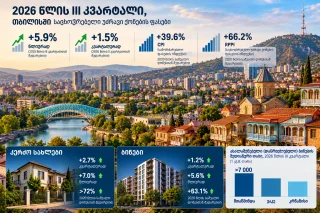 Residential Property Prices in Tbilisi Rise by 5.9% Year-on-Year
EB-5 in 2026: How Much Does a U.S. Investor Visa Cost?
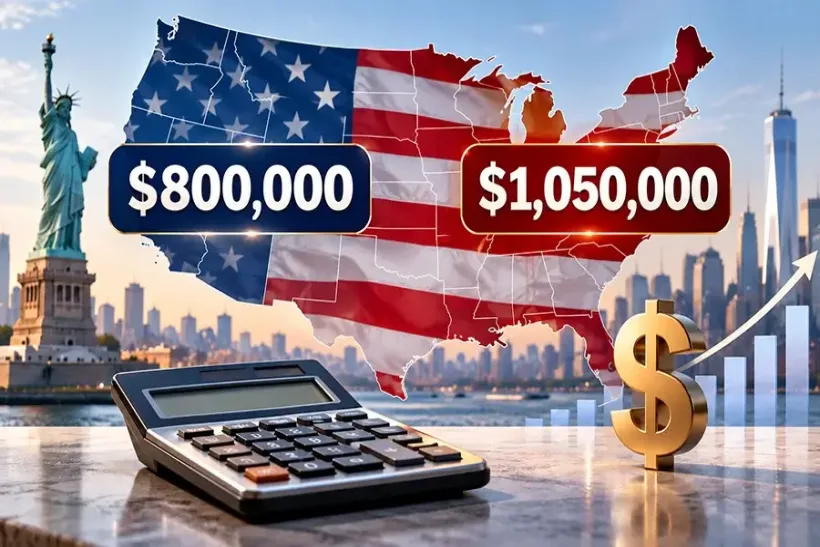
The U.S. EB-5 investor visa allows foreign nationals to obtain a green card through investment in the American economy. In 2026, the minimum required capital is $800,000 or $1.05 million, depending on the type of project. From November 30, government fees under the program will rise significantly, so the full cost of EB-5 includes not only the investment itself but also expenses related to obtaining immigration status.
U.S. Raises Fees for the EB-5 Program
The U.S. Department of Homeland Security has approved new fees for the EB-5 program. On average, fees for existing forms will increase by 70.7%. The changes take effect on November 30, 2026, and will apply to documents filed on or after that date.
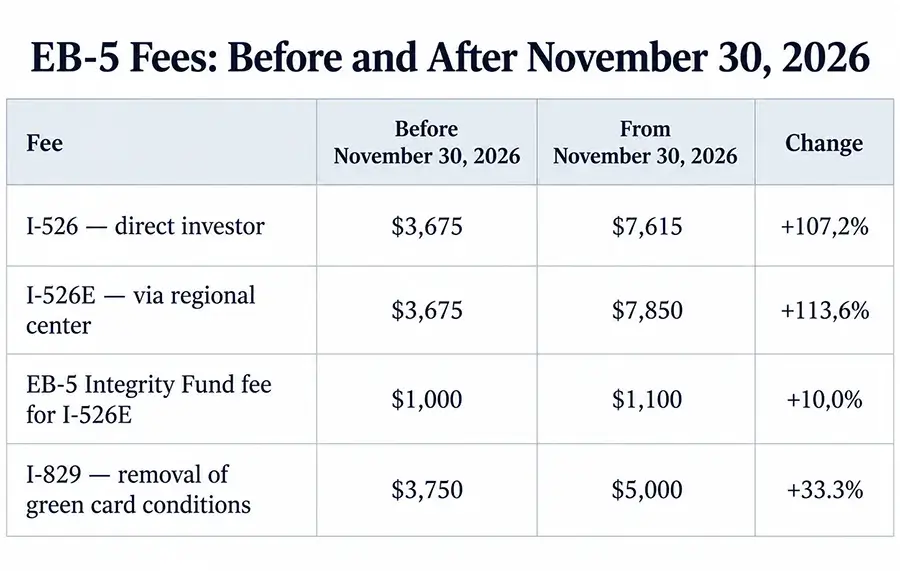
For direct investors, the filing fee for Form I-526 will rise from $3,675 to $7,615. Investors participating in regional center projects will pay $7,850 for Form I-526E instead of the current $3,675.
The additional EB-5 Integrity Fund fee for regional center investors will increase from $1,000 to $1,100. As a result, mandatory government payments at the initial filing stage will rise from $4,675 to $8,950.
U.S. fees for subsequent procedures will also change. Filing Form I-829 to remove conditions on permanent resident status will cost $5,000 instead of $3,750. A new Form I-527, intended for certain investors who filed I-526 before the 2022 program reform, will carry a $10,330 fee.
Minimum Investment Required for EB-5
The minimum investment required to obtain a green card through EB-5 is $800,000 or $1.05 million, depending on the type of project. The lower threshold applies to projects in rural areas, high-unemployment areas, and certain infrastructure projects. In other cases, an investor must contribute at least $1.05 million.
The project must also comply with the program’s job creation requirements. The investment must result in at least 10 full-time jobs for qualifying U.S. workers.
The $800,000 and $1.05 million amounts refer only to the required investment. Government fees and other costs associated with obtaining a U.S. investor visa are calculated separately.
Ways to Invest Through the EB-5 Program
The EB-5 program offers two main investment options: participation through a regional center or direct investment in a U.S. business.
Regional centers are authorized by USCIS to operate within the program and raise capital from foreign investors for specific projects. This format generally involves a more passive role, as the applicant does not need to manage the business on a day-to-day basis.
One important difference concerns job creation. Regional center projects may count both direct and indirect jobs. This makes it easier to demonstrate compliance with EB-5 requirements in large investment projects.
Under the direct investment model, capital is invested directly in a commercial enterprise. The investor has greater control over the business but also assumes more responsibility for its operations and compliance with immigration requirements.
What the U.S. EB-5 Investor Visa Provides
U.S. Permanent Resident Status
EB-5 is an immigrant visa category and, if all requirements are met, allows the investor to obtain U.S. permanent resident status. Initially, the investor receives a conditional green card valid for two years.
Before the end of that period, Form I-829 must be filed. USCIS reviews whether the program requirements have been met, after which the conditions may be removed. The investor can then continue living in the country as a permanent resident without the two-year restriction.
A green card gives the holder the right to live and work permanently in the United States without being tied to a specific employer. A permanent resident may later become eligible to apply for U.S. citizenship if the general naturalization requirements are met.
EB-5 for the Investor’s Family
The program allows the principal applicant to include immediate family members in the immigration case. A spouse and unmarried children under the age of 21 may receive green cards together with the investor.
A separate minimum investment is not required for each family member. They receive derivative status based on the principal applicant’s case and go through the conditional permanent residence stage together. Once the conditions are removed, the spouse and children included in the application also retain U.S. permanent resident status.
EB-5 Green Card Processing Times
There is no single fixed processing time for a U.S. investor visa. The duration depends on the investment structure, USCIS workload, the applicant’s country of birth, visa availability, and the circumstances of the individual case.
According to USCIS statistics for fiscal year 2026, the median processing time for completed I-526E petitions was about 11 months. For I-526 petitions involving direct investment, the figure was approximately 26 months. These figures relate to cases already completed and do not guarantee the same timeline for a new application.
After the investment petition is approved, the next stage begins. Applicants outside the United States go through immigrant visa processing at a U.S. consulate, while some investors already in the country may be eligible to adjust status. This period also forms part of the overall green card timeline.
EB-5 Visa Backlog in 2026
The number of EB-5 immigrant visas is subject to an annual quota. For some applicants, waiting times depend on the country of birth and the category of the investment project.
In October 2026, no cut-off date applies to most countries in the main EB-5 category. For mainland China, the Final Action Date is December 1, 2016, while for India it is December 1, 2023. Reserved categories for rural projects, high-unemployment areas, and infrastructure investments are available to all countries without a priority-date backlog.
Reserved categories account for 32% of the annual EB-5 quota: 20% of visas are allocated to rural investments, 10% to high-unemployment areas, and 2% to infrastructure projects. The remaining share falls under the general EB-5 category.
Additional Costs of the EB-5 Program in the U.S.
The full cost of EB-5 is not limited to the $800,000 or $1.05 million investment and USCIS government fees. Additional expenses arise when applying for a U.S. investor visa, and their amount depends on the selected project, filing method, and circumstances of the individual applicant.
The budget typically includes immigration attorney fees, document translation and certification, bank charges, and preparation of evidence proving the lawful source of funds. When investing through a regional center, the investor may also pay a separate project administration fee. There is no single standard rate, as the amount is set by the project manager.
Additional payments also depend on the way the green card is obtained. Applicants going through consular processing pay the relevant immigrant visa costs and expenses for the mandatory medical examination. Different forms and fees apply to applicants adjusting status from within the United States.
International Investment analysts note that the real cost of a U.S. investor visa consists of several components: the required investment capital, government payments, and expenses associated with preparing and managing the case. These costs should be calculated separately from the funds invested directly in the project.
FAQ About the U.S. EB-5 Investor Visa
How much do you need to invest in EB-5 in 2026?
The minimum investment is $800,000 for qualifying projects in rural areas, high-unemployment areas, and infrastructure. In other cases, at least $1.05 million is required.
How much will EB-5 filing cost from November 30, 2026?
The I-526 filing fee will be $7,615, while I-526E will cost $7,850. Regional center investors will also pay an additional $1,100 contribution to the EB-5 Integrity Fund.
Can you get a green card with an $800,000 investment?
Yes. A green card through an $800,000 investment is available for projects that qualify for the reduced investment threshold. In other cases, the minimum amount is $1.05 million.
What is the difference between a regional center and direct investment?
With a regional center, funds are invested in an organized investment project and the investor generally does not manage the business directly. With direct investment, the applicant invests directly in a commercial enterprise and usually takes a more active role in its operation.
Does the investor’s family receive green cards?
Yes. The principal applicant’s spouse and unmarried children under 21 may also become permanent residents.
How long does the EB-5 process take?
There is no fixed timeline. It depends on the type of application, USCIS processing times, visa availability, and the circumstances of the individual case.
Does the U.S. EB-5 investor visa provide citizenship?
No. EB-5 provides a pathway to a green card. Eligibility to apply for citizenship may arise later if the general naturalization requirements are met.
When do the EB-5 fees increase?
The new fees take effect on November 30, 2026, and apply to documents filed on or after that date.