







 Vietnam Mortgage Surge Pushes Homes Out of Reach
 Lithuanian Apartment Prices Accelerate Across Major Cities
 London Flats Lose Value Ahead of Leasehold Reform
 Construction of the Batumi–Sarpi Highway Begins in Georgia
 Baltic Property Investment Accelerates in 2026
 Hong Kong and Singapore Renew Their Expat Rivalry
Ireland Softens Airbnb Curbs as Rental Supply Stays Scarce
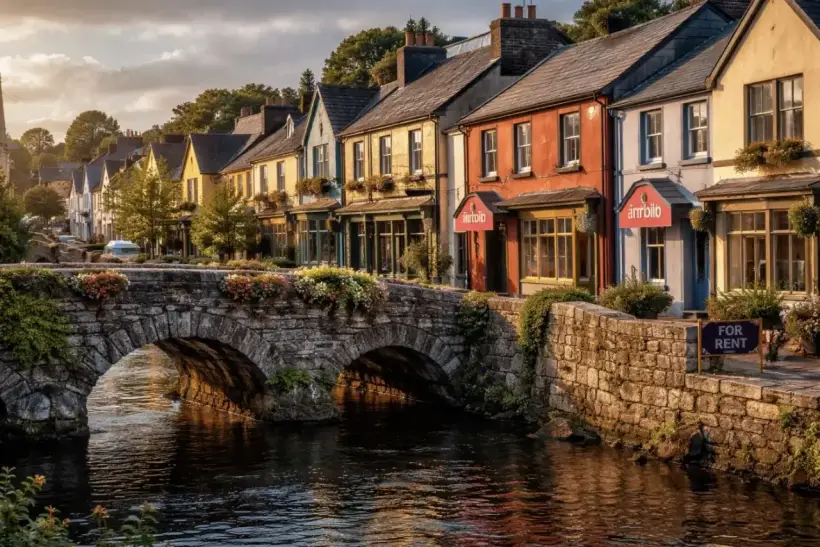
Ireland has decided to exempt smaller towns from parts of its new short-term letting crackdown even as long-term rental supply in those locations remains exceptionally thin. According to the Irish Independent, fewer than 150 long-term rental properties were available in the towns that will now be excluded from the tighter rules. At the same time, the government has confirmed that a national short-term letting register, run by Fáilte Ireland, is due to begin on 20 May 2026.
Ireland’s short-term letting rules are now focused on larger towns
The central policy shift is that the new restrictions are being targeted mainly at larger urban areas. RTÉ reported that the rules will apply to towns with populations above 20,000, after the government moved away from an earlier 10,000 threshold, and that there are 20 such towns under the 2022 Census. In April 2025, the Department of Enterprise had said the policy was intended generally to preclude new planning permissions for short-term lets in cities and towns with populations above 10,000, or another level set by regulation, showing how the population threshold was later politically recalibrated.
That change matters because it leaves a wide range of smaller tourist and coastal towns outside the main restriction regime even though housing scarcity in those locations is already acute. The combination of the new 20,000 threshold and the Irish Independent’s report of fewer than 150 long-term rentals in exempt towns suggests the housing pressure is not confined to Dublin and the largest cities.
A national register for short-term lets starts in May 2026
The broader regulatory framework remains in place. The Department of Enterprise says the Short Term Letting and Tourism Bill will introduce a national register for all short-term lets from 20 May 2026, operated by Fáilte Ireland. Hosts offering accommodation for up to 21 nights will have to register, obtain a valid registration number and display it on listings. The state also plans enforcement tools including fixed payment notices, summary court proceedings and financial sanctions for platforms that fail to comply with EU short-term rental data rules.
The government says the new system is intended not only to improve transparency in the tourism market but also to rebalance the relationship between short-term accommodation, the long-term housing sector and community needs. In its November 2025 paper on rebalancing short-term lets, the Department of Housing said rapid growth in short-term rentals had created challenges precisely because it had become harder to determine which homes should remain in long-term residential use.
Ireland’s long-term rental market remains at a historic low
The policy softening comes at a time of exceptionally weak rental supply. Daft.ie figures cited by RTÉ showed that fewer than 1,800 homes were available to rent across Ireland on 1 February 2026, down 22% from a year earlier and the lowest February level in a series going back to 2006. The Journal, citing the same Daft report, put the total at 1,777 properties.
Against that backdrop, the Irish Independent’s finding of fewer than 150 long-term rentals across towns exempted from the new rules becomes especially significant. It suggests that even relatively small numbers of homes diverted into tourism use can have an outsized effect in markets where the long-term supply base is already extremely narrow.
Short-term lets already outnumber regular rentals by more than four to one
National data points to a much wider imbalance. Threshold said in March 2026 that there were more than 8,600 short-term lets advertised by multi-property hosts across Ireland, compared with fewer than 2,100 homes available in the private long-term rental market, a ratio of 4.1 to one. Using a broader entire-home count, Inside Airbnb data cited by Threshold indicated there were 20,039 whole homes or apartments listed for short-term holiday use nationwide.
The imbalance is even sharper in tourism-heavy counties. Threshold said Kerry had 1,009 short-term lets and only 33 homes for private rent, Clare had 532 against 19, Donegal had 662 against 27, Mayo had 350 against 25, and Leitrim had 87 against 7. These figures matter because many of the areas most exposed to tourism pressure fall outside the largest population centres that will face the strongest new restrictions.
The fight over the 20,000 population threshold has become central
Threshold openly criticised the move from 10,000 to 20,000 residents, arguing that the change is particularly troubling for rural and regional areas where rental supply is already extremely limited. The charity urged the government to restore the 10,000-population planning threshold and said registration alone would not bring homes back into long-term use without credible enforcement.
That criticism is reinforced by another data point from Threshold: between 2019 and May 2025, local authorities received only 426 change-of-use planning applications for short-term lets, equivalent to about 1.3% of short-term rental properties at that time. In other words, compliance with existing planning requirements appears to have been very low even before the new national register takes effect.
Ireland is trying to balance tourism and housing policy
The government’s position is built around balance rather than prohibition. The Department of Enterprise says tourism supported 228,000 jobs and generated EUR 6 billion for the Irish economy in 2024, making short-term accommodation an important part of the sector. At the same time, ministers say local housing need requires stronger controls on the conversion of homes away from long-term use.
That makes the current reform a compromise: stricter rules for bigger towns, more flexibility for smaller ones and a national register to improve visibility across the market. But the underlying supply data suggests that exempting smaller towns could blunt the housing impact of the reform precisely in areas where the market is most fragile. That conclusion is supported by the combination of Independent, Daft.ie and Threshold figures.
As International Investment experts report, Ireland’s short-term letting reform is becoming a test case for Europe. On paper, the country is strengthening oversight and transparency, but the softer treatment of smaller towns may limit how many homes actually return to the long-term rental sector. For investors, that means a more complex and locally uneven regulatory map. For renters, it means the housing shortage in tourism-dependent areas may remain severe even after the register begins operating.
FAQ about Ireland’s short-term letting reform
What changes in Ireland’s short-term letting rules in 2026?
From 20 May 2026, Ireland will introduce a national register for short-term lets, mandatory registration for properties rented for up to 21 nights and a requirement to display a registration number on listings.
Which towns will face the tighter restrictions?
RTÉ reported that the main restrictions will apply to towns with populations above 20,000, although the policy had earlier been framed around a 10,000 threshold.
Why has the decision become controversial?
Because the Irish Independent reported that there were fewer than 150 long-term rentals available in the towns that will be exempt from the new rules, showing how thin supply already is in those areas.
How severe is Ireland’s rental shortage overall?
Daft.ie figures cited by RTÉ showed fewer than 1,800 homes available to rent nationwide on 1 February 2026, the lowest February availability in the series since 2006.
How many short-term lets are there in Ireland?
Threshold said there were more than 8,600 short-term lets advertised by multi-property hosts, compared with fewer than 2,100 homes in the long-term private rental market.
Will the register alone solve the housing problem?
Threshold says no. The charity argues that registration without planning enforcement will not be enough to return significant volumes of housing to long-term use.