







 Buses from Latvia to Russia and Belarus May Be Cancelled
 Egypt’s Economy Accelerates to 5.1%
 Kazakhstan Recovers $2.5 Billion in State Assets
 Argentina Draws Families While Investor Citizenship Remains Uncertain
 Antalya Loses 665,000 Tourists in Eight Months
 New Housing in the UAE: Dubai Leads in Construction Volume
Irish Homes Are 17% Overvalued as Supply Lags
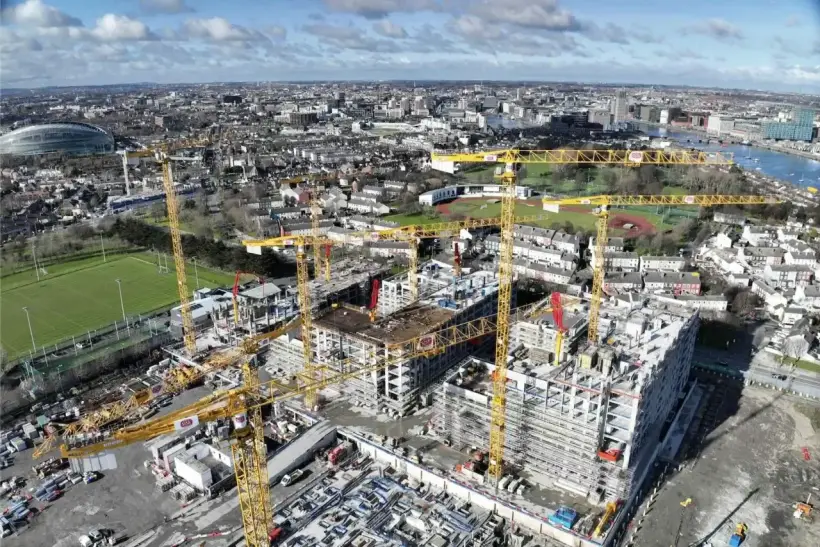
Irish residential property prices are about 17% above levels consistent with current incomes, interest rates and demographic fundamentals, according to new research from the Economic and Social Research Institute. The gap has widened substantially, but today's market differs sharply from the property bubble of the mid-2000s. Credit growth and household leverage are far less extreme, while the central problem is a persistent shortage of homes. Property prices are also still rising: the national index increased 5.6% year on year in June 2026, when the median transaction price reached €396,000.
Irish housing is around 17% above fundamental values
The latest ESRI research uses four approaches to compare observed residential prices with levels implied by household incomes, interest rates, demographics and other economic variables.
All four methods indicate overvaluation in 2025, with a composite estimate of about 17%. Before Ireland's previous property collapse, the comparable measure exceeded 40% in 2006.
The underlying risks are different today. Household indebtedness and credit-market indicators remain well below their pre-financial-crisis peaks, leading the researchers to describe the current pressure as more consistent with structural housing-supply imbalances than credit-driven price growth.
The 17% estimate does not mean every Irish home is exactly 17% above an objective fair value, nor does it predict a 17% decline. It is a model-based estimate of the gap between market prices and selected economic fundamentals.
The gap has widened from 8–10%
Similar analysis in late 2024 put Irish residential overvaluation at approximately 8–10%. At the time, researchers found that prices had started moving above values suggested by their models after several years of relative alignment.
The latest findings show that the gap continued to widen.
Middle-income households appear particularly exposed. For this group, the price-to-income ratio has moved furthest away from its long-run benchmark, leaving buyers caught between rising property values and borrowing limits tied directly to income.
A supply-constrained market can remain expensive for a prolonged period even without the rapid debt accumulation normally associated with a speculative bubble.
Irish property prices are still increasing
Official statistics do not yet show a nationwide correction.
Ireland's Residential Property Price Index rose 5.6% in the 12 months to June 2026, down from 6.1% in May. It was the slowest annual increase since January 2024.
Dublin prices increased 4.6%, while properties outside Dublin rose 6.4%. National house prices were up 5.2% and apartment prices 8%. Apartments outside Dublin recorded particularly strong annual growth of 10.2%.
The median price paid for a residential property in the 12 months to June was €396,000. Dublin's median was €500,000. Dún Laoghaire-Rathdown was the most expensive local authority area at €682,334, while Longford was the cheapest at €198,000.
The national index is now 26.5% above its previous nominal peak in April 2007. That comparison is not adjusted for inflation accumulated over almost two decades.
Housing supply remains the central constraint
Ireland completed 8,823 new dwellings in the second quarter of 2026, 3.6% fewer than in the same period a year earlier.
Apartment completions fell 12.2% to 2,658. Total completions in Dublin declined 16.4%, even though the capital accounted for 75.5% of all apartments completed nationally during the quarter.
The first-half comparison is stronger because of a better first quarter. Ireland completed 16,679 homes during January through June, up about 10.8% from 15,059 a year earlier. Full-year completions reached 36,215 in 2025.
Even that improvement is unlikely to eliminate the accumulated shortage quickly. Ireland would need several years of construction substantially above recent levels to close the gap between household formation and housing availability.
The government is targeting 300,000 homes
Ireland's Delivering Homes, Building Communities plan for 2025–2030 targets 300,000 homes by the end of the decade, including 72,000 social homes and 90,000 affordable housing supports.
The programme combines infrastructure investment in water, energy and transport with serviced land, planning and regulatory measures, tax changes and additional private-sector investment.
Across the life of the plan, the target implies an average pace of roughly 50,000 homes a year. That compares with 36,215 completions in 2025.
The speed at which supply increases is therefore central to the future direction of prices. If annual construction moves close to the government's target, scarcity should gradually ease. If completions remain nearer current levels, upward pressure is likely to persist.
Mortgage rates have eased slightly
Borrowing costs are no longer rising as they did during the European Central Bank's tightening cycle, although mortgages remain considerably more expensive than during the ultra-low-rate period.
The weighted average rate on new Irish mortgage agreements was 3.49% at the end of June 2026, one basis point higher than in May but 11 basis points lower than a year earlier. The comparable euro-area average was 3.51%.
Fixed-rate agreements represented 93% of new mortgage volumes and carried an average rate of 3.46%. Variable-rate agreements averaged 3.96%. New mortgage agreements totalled €1.1 billion in June, up 9% year on year.
Lower rates provide some relief, but small changes in borrowing costs cannot fully offset property prices that have risen much faster than many household incomes.
Mortgage rules limit a repeat of the credit boom
Ireland's post-crisis mortgage rules place firm limits on borrowing relative to income and property value.
First-time buyers can generally borrow up to four times gross annual income, while second and subsequent buyers are limited to 3.5 times income. Both categories normally require a deposit of at least 10%.
Buy-to-let purchasers need a minimum 30% deposit. Lenders can exceed the standard limits for only part of their new business: up to 15% of lending to first-time and subsequent owner-occupier buyers, and 10% of buy-to-let lending.
At the national median property price of €396,000, a 10% deposit would amount to €39,600 and leave a mortgage requirement of €356,400. Under the standard four-times-income cap, that would imply gross household income of about €89,100 for a first-time buyer before the lender conducts its own affordability assessment.
First-time buyers remain active
High prices have not stopped transactions.
In the 12 months to June 2026, households registered 51,253 market-price residential purchases. First-time buyer owner-occupiers accounted for 20,716 transactions, or 40.4% of the total.
In June alone, 1,705 first-time buyer purchases were filed, 11.4% more than a year earlier. They included 699 newly built homes and 1,006 existing properties.
Demand therefore remains resilient despite worsening affordability. Population growth, employment, scarce supply and buyer-support schemes continue to underpin activity.
New rents are rising faster than house prices
Households unable or unwilling to buy also face increasing pressure in the rental market.
The national standardised average rent for a new tenancy reached €1,839 a month in the first quarter of 2026, up 9.1% year on year. The annual increase had been 5.4% in the final quarter of 2025.
Existing tenancies averaged €1,513 a month, an increase of 4.2%. The gap between the standardised averages for new and existing tenancies was therefore €326 per month.
Ireland introduced a new national rent-control system on March 1, 2026. For most tenancies, annual rent increases are limited to 2% or the rate of inflation, whichever is lower. New tenancies created from March can reset to market rent only in specified circumstances, while ongoing tenancies created before March generally cannot be reset to market level.
Because the new rules applied for only the final month of the first quarter, it is too early to attribute the quarter's acceleration in new-tenancy rents to the reform.
A 17% valuation gap is not a 17% crash forecast
There are several ways for an overvaluation gap to narrow.
House prices could fall, but they could also remain broadly stable while incomes rise. Faster construction could reduce scarcity and restrain future price growth. Lower mortgage rates or demographic changes would also alter the level supported by valuation models.
That is the crucial difference from Ireland's mid-2000s housing cycle. The earlier boom involved a powerful feedback loop between rapidly rising house prices and expanding credit. Today's mortgage market is more tightly constrained and household leverage is lower, while the shortage of physical housing stock remains the dominant pressure.
As International Investment experts report, the 17% estimate should be read neither as a forecast of a 17% property crash nor as proof that current prices can rise indefinitely. Irish housing has moved materially ahead of levels supported by incomes and borrowing costs, with middle-income households under particular pressure. At the same time, chronic undersupply can keep an expensive market expensive for years. The key variable is now construction: if Ireland approaches roughly 50,000 completions a year, price growth could slow substantially; if supply continues to lag household demand, affordability pressures are likely to persist even without a credit bubble.
FAQ: Irish house prices in 2026
How overvalued is Irish housing?
ESRI estimates that residential prices are around 17% above levels consistent with incomes, interest rates, demographics and other economic fundamentals.
Does that mean Irish house prices will fall 17%?
No. Overvaluation is a model estimate rather than a forecast. The gap could narrow through lower prices, higher household incomes, changing interest rates or increased housing supply.
How overvalued was Irish property before the financial crisis?
The comparable estimate exceeded 40% in 2006. The current market also has lower household indebtedness and much tighter mortgage-lending rules.
What is the median home price in Ireland?
The median residential property price in the 12 months to June 2026 was €396,000. It was €500,000 in Dublin, €682,334 in Dún Laoghaire-Rathdown and €198,000 in Longford.
How fast are property prices rising?
The national Residential Property Price Index increased 5.6% year on year in June 2026. Dublin prices rose 4.6%, while prices outside Dublin increased 6.4%.
How many homes is Ireland building?
Ireland completed 8,823 dwellings in the second quarter of 2026 and 16,679 during the first half of the year. Full-year completions reached 36,215 in 2025.
What is Ireland's housing target?
The government's current plan targets 300,000 homes by the end of 2030, requiring a considerably higher annual construction rate than recent levels.
What are mortgage rates in Ireland?
The weighted average rate on new Irish mortgage agreements was 3.49% at the end of June 2026. New fixed-rate agreements averaged 3.46%.
How much can a first-time buyer borrow?
The standard loan-to-income limit is four times gross annual income. Most first-time buyers also need a minimum deposit of 10%.
How expensive is renting in Ireland?
The standardised average rent for a new tenancy was €1,839 per month in the first quarter of 2026. Existing tenancies averaged €1,513.