











Young Japanese Buyers Turn to 50-Year Mortgages

Record apartment prices and higher borrowing costs are reshaping Japan's mortgage market. Banks are increasingly offering 40- and 50-year loans instead of the conventional 35-year term, with younger buyers among the most enthusiastic users. After PayPay Bank launched its longer product, 70% of borrowers in their 20s and 49% of those in their 30s selected terms exceeding 35 years. Longer repayment periods reduce the monthly bill, but principal declines more slowly, lifetime interest costs rise and some borrowers can remain in debt until close to age 80.
Fifty-year mortgages are becoming more common
For decades, 35 years was the conventional maximum term for a Japanese housing loan. Rising property prices have pushed lenders to extend that horizon, bringing more 40- and 50-year products to the market.
Younger buyers have adopted them particularly quickly. After PayPay Bank extended its maximum term to 50 years in July 2025, 70% of borrowers in their 20s and 49% of those in their 30s chose repayment periods longer than 35 years. Many ultra-long mortgage products require full repayment before the borrower reaches 80.
For buyers in their 20s or early 30s, that makes a half-century loan technically possible. It reduces the required payment today but does not reduce the purchase price.
Greater Tokyo new apartments now average more than ¥100 million
The rise of ultra-long mortgages coincides with record prices in the new-condominium market.
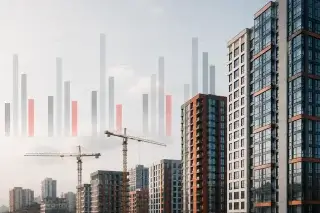
The average price of a newly built condominium in Greater Tokyo, which includes the capital and Kanagawa, Saitama and Chiba prefectures, reached ¥101.35 million in the first half of 2026. That was a 13.1% annual increase and the first time the half-year average exceeded ¥100 million.
In Tokyo's 23 special wards, the average rose 9.1% to a record ¥142.49 million. The equivalent averages were ¥83.46 million in Kanagawa, ¥89.97 million in Chiba and ¥64.69 million in Saitama.
Developers supplied 7,989 new units across Greater Tokyo during the period, 0.8% fewer than a year earlier.
The average does not mean a typical apartment everywhere in the region costs more than ¥100 million. A relatively small number of expensive central Tokyo projects can push up the mean. Even so, rising new-build prices increase the amount many households need to finance.
Lower monthly repayments come with a larger total bill
PayPay Bank illustrates the trade-off using a ¥40 million mortgage.
At an assumed interest rate of 1.2%, a 35-year loan produces a monthly payment of ¥116,680. Extending the same principal to 50 years lowers the monthly payment to ¥94,802 in the bank's example, which assumes a 1.5% rate for the longer term.
The monthly saving is almost ¥22,000. Total repayments move in the opposite direction, increasing from about ¥49.04 million over 35 years to ¥56.92 million over 50 years.
The bank's current product also applies an interest-rate surcharge to loans exceeding 35 years and requires the mortgage to be fully repaid before the borrower reaches 80.
A longer mortgage can therefore improve monthly affordability or support a larger loan, but principal is repaid more slowly and interest accrues for many additional years.
Banks are expanding ultra-long lending
PayPay Bank began accepting 50-year mortgage applications on July 1, 2025. It explicitly linked the new product to rising property prices and mortgage rates, arguing that longer repayment periods could reduce monthly costs and allow customers to consider larger borrowing amounts.
By 2026, ultra-long mortgages were spreading across the industry. Japan's Financial Services Agency has identified online and other lenders including SBI Shinsei Bank and Rakuten Bank among institutions offering loans lasting four or five decades, and the regulator has increased scrutiny of the segment.
Rakuten Bank began offering Flat 50 on August 25. Under its standard eligibility rules, applicants must be under 44 when applying and under 80 when the mortgage is fully repaid, unless they use an intergenerational repayment arrangement.
Flat 50 is not available for every property
The government-backed Flat 50 programme differs from an ordinary bank mortgage. It is designed for qualifying homes that meet enhanced durability and other technical standards.
In September 2026, the most common Flat 50 rate for terms of 36 to 50 years was 3.70%. The corresponding most common Flat 35 rate for loans covering no more than 90% of the property's value was 3.46%.
Flat 50 rates ranged from 3.70% to 5.62%. Once the mortgage is issued, the rate and repayment schedule are fixed for the full term. The programme can also allow a buyer of the property to assume the remaining Flat 50 debt under specified conditions.
Flat 50 therefore should not be read as a universally available 50-year loan for any home. Both the borrower and the property must meet programme requirements.
Japan is no longer a near-zero-rate market
Longer mortgage terms are spreading just as borrowing is becoming more expensive.
Since June 17, 2026, the Bank of Japan has targeted the uncollateralised overnight call rate at around 1%. The interest rate on the complementary deposit facility is also 1%, while the basic loan rate is 1.25%. The next monetary-policy meeting is scheduled for September 17–18.
That represents a major change for a housing market accustomed to exceptionally cheap money.
Borrowers with fully fixed mortgages are protected from subsequent policy-rate changes once their loans are issued. Variable-rate borrowers remain exposed to adjustments in bank lending rates.
PayPay Bank, for example, raised its base variable mortgage rate from 2.93% to 3.28% in July. That is a reference rate rather than the actual rate charged to every borrower, as individual customers receive contractual discounts from the base rate.
The longer a variable-rate mortgage remains outstanding, the more time the household is exposed to changes in financing conditions.
The financial regulator is monitoring long-term repayment risks
Japan's Financial Services Agency has begun paying closer attention to ultra-long mortgages because they are increasingly used by younger borrowers with relatively modest incomes.
The central concern is not simply the length of the contract. A 40- or 50-year mortgage requires lenders to assess whether borrowers can continue servicing their debt across multiple economic cycles, changes in interest rates, employment disruptions and eventually retirement.
The regulator has not announced a ban or general restriction on 50-year loans. Its focus is on how lenders assess risk and which customers qualify.
Principal declines more slowly
The reduction in monthly payments is easy to see in a household budget. The slower accumulation of home equity is less visible.
A borrower on a 50-year amortisation schedule repays principal more slowly than someone with a 35-year loan. If the owner sells after five, ten or fifteen years, the outstanding mortgage balance will generally be higher.
That becomes important if property values weaken. The larger the debt relative to the resale value, the less equity the household can recover when moving.
Japanese urban property prices have risen strongly in recent years, but a 50-year contract covers too long a period for any buyer to assume uninterrupted appreciation.
Some borrowers could remain in debt into retirement
The age limit of 80 does not mean banks expect every borrower to keep the mortgage until that point. Households can make early repayments, refinance or sell.
The scheduled term nevertheless illustrates the scale of the commitment. A 29-year-old taking a 50-year mortgage would finish at around 79 if no early repayments were made.
The same person taking a 35-year loan would finish at around 64.
Ultra-long mortgages therefore require households to consider more than current salary. Retirement income, savings, planned early repayments and the expected holding period for the property all become more important.
The Bank of Japan expects inflation to remain above 2%
Housing finance is adjusting to a broader change in Japan's monetary environment.
In its July outlook, the Bank of Japan projected core consumer-price inflation of 2.5% in fiscal 2026 and 2.4% in fiscal 2027, before easing toward 2% in fiscal 2028.
The central bank also said that if its baseline economic and inflation outlook is realised, it expects to continue raising the policy rate and adjusting the degree of monetary accommodation.
For homebuyers, that makes it risky to assume that Japan will automatically return to the mortgage rates associated with its long period of near-zero monetary policy.
Longer terms increase borrowing capacity
The broader effect of a 50-year mortgage goes beyond the repayment schedule of one household.
Spreading the same principal across another decade or more allows borrowers to service larger debts at similar monthly payments. That increases purchasing capacity.
For an individual family, this can make homeownership possible. For the housing market, the effect is more complicated because additional financing capacity can sustain demand at elevated prices.
A longer mortgage does not create more apartments, lower construction costs or increase the supply of developable land.
With fewer than 8,000 new condominiums supplied in Greater Tokyo in the first half of 2026 while average prices reached a record, longer loan terms mainly change how households finance expensive housing.
As International Investment experts report, a 50-year mortgage can make sense for a younger borrower when lower required payments create a genuine financial buffer, income is stable and the loan allows flexible early repayment. It does not make the property itself cheaper. If ultra-long terms become a widespread response to rising prices, they increase buyers' financing capacity without adding housing supply. Part of today's affordability problem is then shifted from the monthly payment into higher lifetime interest costs and a longer period of debt.
FAQ: 50-year mortgages in Japan
Can you get a 50-year mortgage in Japan?
Yes. Several banks offer terms of up to 50 years, while the government-backed Flat 50 programme provides fully fixed financing for qualifying homes.
Why are younger Japanese buyers choosing longer mortgages?
The main advantage is a smaller required monthly payment. With property prices at record levels, a longer term can allow a household to finance a larger purchase with its current income.
How popular are terms longer than 35 years?
After PayPay Bank launched its 50-year option, 70% of borrowers in their 20s and 49% of those in their 30s selected terms exceeding 35 years.
How much does a new Tokyo condominium cost?
The average price of a new condominium in Tokyo's 23 special wards reached ¥142.49 million in the first half of 2026. The Greater Tokyo average was ¥101.35 million.
How much can a 50-year mortgage reduce monthly repayments?
In PayPay Bank's ¥40 million illustration, the monthly payment falls from about ¥116,700 over 35 years to about ¥94,800 over 50 years. The examples use different interest rates.
How much does the total repayment increase?
In the same example, total repayments rise from approximately ¥49.04 million over 35 years to ¥56.92 million over 50 years.
What is the Flat 50 rate?
The most common Flat 50 rate in September 2026 was 3.70% before any applicable rate-reduction schemes.
Who can use Flat 50?
Under standard rules, applicants must generally be under 44 when applying and under 80 at final repayment. The property must also meet the programme's technical eligibility requirements.
Can mortgage payments continue into retirement?
Yes. A person taking a 50-year mortgage at around age 30 could remain on the scheduled repayment plan until close to age 80 unless the debt is repaid early.
Do 50-year mortgages solve Japan's housing-affordability problem?
They reduce monthly repayment burdens but do not reduce property prices or increase housing supply. By expanding borrowing capacity, ultra-long mortgages can also help sustain demand at high prices.