







 The World’s Strongest Passports for Travel, Living and Investment
 Young Icelanders Shift Into Rental Housing
 Argentina Rents Rise but Lag Inflation
 Hungary Plans Wealth Tax Above 1 Billion Forints
 China Rewrites Its New-Home Sales Model
 Apartment Sales in Tbilisi and Batumi Reached $485 Million in July
Russian Developers’ Debt Nearly Doubled in a Year
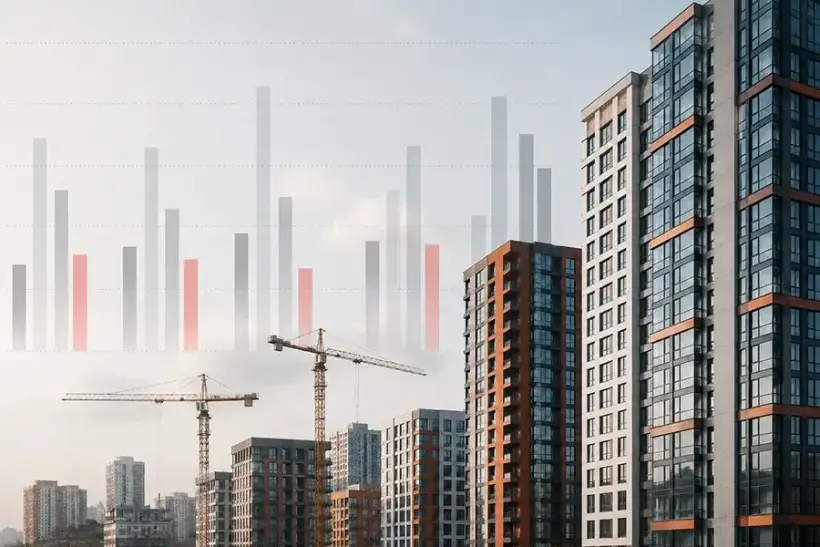
The debt burden of Russian property developers increased significantly, while business profitability declined. The financial cushion accumulated in previous years has been largely exhausted, and the sector could face additional pressure from expensive borrowing and tighter subsidized mortgage conditions, according to a study by the Expert RA rating agency.
Mortgages in Russia Are Limiting Demand
The financial position of Russian developers began to deteriorate noticeably after the cancellation of the broad-based subsidized mortgage program in mid-2024. Before that, strong demand for new-build housing had been supported by subsidized loans, while robust results in 2020–2023 allowed developers to build up a substantial financial cushion.
After the program ended, some buyers left the primary housing market. At the same time, the high Bank of Russia key rate sharply reduced access to market-rate mortgages: monthly payments increased, while housing loans became less affordable. Sales slowed, followed by weaker inflows into escrow accounts.
This has direct financial consequences for developers. Banks take escrow balances into account when determining project financing terms: the more money accumulated in these accounts, the cheaper the loan is for the developer. When sales are weak, borrowing costs rise and companies have to spend more on debt servicing.
Changes to the family mortgage program have added further pressure. Its terms were revised in February 2026, reducing access for some borrowers. Subsidized loans nevertheless remain one of the main sources of demand in the primary housing market.
The financial reserves accumulated earlier allowed the industry to absorb deteriorating market conditions for some time. According to Expert RA, however, this cushion was almost exhausted by the end of 2025. As a result, developers entered 2026 with higher debt and interest burdens and less capacity to offset rising costs with profits earned in previous years.
New-Home Sales in Russia Are Declining
By the end of 2025, the financial burden on Russian developers had increased considerably. One of the main reasons was weaker new-home sales: escrow accounts were being replenished more slowly, while the need for borrowed capital remained high.
Russian developers’ debt is also increasing because investment activity remains strong. Many companies continue to launch new projects and expand their portfolios despite weaker demand. This requires additional borrowing at a time when the cost of debt remains high.
To assess the situation, Expert RA uses the net debt-to-EBITDA ratio. Cash assets and the portion of project financing covered by escrow balances are deducted from total debt. EBITDA shows earnings before interest, taxes, depreciation and amortization.
For some participants in the study, the ratio increased severalfold over the year. A negative net debt figure was recorded only for Glavstroy-Regiony: under the agency’s methodology, the company’s available cash resources exceeded the liabilities included in the calculation.
The study covered A101, Pioneer Group, G-Group, LSR Group, PIK, Talan Group, Strana Development, Etalon Group, DARS, Glavstroy-Regiony and Zhelezno Finance. Among the companies analyzed, 27% have a ruA rating, corresponding to a moderately high level of creditworthiness. The remaining 73% are rated ruBBB, a lower category that implies greater sensitivity to deteriorating economic conditions. The analysis covers Expert RA clients and does not represent the entire Russian development sector.
Gap Between Bank Loans and Escrow Funds Is Widening
Weak sales are changing the financing structure of residential construction. According to the Bank of Russia, developers’ debt to banks reached RUB 10.8 trillion, while escrow accounts held RUB 7.5 trillion. The gap between the two figures amounted to RUB 3.3 trillion.
Buyers’ funds directly affect the cost of project financing. The higher the escrow balances, the lower the interest burden for a developer. When sales slow, loan coverage declines and bank debt becomes more expensive to service.
The gap is particularly visible in Tatarstan. By July 2026, local developers owed banks RUB 298 billion, putting the republic first in the Volga region and among the five Russian regions with the highest levels of lending to developers. Escrow accounts held RUB 216 billion, leaving a difference of RUB 82 billion.
This increases companies’ sensitivity to borrowing costs. As long as sales remain weak, it is more difficult for developers to reduce financing expenses even if construction volumes remain high.
Expensive Loans Are Reducing Profits
The high key rate is increasing developers’ expenses in several areas. Companies are paying more for both project financing and corporate loans used to expand their businesses and launch new developments.
At the end of 2025, EBITDA interest coverage did not exceed 1.5x for most companies in the Expert RA sample. This means operating earnings provided only a limited cushion for servicing interest expenses.
Weak demand creates additional pressure. When escrow accounts are replenished slowly, project financing terms become less favorable and borrowing costs rise. As a result, a significant share of operating profit is absorbed by interest payments.
Dmitry Sergienko, Senior Director for Corporate Ratings at Expert RA, notes that the high rate affects both project and corporate debt. The longer borrowing remains expensive, the greater the impact on developers’ financial results.
Developer Profitability Is Declining
Slower demand limits developers’ ability to raise apartment prices in line with their own rising costs. At the same time, construction materials and financing are becoming more expensive, gradually reducing project margins.
At the end of 2025, the average EBITDA margin among companies in the Expert RA sample was around 20%. Dmitry Sergienko notes that this remains relatively high compared with many other industries, although net profitability is considerably lower after interest and other mandatory expenses are taken into account.
The agency has recorded declining profitability among almost all developers under review. If borrowing costs remain high, further margin compression will have an increasingly noticeable impact on financial results.
Financial statements for 2025 still partly reflect projects launched under more favorable market conditions. Because of the long construction cycle, the consequences of ending the broad subsidized mortgage program in mid-2024 are expected to become more visible in 2026–2027 results.
Largest Upcoming Debt Payments
Over the next 12 months, the largest volume of obligations among Expert RA clients falls on LSR Group, at RUB 11 billion. Its financial position is assessed as stable: operating cash flow, cash balances and available credit lines should allow the company to meet scheduled payments and fund capital expenditure.
Etalon Group faces RUB 7.95 billion in upcoming payments. The company has a ruBBB+ rating with a stable outlook, while payments on project loans are almost fully covered by funds held in escrow accounts.
G-Group is due to pay RUB 4.8 billion. Its ability to service the debt is assessed positively, taking into account cash reserves, expected operating cash flow and undrawn credit facilities.
Strana Development has RUB 2 billion in obligations, DARS RUB 1 billion and A101 RUB 500 million. Expert RA does not identify critical risks to these companies’ ability to meet the payments over the period under review.
Outlook for Russian Developers
One of the main factors supporting Russian developers remains subsidized mortgages, particularly the family mortgage program. Even after the changes to its terms, it continues to generate part of the demand for new-build housing and support developers’ sales.
Another source of potential demand is Russia’s relatively low housing provision. Deputy Prime Minister Marat Khusnullin previously estimated the figure at around 30 sq. m per person, compared with about 35 sq. m in Eastern Europe, 41 sq. m in China and more than 60 sq. m in the United States.
The lack of new construction in many Russian cities also points to potential demand. According to Khusnullin, around 800 cities across the country saw no new apartment buildings completed over the past five years. A further reduction in the key rate could also support the sector. If it approaches 10%, market-rate mortgages would become more affordable and developers’ project financing costs would decline.
The key rate remains the main risk for the industry. Kirill Kholopik, CEO of the Unified Resource of Developers, believes that the easing cycle could pause at around 14%. Sberbank CEO German Gref has expressed a similar view, referring to the possibility of “tactical pauses.”
Expert RA expects monetary policy easing to continue. Dmitry Sergienko notes that a noticeable improvement in conditions for developers is possible if the rate approaches 10%, which would reduce financing costs and improve access to market-rate mortgages.
The base-case scenario nevertheless assumes a gradual deterioration in financial indicators as 2026–2027 reports are published and increasingly reflect projects completed after the end of the broad subsidized mortgage program. The agency does not expect a catastrophic downturn or widespread developer bankruptcies. The market is unlikely to collapse, but financial pressure will remain.
What This Means for Investors
International Investment analysts note that rising debt is changing the development model of Russia’s new-build housing market. Developers are finding it increasingly difficult to service loans, preserve previous profitability levels and maintain a rapid pace of new project launches at the same time. This could lead to more cautious investment policies and a reduction in supply in areas where demand is insufficient.
In the short term, pressure on sales is likely to preserve discounts, installment plans and other incentives aimed at attracting buyers. For investors, this implies weaker potential for rapid price appreciation after purchase: part of the future return may effectively be absorbed by discounts already offered by developers and by strong competition between projects.
Over a longer horizon, fewer new launches could alter the balance between supply and demand. If mortgage conditions improve faster than developers restore construction volumes, a shortage of new projects in certain locations could once again support prices. The coming period therefore looks more like a phase of reassessing risk and expected returns than the beginning of another cycle of rapid market growth.