












The World’s Strongest Passports for Travel, Living and Investment
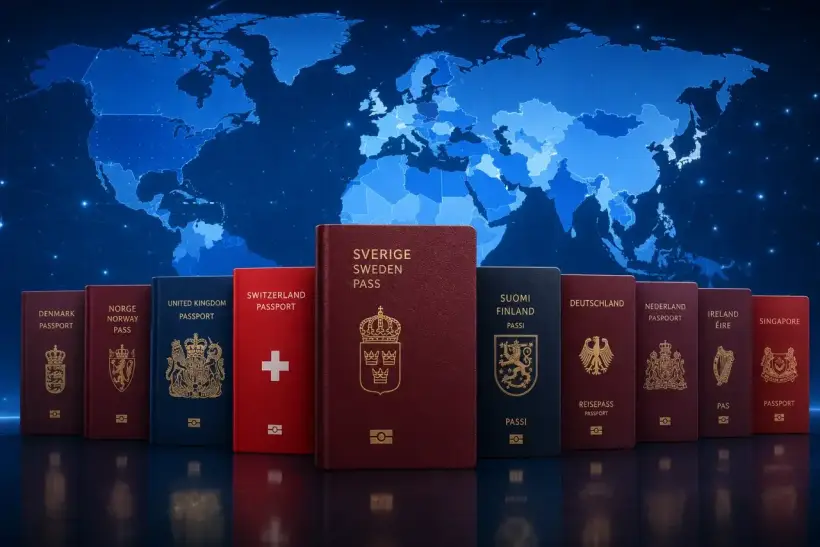
Global Citizen Solutions compared 200 countries across 15 indicators, taking into account travel freedom, investment conditions and quality of life. The global passport ranking is led by Sweden, Switzerland and Finland, while Somalia and Afghanistan are at the bottom of the list.
How the Passport Ranking Is Compiled
The Global Passport Index assesses countries across 15 indicators grouped into three categories. International mobility accounts for 50% of the final score, while investment opportunities and quality of life each contribute 25%.
The mobility component considers entry conditions in other countries, including visa-free access, visas on arrival and electronic travel authorizations. The quality of life in accessible destinations also matters: access to countries with better living standards carries greater weight.
The investment component covers the state of the economy and business environment, income levels and taxation. The quality-of-life assessment includes the cost of living, safety, infrastructure, personal freedoms, environmental conditions and other indicators.
Sweden Ranks First
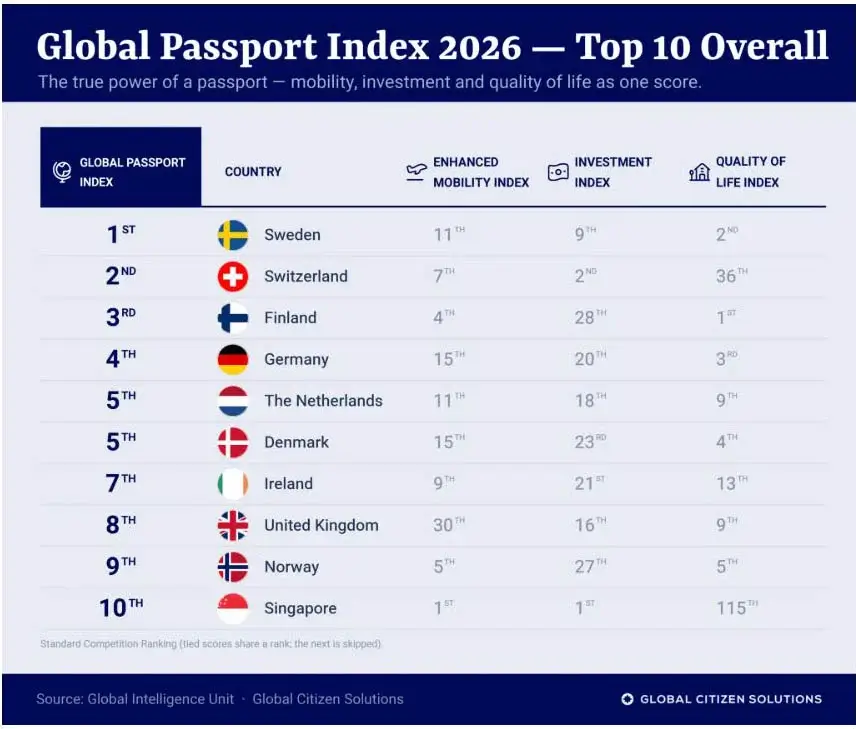
Sweden scored 96.05 points out of 100 and topped the Global Passport Index for the third consecutive year. However, it does not lead in any individual category: it ranks 11th for international mobility, ninth for investment opportunities and second for quality of life.
Its top position is the result of consistently strong performance across all three areas. The Swedish passport offers broad travel opportunities, while the country’s strong quality-of-life and economic indicators raise its overall score.
Switzerland is Sweden’s closest competitor. It ranks second overall and is among the world leaders for investment attractiveness, although it stands only 36th for quality of life. Finland, which ranks third overall, shows the opposite pattern: it leads the quality-of-life ranking and places fourth for international mobility, but trails the leaders on investment indicators.
Germany ranks fourth, supported by its strong performance in quality of life, where it holds third place. Denmark, the Netherlands, Ireland, the United Kingdom and Norway also made the top 10. Singapore is the only non-European country among the leaders: it ranks first for both mobility and investment opportunities, but only 115th for quality of life, pushing it down to 10th place overall.
Singapore Leads in Travel Freedom
Singapore recorded the highest international mobility score at 114.2 points. Its citizens have access to 184 destinations: 129 offer visa-free entry, while another 55 provide a visa on arrival or electronic authorization.
The UAE and Spain follow with 112.4 points. Finland, Norway, Italy, Belgium, Switzerland, France and Ireland also rank near the top. Differences in the number of accessible destinations are small: Spain, Norway, Italy and Switzerland have the same total as Singapore — 184 — while the UAE, Belgium and France have 183, and Finland and Ireland have 182.
The ranking depends on more than the number of countries that can be entered without a conventional visa. Global Citizen Solutions also takes into account the quality of life in accessible destinations, so the same number of destinations can produce different scores.
Investment Opportunities
Singapore also ranks first in the investment component, with 84 points. Switzerland follows with 82.7 points and the United States with 80. The UAE and Monaco complete the top five, benefiting in part from a zero personal income tax rate.
Hong Kong, Andorra and Macao also rank highly. These jurisdictions combine relatively low tax burdens with strong business environments and high income levels. Sweden, despite a maximum personal income tax rate of 52%, ranks ninth due to stronger performance on other economic indicators, while South Korea completes the top 10.
To calculate the investment component, Global Citizen Solutions considers market development and innovation, gross national income per capita and the maximum personal income tax rate. As a result, the geography of this category differs significantly from the overall ranking: alongside European countries, strong positions are held by economies and territories in Asia, the Middle East and North America.
Northern Europe Leads in Quality of Life
Finland ranks first for quality of life with 89.6 points, narrowly ahead of Sweden at 89.2. Germany, Denmark and Norway follow. As a result, four of the top five positions are held by Northern European countries.
Spain, New Zealand, Canada, the United Kingdom and the Netherlands also made the top 10. The assessment takes into account socio-economic development, the cost of living, personal freedoms, environmental conditions, subjective well-being and attitudes toward migrants.
Strong results in this category help explain the high overall positions of European countries in the Global Passport Index. Even with more modest mobility or investment scores, a high quality-of-life result can significantly improve a country’s final standing.
Kosovo Posts the Biggest Improvement
Kosovo recorded the strongest year-on-year improvement: its score rose by 5.27 points and the country climbed eight places to 91st. The main factor was greater travel freedom following the introduction of visa-free access to the Schengen Area. Over five years, Kosovo has gained 18 points, the largest increase among all countries in the ranking.
The UAE also strengthened its position significantly. New visa agreements helped the country rise to third place in international mobility and reach a record 21st position overall. Oman likewise improved its result largely due to expanded visa-free access.
For some countries, progress was driven mainly by economic changes. Albania improved its investment climate and income indicators, Saudi Arabia strengthened its results for income, investment and quality of life, while Hong Kong climbed 12 places thanks to gains across several components of the index.
The Gap Between Countries Remains Huge
At the opposite end of the Global Passport Index is Afghanistan with 23.10 points. Somalia, South Sudan, Yemen and Syria are also among the weakest performers. The gap between first and last place stands at 72.95 points and, according to Global Citizen Solutions, has continued to widen since 2021.
The authors link this disparity to countries’ economic conditions, the quality of public institutions, international relations and visa policies. The contrast is particularly striking within Asia: Singapore is in the global top 10, the UAE ranks 21st and Japan 23rd, while Afghanistan, Yemen and Syria remain near the bottom.
Over the past five years, the upper part of the ranking has changed relatively little, while countries near the bottom have remained far more vulnerable. As a result, the opportunities that citizenship provides for travel, investment and living continue to depend heavily on a person’s country of origin.
What the Ranking Means for Investors
International Investment analysts note that such indices can serve as a useful benchmark when choosing a country for second citizenship, relocation or long-term capital allocation. A high position reflects a combination of factors, including travel freedom, economic stability, quality of life, the tax environment and international opportunities.
However, a ranking cannot replace a detailed analysis of a specific jurisdiction. Requirements for citizenship or residence permits, taxation, capital protection, property prices and residency rules can differ substantially even among countries with similar scores. Broad indices also do not always capture factors that may be important to particular categories of investors.
Georgia, for example, ranks in the upper third for investment opportunities, placing 68th among 200 countries. At the same time, its appeal to foreign investors is shaped by other factors as well: relatively straightforward entry and residence rules, the absence of restrictions on foreigners purchasing most types of real estate, a relatively light tax burden, and preferential regimes for certain categories of entrepreneurs and property owners.
Such rankings provide a useful reference point for comparing countries, but the final choice depends on an investor’s individual goals and priorities.