







 Vietnam Mortgage Surge Pushes Homes Out of Reach
 Lithuanian Apartment Prices Accelerate Across Major Cities
 London Flats Lose Value Ahead of Leasehold Reform
 Construction of the Batumi–Sarpi Highway Begins in Georgia
 Baltic Property Investment Accelerates in 2026
 Hong Kong and Singapore Renew Their Expat Rivalry
New Rules for Kazakhstan Residency Permits 2026: Language, Points System, and Financial Threshold
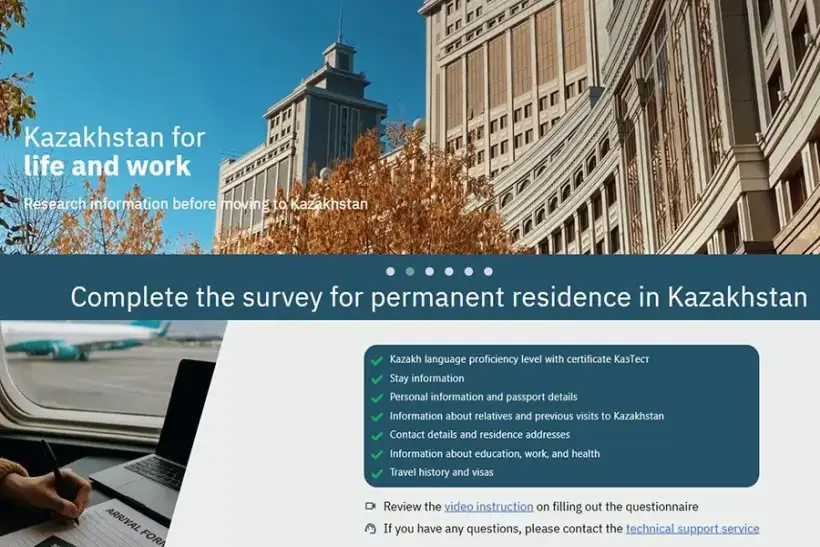
Kazakhstan has revised its residency permit procedures, making the process significantly more complex and multi-stage. Foreign nationals are now required to undergo a digital screening, demonstrate language proficiency, and confirm financial capacity. The new rules are implemented on a pilot basis until the end of 2026 and effectively raise the requirements for those wishing to stay in the country long-term.
The pilot project covers permanent residence permits (PRP), residence permits valid for up to 10 years, and the “kandas” status for ethnic Kazakhs returning to their historical homeland. All applicants are now subject to a unified filter — an assessment of “immigration potential.” Authorities aim to attract more qualified and economically active migrants.
Five Stages of Obtaining a Kazakhstan Residence Permit: From Test to Interview
The procedure for obtaining a Kazakhstan residence permit has become fully digital. It is conducted through the state migration portal and takes around 30 days.
Kazakh language test
The first stage is the Kazakh language test (KAZTEST) at A1 level. The exam is paid, conducted online via app.testcenter.kz, lasts 1 hour and 10 minutes, and includes 60 questions covering listening and reading. Applicants must score at least 30% in each section. The use of phones, headphones, or cheat sheets is prohibited. Violations may result in a 30-day ban from retaking the test. Three attempts are allowed, each requiring a separate payment.
Application form
At the next stage, applicants must complete a detailed form on the migration.enbek.kz portal, available only after obtaining the KAZTEST certificate. It includes basic personal data and the following information:
education and language skills (including English with IELTS or TOEFL certification);
work experience and military service;
health status;
criminal record and deportation history — both personal and of family members.
Applicants must also provide full information about relatives — from grandparents to grandchildren.
Immigration Potential
At the third stage, immigration potential is assessed using a points-based system. It includes eight criteria:
age — up to 110 points (the younger, the better);
education — up to 150 points;
language proficiency — up to 240 points: Kazakh up to 120, English up to 60 (IELTS/TOEFL required), Russian up to 60;
study/work experience in Kazakhstan and abroad — up to 80 points;
professional skills — up to 80 points.
Additional factors, such as having relatives in Kazakhstan, may add up to 200 points. Health status is also taken into account through a coefficient from 0 to 1. Although total scores can reach several hundred points, the key threshold is 400. If the score is lower, the system automatically issues a rejection.
Security Checks and Interview
At the fourth stage, the police and the National Security Committee review applicants for criminal records, search status, and possible links to terrorist or extremist organizations. If everything is in order, the applicant is invited to an interview conducted by the employment and social protection authorities or Kazakhstan’s embassies and consulates. After a successful interview, an “Eligibility Assessment Notification” is issued, which is required to proceed with PRP, residence permit, or kandas status applications.
Financial Threshold for Foreigners in Kazakhstan and the “Exit Permit”
After completing all stages, applicants must submit a large package of documents to the Public Service Center. One of the key requirements is proof of financial stability: at least 5.7 million tenge (around $12,000) in a Kazakhstani bank account.
Lawyers note that this requirement has become a significant barrier. Opening a local bank account has become more difficult, and funds often need to be transferred from foreign financial institutions. In practice, some applicants use temporary transfers from employers to obtain the required bank certificate.
Another requirement is either consent from the country of citizenship for permanent residence abroad or an official “exit certificate.” However, there is still no clarity on how this document should look or how realistically it can be obtained. This remains one of the most controversial points for applicants. The processing time may take up to 45 calendar days.
PRP and Residence Permits: How Foreign Stay Is Structured in Kazakhstan
A permanent residence permit (PRP) is a mandatory intermediate stage for those planning to stay long-term in Kazakhstan. It is issued by migration authorities and grants basic rights: legal residence, employment, and business activity. Without it, it is not possible to proceed to the residence permit stage.
A residence permit is issued for up to 10 years (but not longer than the validity of the passport) and significantly expands opportunities. It allows free employment, property purchase, and business registration. It does not require annual renewal, making it a more stable status compared to temporary options.
More Accessible Alternatives: RVP and Remote Work Visas
In practice, many foreigners opt for a simpler route — a temporary residence permit (RVP). It is issued based on a specific reason: work, study, medical treatment, or family reunification. It is usually valid for one year but can be extended if the basis remains valid.
RVP renewal is relatively straightforward: the basic set of documents remains unchanged — passport, employment contract, and employer’s letter.
Another option is special visas for remote workers, introduced in 2025. These include the Digital Nomad Visa (B9-1) for IT professionals and the Neo Nomad Visa (B12-1) for remote workers with a monthly income of at least $3,000. These visas are renewed annually and allow legal residence and work in Kazakhstan while bypassing the more complex residence permit procedure.
Who Is Exempt from the New Rules
The new requirements do not apply to all foreign nationals. Certain categories remain under previous procedures and are exempt from language testing and the points-based system.
No changes apply to digital nomads and professionals in in-demand fields, which include a broad range of occupations — from doctors and engineers to mathematicians, technical educators, and graphic designers. They continue to follow separate qualification recognition procedures without the new testing or ranking system.
An exception is also made for political refugees. However, experts note that Kazakhstan should not be considered a safe jurisdiction for such cases, particularly for individuals with potential conflicts with authorities in their home countries.
Another important point is that the new rules do not affect the renewal of already issued residence permits. Those who already hold a Kazakhstan residence permit will continue renewing it under the existing procedure.
A Strict Selection System Instead of Formality
Analysts from International Investment note that Kazakhstan began tightening rules for foreigners in 2023, when visa runs were abolished and restrictions were introduced on time spent outside the country before re-entering visa-free. Later, requirements for residence permits and citizenship were revised. Stricter rules were also introduced for issuing individual identification numbers and in the banking system.
The new model functions as a comprehensive screening mechanism that takes into account a wide range of applicant data. Although it is currently an experiment that may be discontinued in 2027, the overall trend is already clear: Kazakhstan is steadily building a new framework for migration policy.
If implemented permanently, relocation to the country will become significantly more difficult for many foreigners. The era when Russian citizens could enter using only a national passport is gradually coming to an end. Similar trends are being observed in many countries worldwide.
FAQ: New Kazakhstan Residence Permit Rules 2026
Who must go through the new residence permit procedure?
The new rules apply to foreign nationals applying for a permanent residence permit (PRP), a residence permit (RP), or “kandas” status. All applicants must undergo a digital screening and an “immigration potential” assessment.
Is the Kazakh language test mandatory?
Yes. Most applicants are required to pass the KAZTEST at A1 level. The exam is taken online and includes listening and reading tasks. Without the certificate, it is not possible to proceed to the next stages.
What is the points system and the passing threshold?
Applicants are evaluated based on several criteria: age, education, languages, work experience, skills, and other factors. The minimum passing threshold is 400 points. If the score is lower, the system automatically rejects the application.
How much money is required for a residence permit?
Applicants must prove financial stability — at least 5.7 million tenge (around $12,000) in a Kazakhstani bank account.
Who is exempt from the new rules?
Digital nomads and professionals in in-demand occupations are exempt from the testing and points system. The new requirements also do not apply to political refugees.
Do the changes affect already issued residence permits?
No. The new rules do not apply to the renewal of existing residence permits. Those who already hold a Kazakhstan residence permit will continue under the previous procedure.
Can you get a residence permit without the points system?
No. The points-based system is a mandatory part of the standard residence permit process. Exceptions apply only to specific categories of applicants.
What is easier to obtain: a temporary or permanent residence permit?
A temporary residence permit (RVP) is generally easier to obtain. It is issued based on work, study, or family reasons and is valid for up to one year, with the possibility of extension as long as the basis remains valid.