










Attack on Dubai, February 28, 2026: Timeline of Events and Impact on the Real Estate Market (Updating)
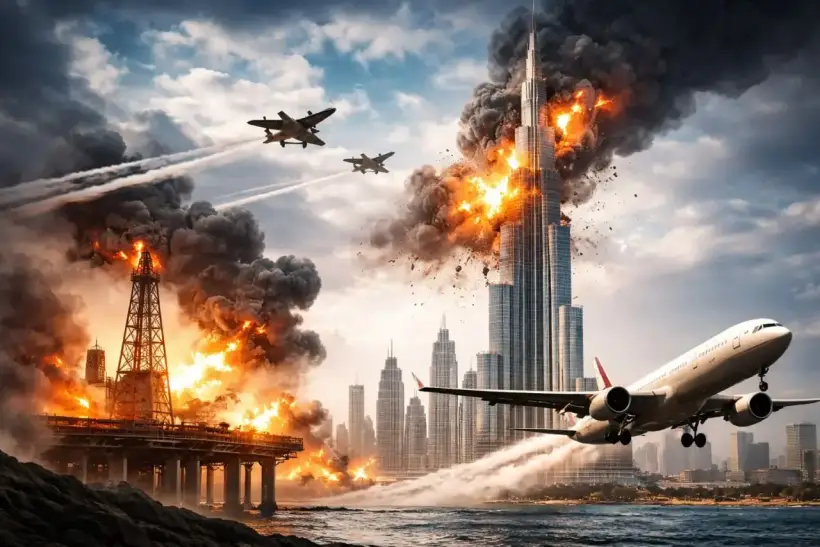
Dubai has been affected by the consequences of military escalation in the Middle East: reports of missile strikes, air defense activity, fires in the Palm Jumeirah area, restrictions at Dubai International Airport (DXB), and flight rerouting. Amid the conflict between Iran and regional countries, tensions in the Persian Gulf are rising, while markets are reacting with oil price volatility and increased geopolitical risks.
The Fairmont hotel in Dubai on fire — photo source: Instagram
On this page, we are publishing a real-time chronology of events in Dubai (UTC+4), separating confirmed official sources, statements by UAE authorities, reports from international agencies, and eyewitness accounts. The material is updated as new information becomes available regarding airspace closures, consequences for tourism, and the Dubai real estate market. Bookmark this page — updates are added continuously.
Press Ctrl + D (Windows) or Cmd + D (Mac) to bookmark this page.
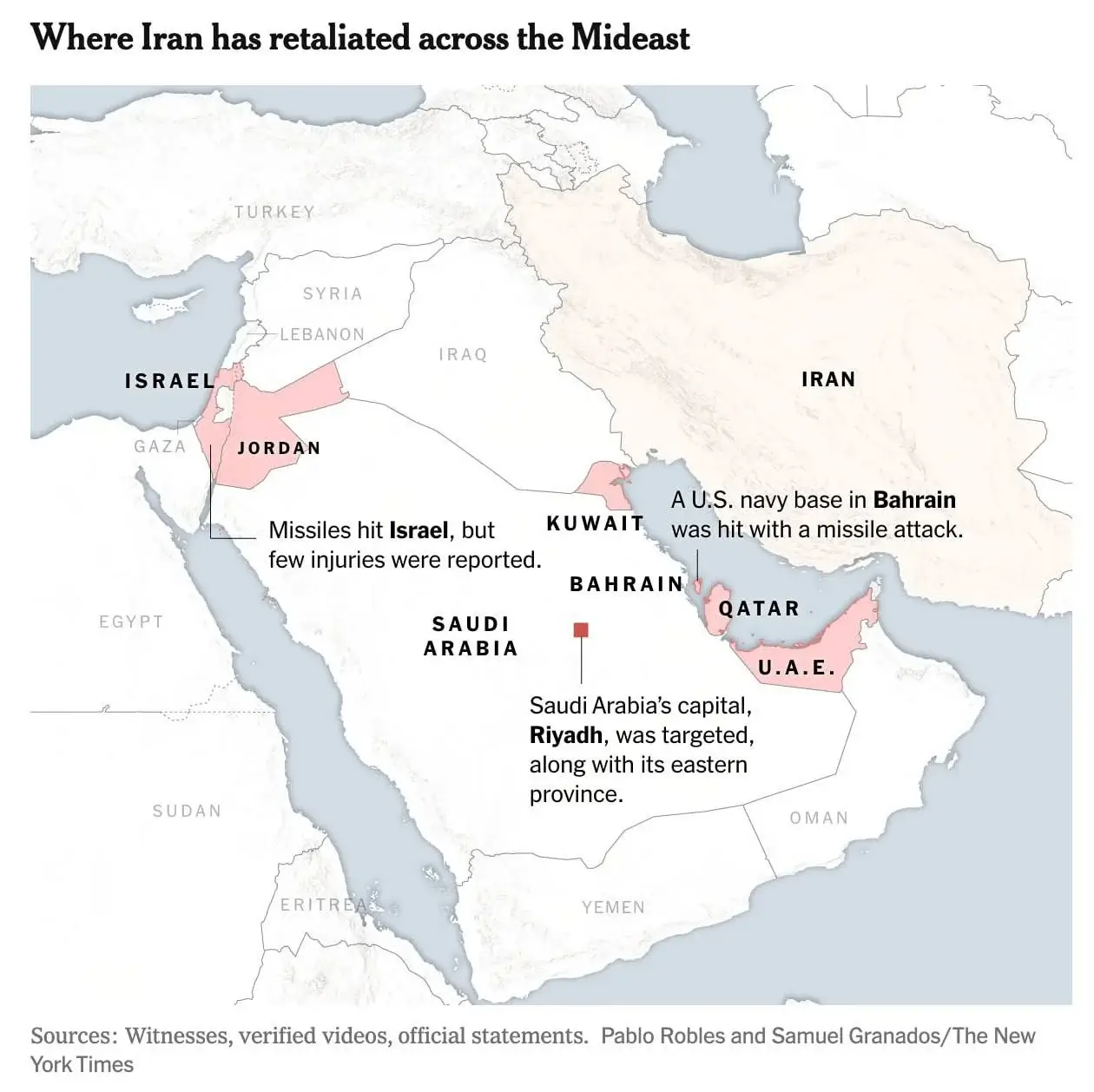
As of February 28, 2026 (throughout the day), it has been officially confirmed that the United Arab Emirates was subjected to waves of attacks from Iran: the UAE Ministry of Defense reported intercepting/destroying a “new wave” of Iranian missiles and drones, with debris falling in several areas of Abu Dhabi and Dubai.
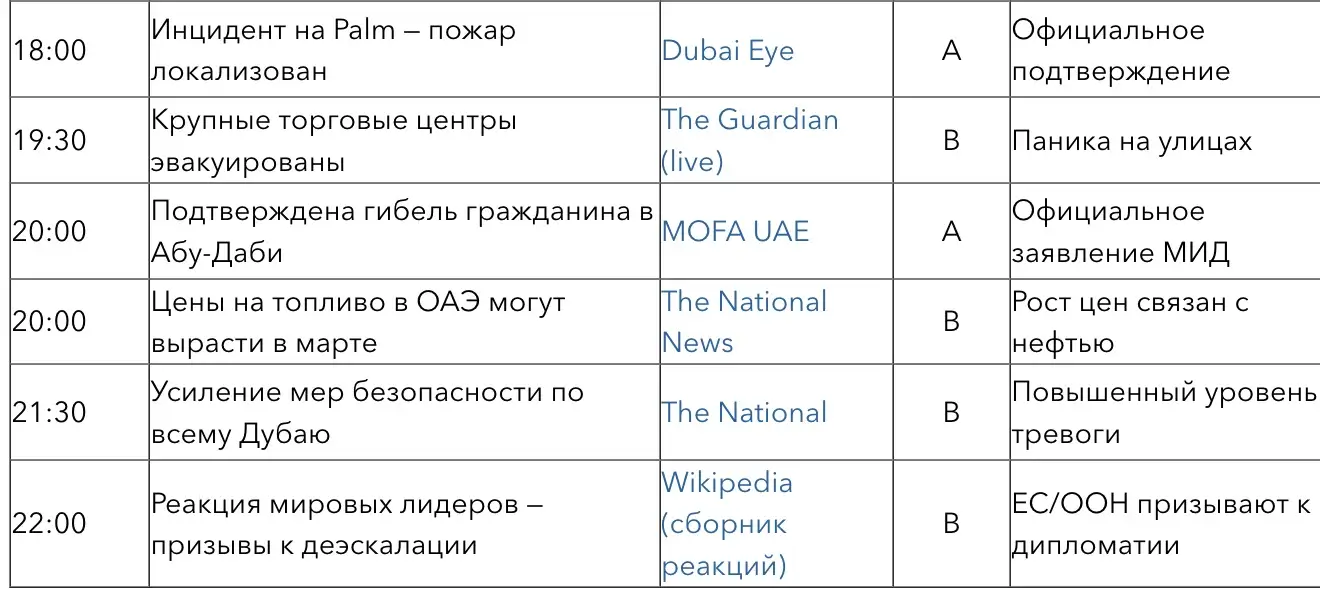
Timeline of Events in the UAE — February 28, 2026 (UTC+4)
A — UAE official authorities / international agencies / Reuters / Gulf News, etc.
B — Major media outlets (Reuters Business, The National, etc.)
C — Other publications (Wikipedia context, social media without direct confirmation)
| 22:20 |
Israeli Prime Minister Netanyahu: “The [Iranian] plan to destroy Israel no longer exists — and it is highly likely that the tyrant [Ali Khamenei] does not either.” |
Israel' Media | C |
| 23:20 |
Iran’s Supreme Leader Khamenei is dead; his body has been found, Reuters reports, citing an Israeli official. |
Reuters | B |
Key Developments
-
Donald Trump stated that he has several possible courses of action regarding an operation against Iran, adding that the country could take years to recover. He also said that negotiations have stalled.
-
The Israel Defense Forces (IDF) reported striking around 500 targets across Iran and announced the start of a new wave of attacks.
-
Iran launched another series of missiles toward Israel. Earlier, military officials said approximately 1,200 missiles had been fired in response to strikes on Iranian territory.
-
The Iranian city of Bushehr was reportedly hit by missile strikes. The Bushehr nuclear power plant, being built with the involvement of Russian specialists, is located there.
-
Iran’s Islamic Revolutionary Guard Corps (IRGC) confirmed the closure of the Strait of Hormuz to maritime traffic, a route that carries about 20% of global oil supplies.
-
The U.S. Department of Transportation advised vessels to leave the Strait of Hormuz, the Persian Gulf, the Gulf of Oman, and the Arabian Sea due to rising security risks.
-
Air raid sirens sounded in Oman, where several U.S. military bases are located. No explosions have been reported there so far.
-
According to Al Mayadeen, Iran’s Supreme Leader Ali Khamenei is operating from a command center and overseeing military operations.
-
U.S. Central Command stated that it successfully repelled hundreds of Iranian missile and drone attacks. While some American facilities sustained damage, operations have not been disrupted.
According to official statements from the U.S. Department of Defense and leading international analytical centers, the current escalation in the Middle East could last several days or even weeks, as it involves a complex network of geopolitical interests and requires time for diplomatic and military maneuvering. Analysts warn that phases of intense strikes and countermeasures rarely last only a single day, especially when major regional powers are involved.
We continue to update the timeline in real time, monitoring new statements from official authorities, international agencies, and verified media outlets.
Important: Some eyewitness accounts, social media videos, and unofficial publications may not be confirmed by official sources or may not be subject to reliable verification.
The Middle East No Longer Appears a “Safe Haven” for Investment
The escalation around the UAE and Iran has increased the region’s geopolitical risks. For investors, this means rising insurance costs, reassessment of yields, and higher risk premiums.
We have curated a selection of properties with below-average risk profiles in countries that currently appear more stable. In a 15-minute consultation, we will review which formats and jurisdictions make sense to enter now and send you an up-to-date подборка from International Investment.
Map
Economic Consequences
The key economic shock “today” is not a change in real-sector prices (which are inertial), but the disruption of the region’s transport and logistics links: the UAE General Civil Aviation Authority announced a temporary partial closure of airspace, and Dubai Airports suspended all flight operations at its two main airports until further notice.
Immediate Consequences by Priority:
Tourism/Aviation.
The blow to tourism has already materialized through cancellations and flight suspensions (including reports of more than 700 canceled flights from Dubai airports). Over a 0–7 day horizon, the baseline scenario is a sharp decline in tourist arrivals and hotel occupancy. Over 1–6 months, recovery is possible if the escalation is quickly contained, but the “safety/air travel” risk premium will become a key factor.
Oil.
Oil markets were closed for the weekend on the day of the strike; the key “signal today” concerns risks to shipping and insurance: sources report suspension of some oil/fuel/LNG shipments through the Strait of Hormuz and increased caution among shipowners and traders. The baseline scenario for 0–7 days is a high probability of an upward price gap at market open, but the scale will depend on (a) the duration of the conflict and (b) the reality/sustainability of shipping restrictions.
Real Estate.
Immediate price reactions are typically weak, but transaction volumes and the speed of attracting external demand may decline within the coming week due to flight suspensions and rising uncertainty. At the same time, the market’s fundamental base remains strong: in 2025, Dubai recorded record transaction volumes and investment levels.
UPD:
21:55 – Italian Defense Minister Guido Crosetto cannot fly from Dubai to Rome due to Iranian airstrikes, reports Fatto Quotidiano.
22:32 – United Airlines has canceled flights to Dubai and Tel Aviv until March 4 and 6, respectively, due to the closure of Middle Eastern airspace, the airline’s press service announced.
March 1, 2026:
00:56 – Unofficial reports emerge of new explosions and SMS alerts:
“Possible missile threat. Take immediate shelter in the nearest safe building or bunker. Stay away from windows and glass doors, shelter behind sturdy structures. Await further instructions. (Ministry of Interior – MOI)”
01:13 – Eyewitness reports indicate debris falling in the Palm Jumeirah area.
01:32 – Eyewitnesses report evacuation of Dubai Airport (DXB).
02:52 – The Dubai International Airport terminal was hit, and people are being evacuated. Emirate authorities report that four people were injured in the strike. Later, it was confirmed that four airport staff were also affected. According to Al Jazeera, the airport building sustained damage.
03:14 – UAV debris hit the famous “sail-shaped” Burj Al Arab hotel in Dubai. The building suffered minor damage, no casualties reported. The drone was intercepted, but its fragments caused a small fire on the hotel façade.
09:18 – The fire at Dubai Airport continues for over six hours. Experts doubt the fire could have started solely from debris; a direct hit is possible.
11:52 – Aeroflot cancels all flights to and from Dubai on Sunday due to extended flight restrictions, the carrier’s press service reports.
14:52 – In Sharjah, a downed Iranian drone hit a shopping mall, causing a fire; people may be trapped under debris. In Dubai, all beaches were closed after the night attacks, and city streets are empty. Swimming is prohibited in Palm Jumeirah and other areas; people stay away from pools and generally avoid going outside, with almost no cars on the roads. Everyone remains in buildings or shelters.
14:53 – S7 Airlines adjusts its schedule due to closed airspace over the Persian Gulf. Flight S7 3774 Dubai–Moscow scheduled for March 1 will now operate on March 3 at 01:25 local time; flight S7 5786 Dubai–Novosibirsk scheduled for March 1 is moved to March 2 at 18:00 local time. Flights from Dubai previously rescheduled from February 28 to March 1 are canceled.
15:00 – ATOR reports that about 20,000 Russian tourists are in the UAE, with their departures canceled or delayed.