







 Vietnam Mortgage Surge Pushes Homes Out of Reach
 Lithuanian Apartment Prices Accelerate Across Major Cities
 London Flats Lose Value Ahead of Leasehold Reform
 Construction of the Batumi–Sarpi Highway Begins in Georgia
 Baltic Property Investment Accelerates in 2026
 Hong Kong and Singapore Renew Their Expat Rivalry
Europe Faces Growing Housing Crisis
Housing affordability has become one of the most pressing social and economic challenges across Europe. Rising house prices and rents are increasingly outpacing income growth, making it harder for millions of people to find housing that is affordable, secure and suitable for their needs.
Across many EU countries, young adults delay leaving their parents’ homes, families struggle to find larger apartments, and workers often commute long distances because housing near major employment centres is too expensive. As a result, housing costs are now shaping both daily life and long-term decisions for European households.
Housing affordability across the European Union
Housing affordability is often measured through the housing cost-to-income ratio. When households spend more than 40% of their disposable income on housing costs such as rent or mortgage payments, this is considered a significant financial burden.
According to Eurostat, in 2024 housing costs exceeded 40% of disposable income for almost 10% of households in EU cities. In rural areas the figure was about 6.3%.
However, the situation varies significantly between member states. In Greek cities, about 29% of households faced excessive housing costs, while in Cyprus the share was only 2.6%. Overall, households in Greece spent around 35.5% of their income on housing in 2024, the highest share recorded in the EU.
House prices and rents continue to climb
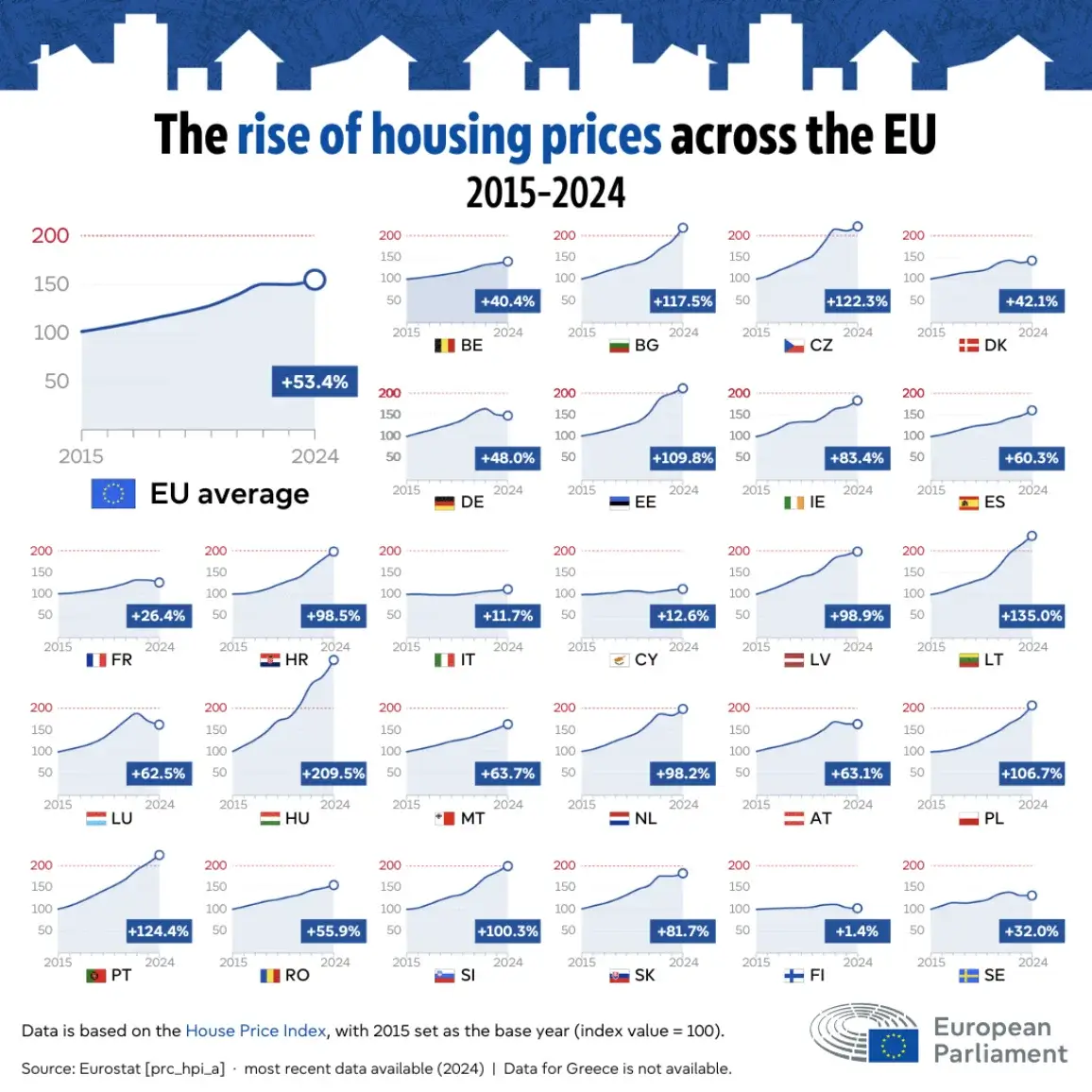
European housing markets have experienced substantial price growth over the past decade. Between 2015 and 2024, house prices across the EU increased by an average of 53.4%.
The sharpest increases were recorded in Central and Eastern Europe. In Hungary, house prices surged by more than 209%, while Lithuania saw growth of around 135% and Portugal about 124%.
Rental markets have also become more expensive. Between 2010 and the first quarter of 2025, rents in the EU rose by an average of 27.8%. The most significant increases occurred in Estonia, where rents climbed more than 220%, followed by Lithuania at 184%, Hungary at 124% and Ireland at 115%. Greece remained the only EU country where rents declined during this period.
Structural housing shortages in Europe
A key factor behind the housing crisis is a shortage of new housing supply. Demand for housing continues to grow faster than construction activity.
According to estimates by the European Investment Bank, the EU needed approximately 2.25 million additional housing units in 2025 alone. This figure was roughly 50% higher than the number of homes actually being built.
The shortage is partly rooted in the aftermath of the global financial crisis in 2008, which significantly reduced investment in housing construction. The COVID-19 pandemic further slowed residential development due to disruptions in supply chains, labour shortages and delays in construction permits.
Urbanisation intensifies housing demand
European cities continue to attract residents seeking employment and educational opportunities. This trend has led to increasing population concentration in large and medium-sized urban areas.
Meanwhile, many rural regions face population decline and rising numbers of vacant homes. The resulting imbalance between growing demand in cities and declining demand in rural areas contributes to rising prices and housing shortages in urban centres.
Social housing decline and short-term rentals
Another structural issue is the limited availability of social housing. In 2021 the EU had approximately 14 million social housing units, representing about 8% of the total housing stock. This share had fallen from around 11% in 2010.
Short-term rental markets have also influenced housing availability in tourist destinations and major cities. A growing number of properties are used for short-term stays rather than long-term housing.
In 2024, about 854 million nights were booked through four major online platforms — Airbnb, Booking, Expedia Group and Tripadvisor. This represented an increase of almost 19% compared with 2023 and set a new record for short-term accommodation in Europe.
Social consequences of the housing crisis
Housing inequality remains widespread across the EU. Research by the European Parliament shows that low-income households are among the most affected by the crisis.
More than 27% of low-income households face severe housing cost burdens and housing deprivation. Around 17% of Europeans live in overcrowded housing conditions where the available living space does not meet recommended standards.
The situation is even more pronounced among migrants and ethnic minorities. More than 33% of non-EU citizens live in overcrowded housing compared with about 14% of EU nationals.
People with disabilities are also disproportionately affected. Fewer than 29% report that their homes fully meet their accessibility needs.
Young Europeans struggle with housing access
Young people are among the groups most affected by rising housing costs. Increasing prices and rents make independent living more difficult for younger generations.
In 2023, the average age at which young Europeans left their parental home was around 26. In several EU countries nearly 70% of young adults aged 18 to 34 continued living with their parents due to housing affordability challenges.
This trend contributes to widening generational inequality and delays major life decisions such as starting a family, relocating for employment or purchasing property.
EU policy response to the housing crisis
Although housing policy primarily falls under national and local governments, EU institutions have started to play a larger role in addressing the crisis.
Following the 2024 European elections, European Commission President Ursula von der Leyen identified housing affordability as a major priority for the EU’s new political cycle. The Commission appointed Dan Jørgensen as the EU’s first Commissioner responsible for housing.
In 2025, the European Parliament also established a special committee to investigate the causes of the housing crisis and propose policy solutions.
EU investment in affordable housing
In 2025 the European Commission and the European Investment Bank announced a joint action plan that aims to mobilise approximately €10 billion in funding over the following two years.
The funds are intended to support construction of new housing, renovation of existing housing stock and research into innovative building technologies.
The European Parliament also approved new rules allowing EU cohesion and social funds to be used for housing upgrades and new construction projects, particularly for social housing. Lawmakers urged member states to at least double their national funding for affordable housing.
Future measures under discussion
The European Commission’s Affordable Housing Plan presented in late 2025, along with proposals discussed by the European Parliament in 2026, outlines several additional measures aimed at improving housing supply and affordability.
These initiatives include regulating short-term rentals, simplifying construction and renovation permits, attracting public and private investment, addressing labour shortages in the construction sector and improving productivity through innovation.
As experts at International Investment note, Europe’s housing crisis reflects long-term structural pressures rather than a temporary market imbalance. Even with increased EU funding and policy reforms, stabilising housing markets will likely take years because the shortage of homes has accumulated over more than a decade of underinvestment and rapid urbanisation.