







 Australia’s Spring Auctions Rise but Remain Well Below 2025
 Number of Foreigners Holding Turkish Residence Permits Exceeds 1.27 Million
 Demand from Russian Tourists for Holidays in Georgia Rises by 20–25%
 Montenegro Property Buying Costs in 2026
 Four in Ten Companies Would Not Choose Slovakia
 Gulf Countries Prepare Unified Tourist Visa
Ryanair Returns Manchester Flight
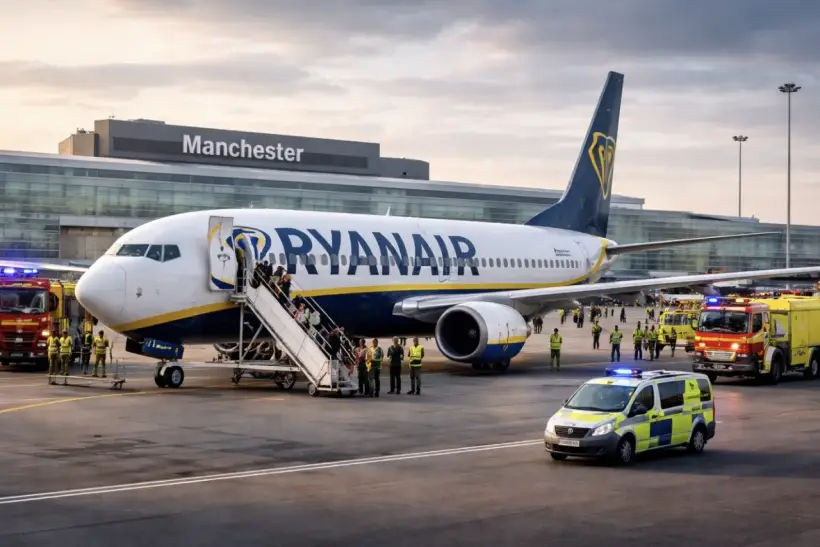
Ryanair Emergency Landing in Manchester
On March 24, 2026, Ryanair UK flight RK3226 from Manchester to Sandefjord Torp in Norway cut short its journey and returned to its departure airport after turning back over the North Sea. Search snippets from news coverage say the aircraft was flying at about 37,000 feet when the crew declared an emergency and headed back toward the UK coastline before landing in Manchester.
What Is Known About Flight RK3226 and the Norway Route
Flight RK3226 is a regular Ryanair UK service linking Manchester Airport with Sandefjord Airport Torp, a Norwegian airport that serves the wider Oslo region. Open flight-tracking references list the route as Manchester to Sandefjord/Torp and identify the aircraft type on this service as a Boeing 737-800, a twin-engine narrow-body jet commonly used on short and medium-haul routes across Europe. Public flight data also shows a scheduled flying time of roughly 1 hour 55 minutes over a distance of about 1,007 kilometers.
How the Mid-Air Emergency Unfolded Over the North Sea
The publicly available account points to a routine departure from Manchester followed by a sudden operational change once the aircraft was over the North Sea. News snippets describe a sharp U-turn and a diversion back to Manchester after the crew declared an emergency, meaning a situation that required priority handling from air traffic control and airport emergency services. At this stage, the open record confirms the return and the emergency declaration, but not the exact trigger behind it. That distinction matters because aviation turn-backs can be caused by technical alerts, onboard medical events, or other safety considerations.
Has Ryanair Confirmed the Cause of the Emergency Landing
As of publication, no detailed public explanation for the RK3226 turn-back was clearly available in open sources reviewed for this article. Ryanair’s official travel update page directs passengers to check the status of their specific flight number and says affected travelers receive updates by email and SMS. In practice, that means the most solidly confirmed facts remain the route, the emergency turn-back, and the aircraft’s return to Manchester, while the underlying cause has not yet been publicly pinned down.
Why Returning to Manchester Was the Logical Safety Move
On short European sectors, returning to the departure airport is a standard safety decision when the crew determines that the most controlled outcome is to land as quickly as possible at a familiar and fully equipped base. Manchester Airport is a major operating point for Ryanair and maintains live arrival and departure systems as well as the ground infrastructure needed to support priority landings and post-flight inspections. From an operational perspective, that makes Manchester the most practical recovery point once the flight could no longer continue to Norway as planned.
As International Investment experts report, the emergency return itself should not be overstated as proof of a severe accident, but it is a clear example of how airline crews, air traffic control and airport response systems are designed to act conservatively when any onboard issue interrupts a flight. Until Ryanair or a later technical report provides more detail, the factually safe formulation is narrow and precise: the Norway-bound service was interrupted, the aircraft turned back over the North Sea, and it returned to Manchester under emergency priority procedures.
FAQ
What happened to Ryanair flight RK3226
The flight from Manchester to Sandefjord Torp turned back over the North Sea and returned to Manchester after an emergency was declared.
Where was the aircraft heading
It was operating a scheduled service from Manchester Airport to Sandefjord Airport Torp in Norway, often presented in flight databases as serving the Oslo area.
What aircraft was used on RK3226
Open flight references list the service as a Boeing 737-800 operated by Ryanair UK.