







 Vietnam Mortgage Surge Pushes Homes Out of Reach
 Lithuanian Apartment Prices Accelerate Across Major Cities
 London Flats Lose Value Ahead of Leasehold Reform
 Construction of the Batumi–Sarpi Highway Begins in Georgia
 Baltic Property Investment Accelerates in 2026
 Hong Kong and Singapore Renew Their Expat Rivalry
Paraguay Tightens Financial Checks for Tourists
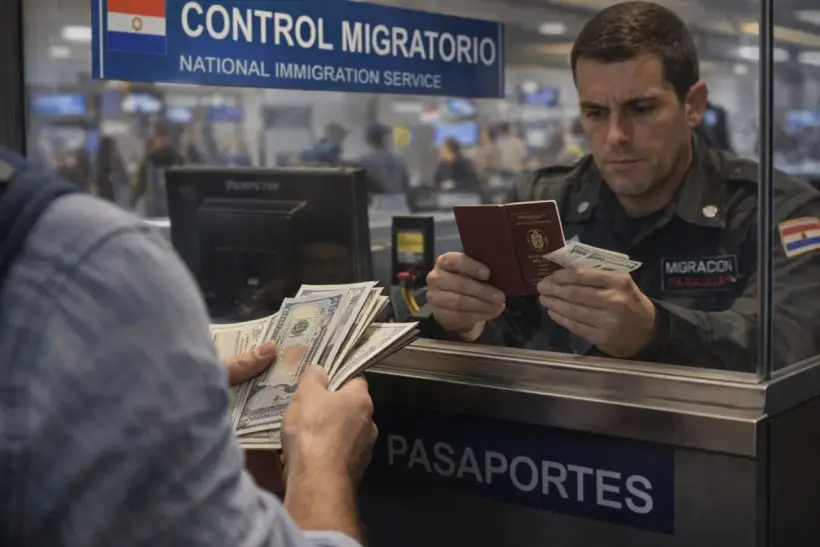
Paraguay Tightens Tourist Screening
Paraguay is reinforcing the use of financial-capacity checks for foreign travelers as inbound tourism accelerates and South American destinations increasingly rely on stricter entry screening. According to Paraguay’s Ministry of Foreign Affairs, applicants for a tourist visa must submit proof of economic solvency, which may include an employment certificate, a bank certificate or another document considered suitable by the consular authority. At the same time, Paraguay’s migration authorities make clear that final admission into the country is decided at the border, even when a visa has already been approved.
What Proof of Funds Means in Paraguay
In Paraguay’s official framework, the phrase proof of funds is most closely reflected by the Spanish term solvencia económica, meaning economic or financial solvency. This is not merely advisory language. On the country’s official visa page, proof of solvency appears among the basic requirements for a tourist visa, alongside a possible travel itinerary, tickets or declared means of entry, while Paraguayan consular offices retain the authority to request additional documents depending on the case.
That distinction matters. Publicly available official sources reviewed for this article do not show a newly announced blanket policy stating that every tourist must always present bank statements before boarding. What they do show is that financial solvency is already embedded in Paraguay’s visa screening system and can form part of the broader admissibility assessment. In other words, the more accurate reading is that Paraguay is formalizing and applying an existing solvency filter rather than unveiling a sudden one-off restriction.
Why Paraguay Is Formalizing Entry Controls
Paraguay’s authorities describe these requirements through the language of lawful entry, document control and digital administration. The Dirección Nacional de Migraciones, or National Directorate of Migration, states that all persons entering or leaving the country must register their movement, while the foreign ministry has expanded online visa procedures. Together, these measures point to a more systematized border model in which financial solvency sits alongside identity verification, invitation letters and travel-route documentation as a standard part of risk assessment.
In practical terms, that aligns with a wider economic-security logic. Governments want to reduce the risk that visitors arrive without sufficient means, overstay, drift into informal work or create unexpected administrative burdens. Paraguay’s official wording is technical rather than political, but the structure of the rules makes clear that the ability to fund one’s stay is increasingly treated as a marker of travel credibility.
Paraguay’s Tourism Boom Adds Pressure on Border Systems
The stricter application of document checks comes at a moment of unusually strong tourism growth. Paraguay’s National Tourism Secretariat, or SENATUR, reported that the country received 3,657,194 international visitors in 2025. Of that total, 2,029,678 were classified as tourists and 1,627,516 as same-day excursionists. The agency described the result as a historic record and said it represented growth of 91.24% from the previous year.
SENATUR also said Paraguay ranked first worldwide in growth of international tourist arrivals in the first quarter of 2025, citing UN Tourism data showing a 53% year-on-year increase. UN Tourism, the United Nations specialized tourism body formerly known as the UN World Tourism Organization, separately reported that global international tourist arrivals rose 4% in 2025 to around 1.52 billion, marking a new post-pandemic record. Against that backdrop, Paraguay’s growth rate stands out as exceptionally strong rather than merely in line with the global rebound.
Regional Trend: Financial Solvency as a Travel Filter
Paraguay does not appear to be alone, even if the legal structures differ across the region. Colombia’s official tourist visa page says applicants must provide documents showing economic capacity sufficient to remain in the country as tourists. Chile’s official travel guidance says that, where proof of economic solvency is required, travelers may demonstrate funds through a bank-account copy or other evidence showing at least USD 46 per day of stay.
That is why the broader claim of a regional move toward solvency-based screening is directionally correct, but it needs careful wording. The evidence does not point to a single identical new rule simultaneously adopted by Paraguay, Uruguay, Brazil, Chile and Colombia in one coordinated step. Instead, it points to a patchwork of similar tools: some countries build solvency into visa review, some apply it selectively at the border, and some publish explicit daily-funds thresholds. For travelers, the practical message is the same, but the legal details still vary by nationality and destination.
What It Means for Travelers and the Tourism Industry
For travelers, the shift means that documents once treated as secondary are becoming central. Even where a full paper visa is not required, immigration officers increasingly expect travelers to be able to show return or onward travel, accommodation details and evidence that they can pay for their stay. For airlines, this matters as well, because carriers may face operational and financial consequences when passengers are denied entry on arrival. Paraguay’s official guidance explicitly underlines that a visa approval does not automatically guarantee entry into national territory.
For Paraguay itself, the combination of record tourism growth and more formal entry checks looks less like a contradiction than a balancing strategy. The country’s National Tourism Program frames tourism as a driver of economic development, income growth and employment. In that context, tightening documentation standards is not necessarily anti-tourism. It is better understood as an attempt to manage fast growth without losing control over the quality and legality of incoming travel flows.
As International Investment experts report, the Paraguay case shows that modern tourism policy is no longer just about opening borders and advertising destinations. Fast-growing travel markets are increasingly pairing promotion with deeper scrutiny of trip purpose, funding sources and lawful stay. For travelers, that means the advantage is shifting toward those who arrive prepared, document-ready and able to show clearly how their trip will be financed.
FAQ
Does Paraguay require proof of funds from tourists?
Paraguay’s foreign ministry says tourist visa applicants must provide proof of economic solvency, such as a bank certificate or employment certificate. The exact entry regime still depends on nationality and travel category.
Is this a brand-new rule for everyone?
The official sources reviewed do not show a separate newly issued blanket rule for all tourists. They do show that proof of solvency is already part of the formal tourist-visa framework.
What does solvencia económica mean?
It means economic or financial solvency, in other words the ability to cover your expenses during your stay in the country.
Why is Paraguay leaning more on this requirement now?
The move coincides with very strong tourism growth. Paraguay reported more than 3.65 million international visitors in 2025 while continuing to formalize border and visa procedures.
Are similar rules used elsewhere in the region?
Yes. Colombia’s tourist visa process includes evidence of sufficient economic capacity, while Chile publishes a daily-funds benchmark where proof of solvency is requested.