







 Vietnam Mortgage Surge Pushes Homes Out of Reach
 Lithuanian Apartment Prices Accelerate Across Major Cities
 London Flats Lose Value Ahead of Leasehold Reform
 Construction of the Batumi–Sarpi Highway Begins in Georgia
 Baltic Property Investment Accelerates in 2026
 Hong Kong and Singapore Renew Their Expat Rivalry
Europe Faces a New Stagflation Risk
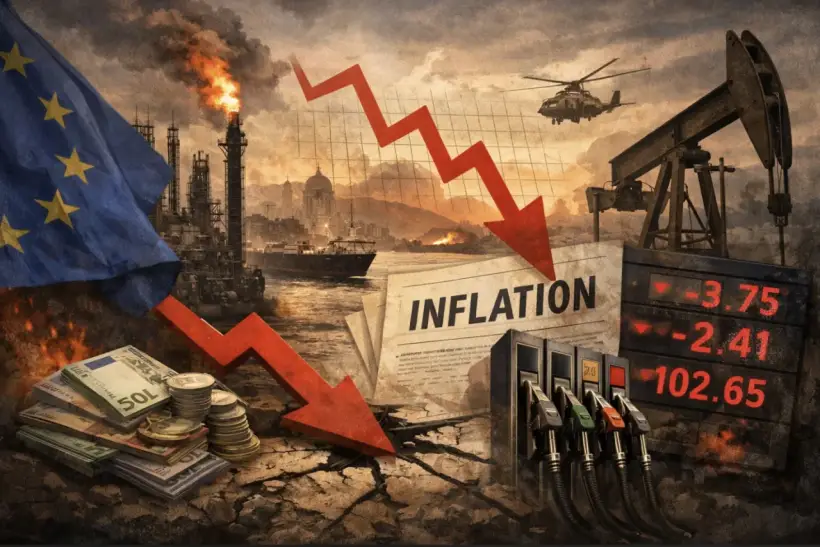
Europe Moves Closer to Stagflation
Europe is moving back into a zone where weak growth and faster inflation are starting to coexist, and the main driver of that risk is the energy shock linked to the prolonged conflict involving Iran. In its March macroeconomic projections, the European Central Bank, or ECB, said euro-area inflation, measured by HICP, the Harmonised Index of Consumer Prices, could jump to 3.1% in the second quarter of 2026. The bank explicitly linked that increase to a surge in energy inflation caused by the Middle East crisis.
Stagflation describes a combination of stagnation, or very weak economic growth, with elevated inflation. It is one of the most difficult environments for central banks because cutting rates to support growth can worsen price pressures, while keeping policy tight can further squeeze businesses and households. That is the balance of risk now taking shape in Europe, where growth remains fragile and energy prices have once again become the main transmission channel for inflation.
The Iran-Linked Energy Shock Is Feeding European Inflation
The ECB is not describing an abstract threat. Its official projection shows the Middle East conflict feeding directly into European inflation through energy markets. The bank expects a sharp rise in headline inflation in the second quarter of 2026, followed by some easing in the third quarter if the energy-price declines embedded in futures markets materialize. This matters especially for Europe because, even after the REPowerEU strategy to reduce dependence on Russian fossil fuels, the EU remains exposed to external oil and gas shocks. The Council of the EU continues to frame energy security around diversifying supply and reducing dependency, and the EU’s historical energy dependency rate has been above half of total demand.
Markets have already reflected that risk. Business coverage on March 24 showed Brent crude moving above $100 a barrel, with traders discussing scenarios of further increases if the conflict continued and disruption risks around the Strait of Hormuz intensified. By March 25, oil prices had partially retreated on ceasefire hopes, but the volatility itself showed how quickly geopolitical risk can pass through to fuel costs, logistics and industrial input prices.
Why Weak Growth Makes the Threat More Serious
Europe’s problem is that the price shock is arriving at a time of already subdued growth. Even before the latest Middle East escalation, the European Commission expected France’s economy to grow by only 0.9% in 2026, citing weak domestic demand, high uncertainty and fiscal adjustment. For the euro area more broadly, official European macroeconomic assessments have also described growth continuing in a difficult international environment with significant structural vulnerabilities. That means even a moderate new hit to energy and transport costs can have an outsized effect on investment, production and consumption.
That is why stagflation risk in Europe is being taken seriously by markets. If inflation rises not because demand is overheating but because imported energy and raw materials become more expensive, the economy takes a double hit. Companies pay more for fuel, electricity, metals and shipping, while households face higher bills for heating, transport and food. At the same time, real income growth does not keep pace. In an economy where industry has already spent years adapting to elevated costs, that combination is especially difficult.
PMI Data Already Show Rising Cost Pressures
Business surveys were already pointing to building price pressure even before the full March energy shock passed through the data. According to the HCOB Eurozone PMI, the Purchasing Managers’ Index compiled by S&P Global with Hamburg Commercial Bank, overall input-cost inflation in February accelerated to one of its highest levels in nearly three years, while manufacturing input-price inflation reached its fastest pace since December 2022. Survey respondents specifically cited higher energy and metal prices. That matters because PMI data capture an earlier stage of inflation pressure inside companies, often before it appears fully in consumer-price releases.
At the same time, March reporting from the UK, which is outside the euro area but exposed to the same energy shock, showed manufacturers facing their sharpest rise in input cost inflation since 1992. For Europe, this acts as a warning signal. When oil and gas prices jump, producers feel it first through higher input costs, then services and goods become more expensive, and only after that does the broader slowdown in real demand become clearer.
What the Scenario Means for ECB Rate Policy
Against that backdrop, the ECB is in an uncomfortable position. If inflation were steadily falling without a new external shock, the case for easier policy would be stronger. But the March ECB projection shows the opposite. Inflation temporarily moves well above target in the second quarter, forcing policymakers to weigh weak growth against the risk of renewed price pressure. The ECB formally defines price stability as 2% inflation over the medium term. That means a short-term move to 3.1% does not automatically signal a permanent inflation regime shift, but it does significantly reduce the room for fast and aggressive rate cuts.
It is also notable that the Banque de France said in its first-quarter inflation-expectations survey that median one-year-ahead business expectations had risen to 2%, while medium-term expectations remained anchored at the same level. That suggests companies and markets do not view the latest shock as pure noise. Even if oil prices retreat later, the surge itself increases caution among central banks and raises the likelihood that borrowing costs will decline more slowly than markets had hoped earlier in the year.
Why Europe Looks More Exposed Than the US
Europe is more sensitive to this type of shock for several reasons. A significant share of its energy still comes from imports. Parts of the euro area, especially industrial economies such as Germany and France, remain more exposed to energy costs than more service-led economies. And after several years of overlapping crises, European growth is still not especially resilient, meaning any external shock tends to show up quickly in business activity and confidence. Even official EU energy policy documents continue to focus on securing competitive prices and reliable supply, which shows the issue is far from resolved.
If the conflict involving Iran drags on, Europe may face not only higher oil prices but also rising transport, chemicals, agriculture and utility costs. That matters especially for property markets, construction, manufacturing and retail, where both energy costs and financing costs play a major role. Even a partial retreat in oil below $100 does not erase the fact that a few weeks of price stress can already change business and consumer expectations.
As International Investment experts report, the main risk for Europe is not only the rise in energy prices itself, but the fact that it is arriving on top of an already weak recovery cycle. In that environment, even a temporary inflation spike can translate into a longer period of expensive financing, cautious consumer behavior and subdued investment activity. For capital markets, mortgages and commercial real estate, that raises the prospect of a familiar scenario in which inflation delays rate cuts while weak growth makes it harder for businesses to absorb higher costs.
FAQ
What is stagflation in simple terms
Stagflation is a situation where the economy grows very slowly, or barely grows at all, while prices continue to rise. It is especially difficult for policymakers because weak growth and inflation call for different responses.
Why does a conflict involving Iran affect Europe
Because Europe remains sensitive to global oil and gas prices. Any military risk in the Middle East can quickly feed into fuel, electricity, transport and industrial input costs across the continent.
What does the ECB forecast for euro-area inflation
The ECB says euro-area inflation could accelerate to 3.1% in the second quarter of 2026 because of the energy shock, before easing to 2.8% in the third quarter if energy prices decline as assumed in futures markets.
Does this mean Europe is certain to enter recession
No. Official sources point to weaker growth and stronger inflation risks, but not to an inevitable recession. The issue is a higher probability of a stagflationary environment if the conflict persists.
Why does this matter for investors
Because stagflation affects rates, borrowing costs, bond yields, real estate pricing and corporate earnings. In that environment, capital becomes more expensive and growth becomes harder to forecast.