







 Vietnam Mortgage Surge Pushes Homes Out of Reach
 Lithuanian Apartment Prices Accelerate Across Major Cities
 London Flats Lose Value Ahead of Leasehold Reform
 Construction of the Batumi–Sarpi Highway Begins in Georgia
 Baltic Property Investment Accelerates in 2026
 Hong Kong and Singapore Renew Their Expat Rivalry
Gulf States Raise Alarm Over Water
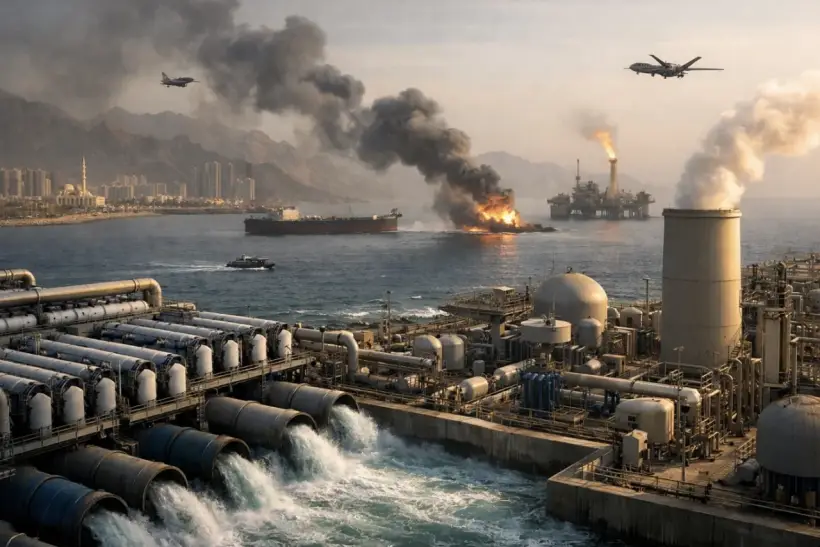
Water infrastructure threats deepen Gulf travel risks
Qatar, Bahrain, Saudi Arabia, the United Arab Emirates, Kuwait, Oman and other Gulf states entered the final days of March 2026 facing a new layer of anxiety after threats against water and energy infrastructure moved to the center of the regional crisis around Iran. Associated Press reported that Iran threatened to fully close the Strait of Hormuz and to retaliate against regional energy and desalination facilities if its own power plants were attacked. The Guardian separately said Tehran had warned of “irreversible destruction” to Gulf water infrastructure.
The issue immediately extended beyond military rhetoric because in the Gulf water is not just a utility. It is a core element of national resilience. Research published by Nature and Scientific Reports shows that the states along the Arabian Gulf are among the world’s largest users of desalination technology, with dependence on desalinated water continuing to rise because of extreme aridity and very limited natural freshwater resources.
Why desalination plants have become a strategic vulnerability
The most sensitive part of the system is the network of large coastal desalination plants. The Guardian reported that Kuwait gets up to 90% of its water from such facilities and Saudi Arabia around 70%. A large share of these plants sits directly on Gulf coastlines, making them exposed to missile, drone and maritime risks in precisely the geography now under the greatest strain.
Even where the total system share is lower, the strategic dependence remains high. Water-security and sector sources indicate that desalination provides the main source of domestic and drinking water in Kuwait, while Saudi Water Authority explicitly describes the sea as a strategic source of potable water for the kingdom. Research focused on Qatar and regional assessments also describe the country as one of the Gulf’s most desalination-dependent states.
The danger is not limited to physical damage. The World Resources Institute says the war has already collided with pre-existing water stress in Iran and across the region, while strikes on water systems could rapidly evolve into humanitarian, industrial and public-health problems. The Guardian added that disabling major desalination plants could quickly force water rationing, disrupt healthcare, halt parts of industry and increase domestic instability, especially where reserve supplies are limited.
Qatar, Bahrain, the UAE and Kuwait are already under tighter travel warnings
By March 28, 2026, the security anxiety in Gulf states had already been reflected in official travel guidance. The UK government advises against all but essential travel to Qatar, Bahrain, Kuwait and the United Arab Emirates. A Foreign Office update published on March 5 also urged British nationals in Bahrain, Kuwait, Qatar and the UAE to register their presence in order to receive direct updates linked to the Middle East crisis.
Saudi Arabia is under a slightly different warning structure, but the language is also severe. The FCDO says missile and drone attacks are continuing across the kingdom, advises increased caution, tells travelers to stay away from oil infrastructure, military and security sites, and states clearly that regional escalation has already caused travel disruption. At the same time, it says commercial departure options remain broadly available despite limited disruptions and temporary airspace closures.
Oman is described in more cautious language, but British authorities have still included it among the countries being regularly monitored under the wider Middle East crisis response. The Guardian also reported that the conflict’s regional spillover affected routes and that Maersk temporarily suspended operations in Oman as shipping risks increased.
How water insecurity becomes a tourism and travel problem
For tourism, the water threat matters because it reaches far beyond traveler comfort. Hotels, airports, resorts, ports, hospitals, shopping centers and urban infrastructure in places such as Dubai, Doha, Abu Dhabi and Manama depend on a stable freshwater supply in an extreme desert climate. A water shock in the Gulf therefore means not an abstract environmental issue, but a direct threat to sanitation, cooling, catering, fire safety, medical services and the day-to-day operation of tourism and business hubs. That conclusion follows directly from the Gulf’s water balance and its dependence on desalination.
Weather has added another layer of risk. The Washington Post reported this week that a rare and dangerous storm episode across the Arabian Peninsula carried the threat of heavy rain, flash floods and transport disruption for areas including Dubai, Abu Dhabi and northern Oman. Combined with military escalation, that creates a dual stress test for civil protection systems, transportation and tourism logistics.
Hormuz pressure is reshaping regional transport and tourism economics
A separate source of market and travel anxiety is the Strait of Hormuz itself. AP noted that roughly one-fifth of global oil trade moves through the corridor, meaning that any threat to close it instantly turns a local military crisis into a global economic problem. That affects not only fuel prices and airline economics, but also goods availability, supply chains and transport schedules, which is especially important for aviation and tourism hubs such as Doha, Dubai, Abu Dhabi and Manama.
The Guardian and the Wall Street Journal also reported that Gulf states are increasingly worried not only about direct military strikes, but about Iranian proxies, sleeper cells, sabotage and attacks on civilian infrastructure. For tourism, that matters because even without large-scale infrastructure destruction, prolonged unpredictability changes the behavior of travelers, insurers, airlines and corporations sending staff into the region.
The Gulf’s security narrative has shifted from oil to water
There has not yet been a region-wide collapse of water supply across Qatar, the UAE, Kuwait, Bahrain, Saudi Arabia or Oman, and that distinction matters. But several facts are already confirmed: official travel warnings have tightened, governments are advising nationals to stay ready to change plans quickly, critical infrastructure is now being openly discussed as a potential target, and water has emerged as one of the most vulnerable resources in the Gulf security architecture. In that sense, the story is no longer only about geopolitics. It is about the everyday resilience of some of the Middle East’s largest tourism and transit hubs.
As International Investment experts report, the current crisis is changing the way risk is assessed across the Gulf. Previously, investors and the travel market focused first on oil, airspace and broad military escalation. Now water infrastructure has moved to the center because it underpins urban life, hotels, healthcare, airports and logistics. For Qatar, Bahrain, Saudi Arabia, the UAE, Kuwait and Oman, that means tourism resilience in 2026 will depend not only on avoiding direct strikes on airports and ports, but also on protecting desalination capacity and the wider freshwater supply chain.
FAQ
Question: Why is water infrastructure so important in the Gulf?
Answer: Because Gulf states depend heavily on desalinated seawater, and large coastal plants provide a major share of drinking and household water.
Question: Which countries are most often mentioned in the current risk discussion?
Answer: Qatar, Bahrain, Saudi Arabia, the UAE, Kuwait and Oman are the most frequently referenced Gulf states in the current reporting and travel-warning context.
Question: Are there already official travel restrictions or warnings?
Answer: Yes. The UK advises against all but essential travel to Qatar, Bahrain, Kuwait and the UAE, while Saudi Arabia carries warnings about continuing attacks and travel disruption.
Question: Could this really affect tourism?
Answer: Yes. A water disruption would affect hotels, airports, restaurants, hospitals and the functioning of cities, making it a tourism and economic risk as much as a military one.
Question: Has the region already suffered a full water-system breakdown?
Answer: No. As of March 28, 2026, the confirmed picture is one of threats, tighter travel advice and infrastructure vulnerability rather than a full region-wide water collapse.